
 Worksheets
Fire Safety Test
Total questions: 20
Worksheet time: 13mins
Which of the following are true for fire? (Select all that apply.)
It takes several minutes for any fire to get out of control.
In only 30 seconds, small flames can get out of control and turn into a major fire.
In only minutes, an entire building can be filled with smoke and toxic gases and room temperatures can reach up to 600 °F (316 °C) at eye level.
Temperatures in the 600 °F (316 °C) range can scorch the lungs and melt clothes to skin.
Which of the following are elements of the fire tetrahedron? (Select all that apply.)
Fuel
Heat
Oxygen
Neutralizing agent
Chemical chain reaction
Which of the following are methods of fire prevention? (Select all that apply.)
Keeping sources of heat away from fuel and oxygen
Following regulations for handling volatile, flammable, and combustible chemicals
Checking the safety data sheets (SDSs) for specific flammability hazards
Ensuring that activities such as welding do not take place near flammable liquids or vapors
Industrially, which of the following are the major area of concern for fire prevention? (Select all that apply.)
Volatile, flammable, and combustible liquids
Organic compounds such as gasoline, turpentine, and solvents create invisible vapors
Vapors from some liquids can mix with air to form largely invisible clouds of potentially flammable and even explosive gas
Organic compounds such as methane, propane, and acetylene are totally gaseous at room temperature and create explosive clouds in the air
Which of the following apply to smoke detectors? (Select all that apply.)
Early fire detection device
Two main types: ionization and photoelectric
Two main types: rate of rising and fixed temperature
Should be installed on ceilings or on walls within 12 inches of the ceiling

How often should smoke detectors be tested?
Once per year
Once every six months
Once per month
Once per week
Which of the following apply to the structural design aspect of evacuation? (Select all that apply.)
All occupied areas should have two exits
Exits should be clearly marked and visible
Signs should show the direction of the nearest exit
Sprinkler installation and non-flammable building materials
Which of the following apply to the preparedness aspect of evacuation? (Select all that apply.)
Practicing the evacuation plan
Knowing how to alert the fire department
Knowing the shortest way out of the building
Knowing where to meet after escaping
If you find yourself trapped in a fire, close all doors between you and the fire and seal the cracks with clothing or towels that are dampened if possible.
True
False
Regarding fire extinguishers, which of the following are true? (Select all that apply.)
If a building has a portable fire extinguisher, you should always use it to extinguish a fire before evacuating the building
Only use a fire extinguisher if you have proper training and are not endangering yourself or others by attempting to extinguish the fire
Only use an extinguisher that is within easy reach, fully charged, and large enough to extinguish the fire
Only attempt to extinguish a fire that is small contained, and hasn't spread to other materials
Before using a fire extinguisher, you should understand the different types of fires
Regarding fire extinguisher ratings, which of the following is NOT true?
Class A and Class B extinguishers are also rated by a number
Class A extinguisher rating numbers are based on the amount of agent, duration, and range of discharge to extinguish test fires
Multi-purpose extinguishers, which can be used on more than one class of fire, commonly include BCD and ABK
Class B extinguisher ratings are based on the square footage of a flammable liquid fire an average person could extinguish
Which of the following does NOT apply to using a fire extinguisher?
Instead of a pin to pull, some fire extinguishers require releasing a lock latch or pressing a puncture lever, or other motion
Aim the suppressant high at the top of the fire flames
Extinguishers have a limited amount of fire-suppressant material, which will be discharged very quickly
After the fire appears to be out, watch the area and use the extinguisher again if necessary
what to do if your clothing catches on fire.
Stop, Drop & Roll
Drop, Roll & Stop
Roll, Drop & Stop
By which of the following can the danger of fire be minimized? (Select all that apply.)
Knowledge
Prevention
Protection
Response
Fire prevention techniques focus on keeping at least one of the four elements of the fire tetrahedron separate from the others.
True
False
Which of the following are the four elements that are necessary to produce and sustain a fire?
Fuel, carbon dioxide, heat, oxygen
Fuel, oxygen, carbon dioxide, chemical chain reaction
Oxygen, carbon dioxide, heat, chemical chain reaction
Fuel, oxygen, heat, chemical chain reaction
Smoke detectors should be kept clear of dust and debris.
True
False
What does the acronym PASS stand for?
Press, Aim, Squeeze, Sweep
Pull, Aim, Squeeze, Stop
Pull, Aim, Squeeze, Sweep
Press, Aim, Sweep, Stop

Match the words to complete the following sentences for fire prevention methods both at home and at work. (Ex- 1A,2B,3C,4B,5E)
(a)
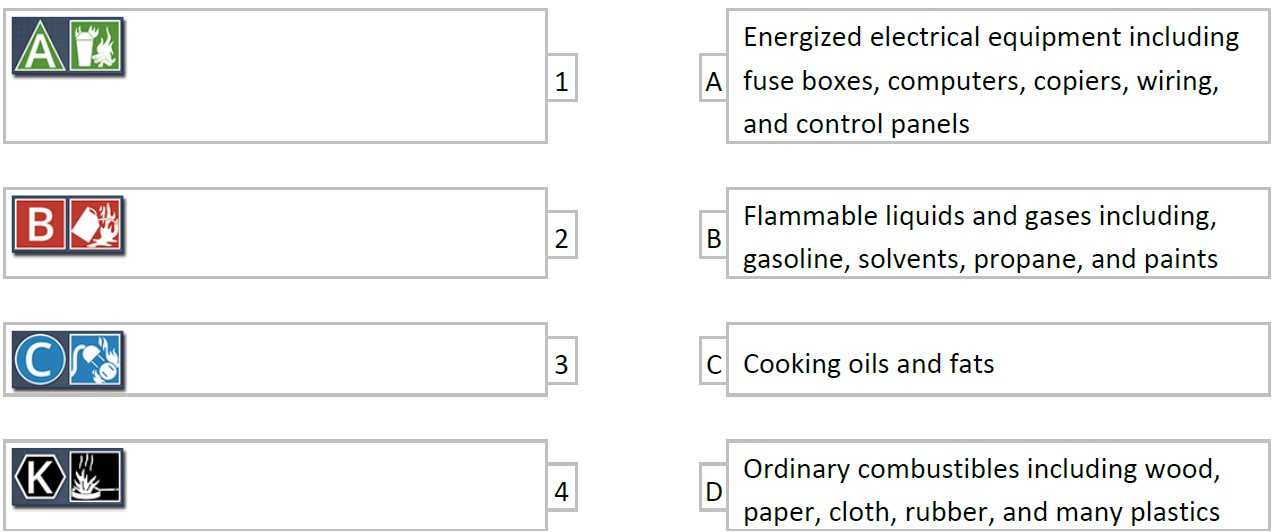
Match the following extinguisher picture icons with their corresponding types of fire they can be used to extinguish. (Ex- 1A,2B,3C,4D)
(a)

