
 Worksheets
Topic 8 Physical Optics
Total questions: 48
Worksheet time: 57mins
The lines which joins all the adjacent points which have the same phase in a wave is called
wavelet
fringe
wave front
None of these
Distance between 2 adjacent wavefront represent
wavelength
speed
intensity
slit separation
Wave front always ______________ to the direction of ray propagation.
tangent
perpendicular
parallel
none of above
Huygen's Principle can be used to construct wavefronts in the following cases EXCEPT
Resolution
Reflection
Refraction
Diffraction
Which of the following statement is TRUE concerning two monochromatic light waves that are coherent?
The have same phase
They have same frequency and constant phase difference
The have almost the same amplitude
They have constructive disturbance.
Position of new wave front of all secondary wavelets for other is ?
Parallel
Normal
Tangent
Any of these
Path difference 2λ correspond to phase difference of
2π
π
2π
4π
One beam of in phase coherent light travels path P1 in arriving at point Q and another coherent beam travels path P2 i arriving at the same point. If these two beams are to interfere destructively, the path difference P1-P2 must be equal to
quarter-integral number of wavelengths
zero
an integral number of wavelengths
half-integral number of wavelengths
To demonstrate the phenomenon of interference, we require two sources
Of the same frequency and having a constant phase difference
Of nearly the same frequency
Of the same frequency
Of different wavelengths
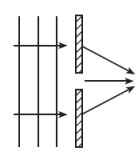
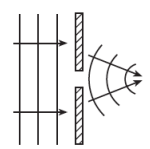
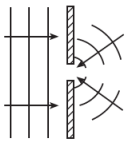
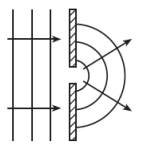
Which diagram best represents the shape and direction of a series of wave fronts after they have passed through a small opening in a barrier?
Extra distance travelled by one of waves compared with other is called
path.
displacement.
phase difference.
path difference.
"Each point on the wavefront emits a semicircular wavelet that moves a distance s=vt. The new wavefront is a line tangent to the wavelets. " This is the statement of
Newton
Planck
Huygen
Young
Huygen’s concept of secondary wave
allows us to find the focal length of a thick lens
is a geometrical method to find a wavefront
is used to determine the velocity of light
is used to explain polarisation
Which of the following is related to Huygen's Principle?
The angle of incidence is equal to the angle of reflection.
Wavelets can interfere with each other, but only before the waves go through a slit.
Every point on a wavefront acts as a source of lots of secondary spherical wavelets, which can therefore interfere with each other.
The speed of light is constant in every medium.
According to Huygens’ principle, light is a form of
particle
wave
rays
radiation
Two light sources are said to be coherent if they
are of the same frequency.
are of the same frequency, and maintain a constant phase difference.
are of the same amplitude, and maintain a constant phase difference.
are of the same frequency and amplitude.
For a sustained interference pattern in double slits, which of the following conditions must be fulfilled? You can choose more than one answer)
sources of same frequency and having a constant phase difference
nearly the same amplitudes
of the same intensities for both sources
small distance between the slits (<λ)
same wavelength ( monochromatic)

Which of the following figures represent is a double
slit interference pattern?
A
B
C
D
For Young's double slit interference distance of nth dark fringe from the center of the screen is
dmλD
Dmλd
(m+21) dλD
(m+21) Dλd
In Young’s double slit experiment, if the monochromatic source of yellow light is replaced by red light in which λyellow < λed , the fringe width
increases
decreases
remains unchanged.
the fringes disappear
In a Young's double slit experiment, green light is incident on the two slits. The interference pattern is observed on a screen. Which one of the following changes would cause the fringes to be more closely spaced?
Reduce the slit separation distance
Use red light instead of green light
Use blue light instead of green light
Move the screen farther away from the slits
Which of the following is TRUE about slit separation, d the distance D from slits to the screen and the separation of fringes in a double slits experiment ?
Separation of fringes increases as D increases.
Separation of fringes increases as D decreases.
Separation of fringes increases as d increases.
Separation of fringes decreases as d decreases.
When a soap bubble is incident with sunlight, a colorful pattern is formed on the surface of the bubble. This phenomenon is caused by
I Reflection
II Refraction
III Interference
IV Diffraction
I & IV
I & III
II & III
II & IV
Every time light hits a "thin film" - there is a phase change occurs for the reflected ray.
TRUE
FALSE
A 180o (½λ) phase change occurs when light reflects from a medium of higher refractive index.
TRUE
FALSE
When light travels through a material with a smaller refractive index toward a material with a larger refractive index (e.g., air to gasoline), reflected ray undergoes π rad phase change that is equivalent to
4λ
2λ
λ
2λ

The index of refraction of the thin film (water) is higher than air as shown in Figure above - the reflected ray will undergo a phase change of ½λ ( or π rad).
TRUE
FALSE

At the bottom soap-air interface ( soap film has a higher index of refraction n > 1) there will be a phase change for ray 2.
TRUE
FALSE

What is the path difference of the reflected rays traveling through the film?
t
2nt
t/2
0

Given the index of refractive for oil and water is 1.40 and 1.33 respectively. Both of the reflected rays act as inphase coherent source.
TRUE
FALSE
When light suffers reflection at the interface between oil ( n= 1.42) and glass (n = 1.56), the change of phase in the reflected wave is
zero
π
2π
2π

What is the condition for the constructive interference of the thin film shown in figure above?
2t = mλ where m = 0,1,2,3,...
2nt = mλ where m = 0,1,2,3,...
2t = (m+½)λ where m = 0,1,2,3...
2nt = (m+½)λ where m = 0,1,2,3...

What is the condition in order for the reflected rays in the soap film shown strongly reflected?
2nt = mλ
2nt = (m+¼)λ
2nt = (m+½)λ
2nt = (m+¾)λ
Bending of light around the edges of an obstacle is known as:
Refraction
Polarization
Diffraction
Interference
Which of the following statement regarding single slit diffraction is FALSE ?
Between each pair of dark fringes there is a bright fringe due to constructive interference.
The higher order bright fringes are much less intense.
All waves interfere destructively creates a dark central fringe on the screen directly opposite the slit.
3rd minimum dark fringe is corresponding to order number n = 3
A narrow slit is illuminated and a diffraction pattern is obtained on a screen. If the width of the slit is decreased, what happen to the width of the central maximum ?
increases
Decreases
Remain unchanged
None of above
Which picture is diffraction?


When compact disk is illuminated by a source of white light, coloured lines are observed. This is due to
dispersion
diffraction
interference
refraction
What is the equation used to determine the maximum order that can be observed on screen ?
n>λd
n<Nλ1
n<dλ
n<Nλ
Number of bright dots can be seen for light passing through a diffraction grating depends on all of the following EXCEPT
grating spacing
wavelength of light used
number of lines of a grating
angle of incident
Red light (630 nm) is passed through a diffraction grating
with 300 lines per cm and a series of bright spots are
observed on a screen. Which of the
following would decrease the numbers of order can be obtained on the screen?
I. Replacing the red light with light of shorter wavelength.
II. Moving the screen closer to the
grating
III Replacing the grating with a grating having
600 lines per cm
I only
II only
III only
I and II only

For the grating shown, which grating produces greater number of bright spots (maxima) on screen ?
100 lines / mm
300 lines / mm
600 lines / mm

The path difference between these two waves is ________.
0 waves
1 wave
2 waves
3 waves

A slide with three diffraction gratings on it is used for an experiment. Which has the largest value of slit spacing, d?
50 lines per mm
100 lines per mm
200 lines per mm
How many diffraction maxima will be seen in total

