wayground logo

Free Printable Worksheets

Font size

S
M
L
XL
Worksheets

DNA & RNA Protein Synthesis

Total questions: 38

Worksheet time: 1hrs 16mins

Name
Class
Date
1.

There are 3 types of RNA. What are they? (Select all that apply)

a)

tRNA

b)

rRNA

c)

mRNA

d)

xRNA

2.
RNA contains the sugar
a)
ribose
b)
deoxyribose
c)
glucose
d)
lactose
3.
Which of the following statements is true?
a)
DNA is single-stranded
b)
RNA is single-stranded
c)
DNA contains uracil
d)
RNA contains deoxyribose
4.
What is the product of translation?
a)
DNA
b)
mRNA
c)
tRNA
d)
proteins
5.

The Process of creating RNA from DNA

a)

Transcription

b)

Translation

c)

Replication

6.

In RNA the base T is replaced with

a)

U

b)

G

c)

C

d)

A

7.

What combines together to make a protein?

a)

Amino Acid

b)

RNA

c)

Ribosome

d)

DNA

8.

What organelle is the site of translation?

a)

Nucleus

b)

Ribosome

c)

Mitochondria

d)

Chloroplast

9.

What is the order for Protein Synthesis?

a)

Transcription -> Translation -> Protein

b)

Translation - > Transcription -> Protein

c)

Protein -> Transcription -> Translation

d)

Translation -> Protein -> Transcription

10.
Which type of RNA takes the instructions from the nucleus to the cytoplasm?
a)
mRNA
b)
tRNA
c)
rRNA
d)
RNA polymerase
11.
What is the product of transcription?
a)
DNA
b)
mRNA
c)
tRNA
d)
proteins
12.

Carries the amino acid used to make a protein

a)

mRNA

b)

rRNA

c)

tRNA

13.

What type of RNA is shown in this image?

a)

rRNA

b)

mRNA

c)

tRNA

14.

What do we call the shape a DNA molecule takes?

a)

double-stranded

b)

double helix

c)

sugar-phosphate backbone

d)

pentagon

15.
A portion of mRNA is coded CUG. The corresponding DNA is coded
a)
GAC
b)
GTC
c)
CTG
d)
CAG
16.
A portion of DNA reads GAG. The corresponding mRNA would be
a)
GUG
b)
GTG
c)
CTC
d)
CUC
17.
Molecule 3 is synthesized in 
a)
ribosomes
b)
chloroplasts
c)
the cell membrane
d)
the nucleus
18.
DNA strands 1 and 2 are able to separate and rejoin easily due to
a)
the action of RNA polymerase 
b)
the nature of hydrogen bonds
c)
the presence of uracil
d)
Trick question! It is none of these.
19.

What type of sugar makes up DNA?

a)

deoxyribose

b)

glucose

c)

fructose

d)

ribose

20.
What shape is RNA?
a)
single helix
b)
double helix
21.

What are proteins composed of?

a)

nitrogen bases

b)

amino acids

c)

phosphates

d)

lipids

22.
Where does transcription take place?
a)
at a ribosome
b)
in the nucleus
c)
at a mitochondria
d)
at a lysosome
23.
If a DNA strand reads ATT CGT CTA, what would the mRNA strand read?
a)
TAA GCA GAT
b)
CGA TGA GUT
c)
UAA GCA GAU
d)
TAA GCA GUT
24.
Transfer RNA or tRNA reads the mRNA in groups of three bases called...
a)
codons
b)
codes
c)
anticodons
d)
bases
25.
How many bases code for one amino acid?
a)
three
b)
four
c)
twenty-three
d)
eight
26.
Who is credited for discovering the shape of DNA?
a)
James Lebron and Francis Oneill
b)
James Watson and Francis Crick
c)
Henry Ford
d)
Rosalind Franklin
27.
What 3 things make up a nucleotide?
a)
Sugar, Phosphate, Nitrogen Base
b)
Sugar, Hydrogen, Carbon
c)
Carbon, Phosphate, Nitrogen
d)
mRNA, tRNA and rRNA
28.
What stores the code for making an individual protein?
a)
DNA
b)
a gene
c)
a chromosome
d)
transfer RNA
29.
DNA is copied during a process called ______________ which results in an identical copy of itself.
a)
Photosynthesis
b)
Transcription
c)
Replication
d)
Translation
30.
Which of the following are found in both DNA and RNA?
a)
ribose, phosphate groups, and adenine
b)
phosphate groups, guanine, and cytosine
c)
phosphate groups, guanine, and thymine
d)
deoxyribose, phosphate groups, and guanine
31.
Which illustration of a chromosomal change best represents a chromosome mutation known as a deletion?
a)
ABCDEFG —> ABCDEF
b)
ABCDEFG —> ABEDCFG
c)
ABCDEFG —> ABCDEFGH
d)
ABCDEFG —> ABCDEFGKMN
32.
The order of nitrogenous bases in DNA determines the order of ______________ in proteins.
a)
nucleic acids
b)
lactic acids
c)
Phosphates
d)
amino acids
33.
What happens during the process of translation?
a)
The cell uses information from messenger RNA to produce proteins.
b)
Messenger RNA is made from DNA.
c)
Copies of DNA molecules are made.
d)
Transfer RNA is made from messenger RNA.
34.
During translation, the type of amino acid that is added to the growing polypeptide depends on the:
a)
anticodon on the mRNA only.
b)
codon on the mRNA only.
c)
codon on the mRNA and the anticodon on the tRNA to which the amino acid is attached.
d)
anticodon on the tRNA to which the amino acid is attached only.
35.
Replicate the following strand of DNA: 
AATCATGGA
a)
AATCATGGA
b)
TTAGTACCT
c)
UUAGUACCU
d)
GGATAUCUA
36.

Transcribe the following DNA strand: CTG AAT

a)

GAC TTA

b)

CTG AAT

c)

GAC UUA

d)

CUG AAU

37.
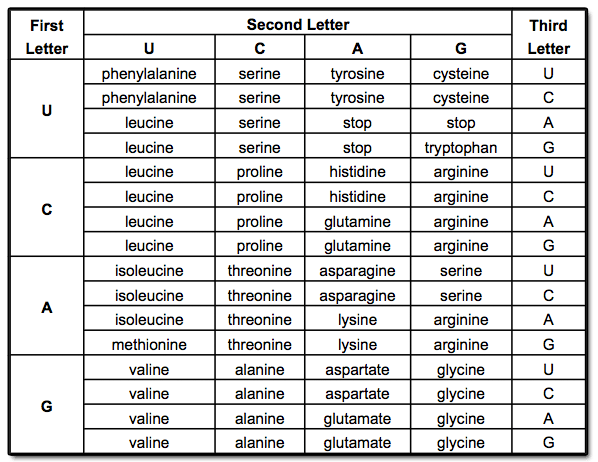
What is the correct amino acid sequence for the mRNA code AUGCCAGUAUGA
a)
Met-Pro-Ala-Val
b)
Met-Pro-Val
c)
Tyr-Gly-His
d)
Tyr-Gly-Arg-His
38.
The anti-codon 
a)
contains a sequence the same as the codon
b)
contains a sequence complementary to the codon 
c)
contains the base thymine