
NEW
Font size
 Worksheets
Semester 2 Review
Total questions: 46
Worksheet time: 59mins
A bus travels 20 km in 30 minutes. What is the average speed of the bus?
20 km/h
30 km/h
40 km/h
50 km/h
Which two measurements are needed in order to calculate the speed of an object in motion?
distance and time
time and mass
force and distance
volume and time

Which of these accurately describes the motion of the toy train?
The toy train speeds up while going forward and then slows down
The toy train slows down while going forward and the moves backwards.
The toy train moves forward at a constant speed , slows down, and then stops.
The toy train moves forward at in increasing speed, stops, and then moves forward.
Four students ran two times around a running path at a local park. Which graph best represents a stop for 10 minutes the student's motion?


Which graph displays the motion of car as it decreasing speed?


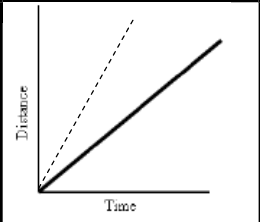
Which graph shows the fastest speed?


Clastic & non-clastic are 2 types of.....
Sedimentary
Igneous
Metamorphic
Intrusive & extrusive are 2 types of...
sedimentary
metamorphic
Igneous
Foliated & non-foliated are 2 types of...
Sedimentary
Metamorphic
Igneous

Which graph best represents a car traveling down the freeway at a constant speed? (6.8D)
a
b
c
d

Calculate the average speed of the object between 1 and 3 seconds.
20 m/s
1 m/s
30 m/s
12 m/s

Calculate the average speed between 0 and 10 hours.
2 km/h
3 km/h
1 km/h
5 km/h
Multicellular, no cell wall, moves and is heterotroph; which kingdom does it belong to?
Animalia
Eubacteria
Fungi
Plantae
Autotrophs
Make their own food
Get their food from others
are Fungi
are none of the above
I am Eukaryotic, mainly multicellular, heterotrophic and reproduce with spores (asexual) and sexually.
Plantae
Animalia
Fungi
Protist
I am:
single celled (mostly), Eukaryotic, heterotroph, reproduce sexual and asexual. What Kingdom am I in?
Fungi
Archaebacteria
Eubacteria
Protists
I have many organisms that cause diseases. What Domain am I in?
Eubacteria
Archaebacteria
Fungi
Eukarya
A group of the same organisms living together in the same place at the same time is:
An organism
A population
A community
A biome
What are groups of different populations living togther in the same place at the same time called?
An organism
A population
A community
A biosphere
What is it called when you have groups of different populations along with their abiotic factors?
An organism
A population
A community
An ecosystem
Together, all the ecosystems on Earth form...
a community.
a biome.
a biosphere.
an Earthsphere.
________________ currents drive Earth's plate movement.
ocean
atmosphere
wind
convection
The San Andreas fault is an example of which type of boundary?
transform
divergent
convergent
universal
Sea-floor spreading explains how.....
new crust is created at a divergent boundary
volcanoes are formed on continents
deep sea trenches are formed

The place where two plates come together is known as a _______
transform boundary.
divergent boundary.
convergent boundary.
rift valley.

Name the plate labelled "C"
north american plate
nazca plate
indian plate
african plate

Plate B is also known as ?
Antarctica plate
African plate
South American plate
Eurasian plate

Plate F is also known as the ....................
Pacific plate
Indo-Australian plate
African plate
Eurasian plate

Plate labelled "H" is the ____________ plate?
South American plate
Cocos plate
North American plate
African plate

"N" is the __________________ plate
Pacific plate
Antarctica plate
Eurasian plate
Indo-Australian plate

"G" is the ____________________ plate
North American
Cocos
Nazca
Juan de Fuca
South American

