
 Worksheets
Evolution -- What do you Know Survey
Total questions: 72
Worksheet time: 50mins
Charles Darwin was the first person to propose
that evolution occurs
a mechanism for how evolution occurs
that the Earth is older than a few thousand years
a mechanism for evolution that was supported by evidence
In Darwinʹs thinking, the more closely related two different organisms are, the
more similar their habitats are
less similar their DNA sequences are
more recently they shared a common ancestor
less likely they are to have the same genes in common
Natural selection is based on all of the following except
genetic variation exists within populations.
the best-adapted individuals tend to leave the most offspring.
individuals who survive longer tend to leave more offspring than those who die young.
populations tend to produce more individuals than the environment can support.
individuals adapt to their environments and, thereby, evolve
Which statement about natural selection is most correct?
Adaptations beneficial in one habitat should generally be beneficial in all other habitats as well.
Different species that occupy the same habitat will adapt to that habitat by undergoing the same genetic changes.
Adaptations beneficial at one time should generally be beneficial during all other times as well.
Well-adapted individuals leave more offspring, and thus contribute more to the next generationʹs gene pool, than do poorly adapted individuals.
Given a population that contains genetic variation, what is the correct sequence of the following events, under the influence of natural selection?
1. Well-adapted individuals leave more offspring than do poorly adapted individuals.
2. A change occurs in the environment.
3. Genetic frequencies within the population change.
4. Poorly adapted individuals have decreased survivorship.
2 → 4 → 1 → 3
4 → 2 → 1 → 3
4 → 1 → 2 → 3
During drought years on the Galapagos, small, easily eaten seeds become rare, leaving mostly large, hard-cased seeds that only birds with large beaks can eat. If a drought persists for several years, what should one expect to result from natural selection?
Small birds gaining larger beaks by exercising their mouth parts.
Small birds mutating their beak genes with the result that later-generation offspring have larger beaks.
Small birds anticipating the long drought and eating more to gain weight and, consequently, growing larger beaks.
More small-beaked birds dying than larger-beaked birds. The offspring produced in subsequent generations have a higher percentage of birds with large beaks.
Which of the following must exist in a population before natural selection can act upon that population?
Genetic variation among individuals
Variation among individuals caused by environmental factors
Sexual reproduction

The treeʹs horizontal axis is a timeline that extends from 100,000 years ago to the present; the vertical axis represents nothing in particular. The labeled branch points on the tree (V—Z) represent various common ancestors. Letʹs say that only since 50,000 years ago has there been enough variation between the lineages depicted here to separate them into distinct species, and only the tips of the lineages on this tree represent distinct species. Which of the five common ancestors, labeled V—Z, has given rise to the greatest number of species, both extant and extinct?
V
W
X
Y
Z
DDT was once considered a ʺsilver bulletʺ that would permanently eradicate insect pests.
Today, instead, DDT is largely useless against many insects. Which of these would have been required for this pest eradication effort to be successful in the long run?
Larger doses of DDT should have been applied.
All habitats should have received applications of DDT at about the same time.
The frequency of DDT application should have been higher.
None of the individual insects should have possessed genomes that made them resistant to DDT.
Of the following anatomical structures, which is homologous to the wing of a bird?
Dorsal fin of a shark
Hindlimb of a kangaroo
Wing of a butterfly
Flipper of a cetacean
If two modern organisms are distantly related in an evolutionary sense, then one should expect that
they live in very different habitats.
they should share fewer homologous structures than two more closely related organisms.
their chromosomes should be very similar.
they shared a common ancestor relatively recently.
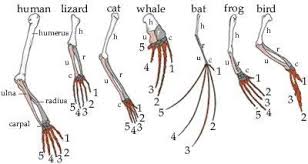
Structures as different as human arms, bat wings, and dolphin flippers contain many of the same bones, these bones having developed from very similar embryonic tissues. How do biologists interpret these similarities?
By the principle of convergent evolution
By proposing that humans, bats, and dolphins share a common ancestor
Ichthyosaurs were aquatic dinosaurs. Fossils show us that they had dorsal fins and tails, as do fish, even though their closest relatives were terrestrial reptiles that had neither dorsal fins nor aquatic tails. The dorsal fins and tails of ichthyosaurs and fish are
homologous.
examples of convergent evolution.
Which of these is a statement that Darwin would have rejected?
Environmental change plays a role in evolution.
The smallest entity that can evolve is an individual organism.
Individuals can acquire new characteristics as they respond to new environments or situations.
Inherited variation in a population is a necessary precondition for natural selection to operate.
About which of these did Darwin have a poor understanding?
that individuals in a population exhibit a good deal of variation
that much of the variation between individuals in a population is inherited
the factors that cause individuals in populations to struggle for survival
the sources of genetic variations among individuals
Each of the following has a better chance of influencing gene frequencies in small populations than in large populations, but which one most consistently requires a small population as a precondition for its occurrence?
mutation
non-random mating
genetic drift
natural selection
gene flow
When we say that an individual organism has a greater fitness than another individual, we specifically mean that the organism
lives longer than others of its species
competes for resources more successfully than others of its species
mates more frequently than others of its species
leaves more viable offspring than others of its species
Fossil evidence indicates that horses have gradually increased in size over geologic time.
Which of the following terms best describes this?
artificial selection
directional selection
stabilizing selection
disruptive selection
A certain species of land snail exists as either a cream color or a solid brown color. Intermediate individuals are relatively rare. Which of the following terms best describes this?
artificial selection
directional selection
stabilizing selection
disruptive selection
Which gas was least abundant in Earthʹs early atmosphere, prior to 2 billion years ago?
O2
CO2
CH4
H2O


A new river forms and splits two populations, causing ______________ speciation
Sympatric
Allopatric
Extreme
Convergent
Orcas occur in the same habitat but some are avoiding each other and do not interbreed. They have different diets, vocal behavior, and social structures. What type of speciation is this?
Allopatric
Sympatric
Complex
Covergent

The presence of islands represents what type of reproductive isolation
allopatric speciation
sympatric speciation
According to scientists, the earth is...
About 1.6 Billion Years Old
About 4.6 Billion Years Old
About 9.6 Billion Years Old
About 14 Billion Years Old
The earliest form of life known on Earth was...
Leafy Plants
Bacteria
Fossils
Anaerobic prokaryotes

Which scientist stated that things like war, famine and disease help to keep the worlds population in check.
Darwin
Lamarck
Malthus

What is the term for a feature that allows an organism to survive better in its environemtn?
variation
adaptation
homologous structure
vestigial structure
One hypothesis that has been proposed regarding the origin of life suggests that life evolved from an "RNA world" to today's "DNA world". Considering the properties of RNA and DNA molecules, which questions would direct an investigation of the most insightful test(s) of this hypothesis?
Could RNA have provided a template for DNA assembly, thereby enabling a more stable molecule that is replicated more accurately?
Is it likely that simple, yet stable RNA molecules served as a primitive precursor to a less stable DNA molecule that was more capable of storing more information?
Since ribozymes could freely enter and leave the vesicles, could these molecules have brought external DNA into the cell as a less stable, but more reliable storage molecule of double-stranded DNA?
Is it likely that RNA molecules functioned as ribozymes to synthesize DNA from amino acids, and that this role was reversed when DNA became the information source?
Which of the following statements can serve as evidence of common descent - the concept that ALL organisms are related? (Select ALL that apply.)
All organisms use the same genetic code, divided into codon triplets.
All organisms use operons to control gene expression.
All organisms contain enzymes aerobic respiration.
All organisms use glycolysis as a precursor to respiration.
All organisms can reproduce sexually and asexually.

The purpose of the Miller-Urey experiment was to test which hypothesis?
DNA replication is semi-conservative.
Organic molecules could have formed from inorganic molecules under the conditions of early Earth.
Early earth conditions included volcanic activity and lightning storms.
RNA was the first nucleic acid.
According to most scientists, what is the ultimate cause of most mass extinctions?
overhunting
evolution of new species to replace old ones
major change in environment or climate
asteroid impact

In a forest in Germany, there is a rat who has three fur coat colors: a light creamy color, a medium tan color, and a dark brown color. In this particular forest, the floor is a medium brown and the intermediate tan color mouse is better camouflaged.
directional selection
disruptive selection
stabilizing selection
artificial selection


Which statement is true comparing natural selection and artificial selection?
In natural selection, traits benefit humans and in artificial selection, the traits benefit the species
In natural selection, traits benefit the species and in artificial selection, the traits benefit humans
In natural and artificial selection, the process takes hundreds of years to occur
In natural and artificial selection, nature determines what traits will be passed down to offspring.

