
Font size
 Worksheets
Test 4 PHY Spring updated through periodic table
Total questions: 78
Worksheet time: 1hrs 13mins
Which inequality correctly compares the masses of electrons, protons, and neutrons?
p+ = n0 = e-
n0 < e-
p+ > e-
e- > n0


Kevin is identifying samples of three unknown metals. One of the properties he will use for identification is the density. The table shows the mass and volume for each sample. Kevin knows that the units of density are grams per cubic centimeter (g/cm3). Calculate the density for sample 2 and find the answer below.
10.49 g/cm3
7.9324 g/cm3
7.9324 g/cm
10.49 g/cm

Mr. Lee wants to confirm the metal used in a ring with a mass of 26.055 g. The volume of the ring is 2.54 cubic centimeters (cm3). What is the metal composition of the ring?
Sterling silver
18-ct white gold
Pure gold
Platinum

Graph A
Graph B
Graph C
Graph D


What was the net loss in glacier ice thickness between the years 1970 and 1996?
8m
6m
7m
10m

The graph shows energy production in the United States in 1967 and 2007 for several sources of energy. Which conclusion is supported by the graph?
In 1967 more energy was produced than in 2007
More energy was produced in 2007 than in 1967 in every category.
In 2007, more energy was produced gas energy than from renewable energy.
People in the United States were more concerned about conserving energy in 1967 than they were in 2007.
Jordan has a mixture of two solids that he has to separate. The solids are small granules that are the same size but different colors. She knows that the silver granules are aluminum and the white granules are salt. Which procedure is the most reliable way to separate the mixture?
Dissolve the mixture in a universal solvent and filter. Then evaporate the solvent to retrieve the salt.
Dissolve the mixture in a universal solvent and filter.
Pass a magnet over the mixture.
Sift the mixture through fine wire mesh.
A mixture of coffee grounds and coffee being poured through filter paper. Which property of the filter paper is being used to separate them out the coffee grounds from the molecules?
Size of particles
polarity of the molecules
Size of pores in the filter
Temperature of the water

In this graph, what is the dependent variable?
Population
Day
Species 5

In this graph, what is the independent variable?
Walla Walla Island
Time
Number of Deer
While driving, Brent noticed the lights from the other cars approaching were blurred, making it hard to see through the thick air. What is happening?
The air is a Homogeneous mixture so it is scattering the light
The air is Heterogeneous so it is separating into different parts
The air is a colloid due to fog, so light is being scattered
The air is a suspension so rain is settling out and scattering light


Carla needs exactly 100.00 grams of sulfur powder for an experiment. The picture shows the mass on the scale so far. She did not zero the scale before starting. Carla knows that the weighing paper weighs 5.10 grams. How much more sulfur powder does Carla need?
4.25 grams
4.35 grams
6.45 grams
3.45 grams

Sun Li investigates the time for 10 grams of table salt to dissolve in 100 milliliters of water. She sets up six beakers, using the information in the table. In which beaker would salt dissolve the fastest?
1
2
3
4

Four student groups pour equal masses of sugar into equal volumes of water. The table lists the differences in conditions for each group. Which group would represent the Hypothesis that decreased surface area and low heat will dissolve solutes faster?
1
2
3
4

The graph shows the temperature changes in a sample of water that is heated steadily from -40°C. Which process is happening in section 3 of the graph?
Ice is getting warmer.
Ice is melting.
Ice is in a liquid state.
Ice is changing to vapor and then to a liquid.
When a Bunsen burner is lit; why is the presence of a flame considered to be an indication of a chemical reaction?
A flame indicates an increase in molecular kinetic energy.
A flame indicates a phase change.
A flame indicates new physical energy is forming.
A flame indicates a decrease in chemical energy.
In science class, a teacher heats a sample of white wax. As the wax warms, it turns to a clear liquid. When the teacher allows the wax to cool, it hardens again, retaining its original color and mass. Heating the wax is classified as a physical change because it
cause a permanent change of energy.
does not change how atoms are bonded to one another
change the mass in the wick.
does not involve the change of molecular bonds.

A student wanted to test some objects to see if they would sink or float. What conclusion can be made from her investigation?
The marble is less dense than the water and the mineral oil
The marble is not denser than the water and the mineral oil
The block is less dense than the water and the mineral oil
The block is more dense than the water and less dense than the mineral oil
Which of the following will happen when a mixture of salt and water are left for a few days?
the water will evaporate
the salt will evaporate with the water
nothing will happen. The salt and water will remain in the cup
once the water evaporates the salt will be left in the container
Students put 2 ice cubes on separate plates. One ice cube had a mass of 20 grams. The other had a mass 0f 30 grams. Which result would be the same for both ice cubes in this investigation?
The time it took each ice cube to melt completely
The temperature at which each ice cube melted
The change in molecular motion of the ice on each plate
The total volume of each ice cube
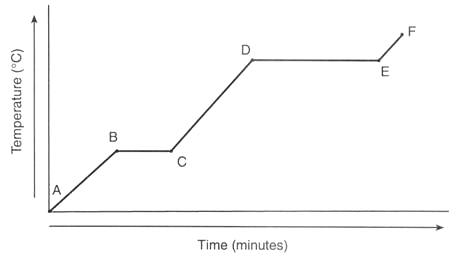
What state & phase is the object likely in from points A to B?
Solid, melting
Liquid, melting
Gas, boiling
Plasma, electrically charged
What is happening to the particles in the substance between points A and B?
Melting
Freezing
Speeding Up
Slowing Down
What is happening to the particles in the substance between points A and B?
Melting
Freezing
Speeding Up
Slowing Down
Spreading out

You are drinking a cold drink on a hot day when you notice LIQUID water has collected on the can. Which answer BEST explains what PHASE CHANGE has occurred AND how the molecule ARRANGEMENT has changed?
The PHASE CHANGE that has occurred is CONDENSATION and the molecule ARRANGEMENT has become CLOSER.
The PHASE CHANGE that has occurred is FREEZING and the molecule ARRANGEMENT has become CLOSER.
The PHASE CHANGE that has occurred is EVAPORATION and the molecule MOVEMENT has become FASTER.
The PHASE CHANGE that has occurred is CONDENSATION and the molecule ARRANGEMENT has become a gas.
Darlene places a bolt in the graduated cylinder to find its volume. Its starting volume is 45.5mL. After she puts the bolt in the graduated cylinder the water level rose to 65.5mL. What is the volume of the bolt?
10 cubic centimeters
19.5 cubic centimeters
20.5 cubic centimeters
21 cubic centimeters
20

A group of students researched the melting points of some representative elements and made up cards containing the symbol and melting point of each element. They then grouped the cards together to make the portion of the periodic table shown. Which conclusion best fits the group’s data?
Elements in periods 4,5, and 6 have melting points that increase and then decrease with increasing atomic number.
A) Group 2 metals have melting points that decrease with increasing atomic number.
A) Elements in a group have melting points that decrease with increasing atomic number.
A) Elements in all groups metals have melting points that decrease with increasing atomic number

Phillip watches a burning log in the fireplace. He makes these observations:
I. There is a strong smell of smoke.
II. The fire gives off heat.
III. Heat waves appear in the air above the log
IV. Light is emitted where there are flames.
V. Ashes form from the logs.
Which of Phillip’s observations are conclusive evidence that the burning log undergoes chemical changes and not just a physical change?
observations I and V only
observations II , III, and V only
observations I, III, and V only
observations I, IV, and V only
Holly is examining an isotope of manganese. She determines that each atom has 36 protons, 36 electrons, and 52 neutrons. What is the mass number for this manganese isotope?
72 amu
88 amu
52 amu
104 amu
Which of the following correctly describes the locations of the P+, e-, n0 subatomic particles of an atom?
P+ and n0 are in the nucleus and the e- are in the outer valence shell
P+ and n0 are in the valence shells and the e- are in the nucleus
P+, e-, and n0 are in the nucleus and the e- are in the nucleus
e- , and n0 are in the nucleus and the P+ are in the nucleus

Transition metals are located in the _______ of the periodic table while the Nobal gasses are on the ___________?
left, right
right, left
middle, right
right, middle

The diagram shows an outline of the periodic table with four elements labeled. Which element is a non-metal?
1
2
3
4
A Bohr model of an unknown element shows 7p+. What element is being diagrammed in the model?
Oxygen
Lithium
Nitrogen
Carbon
Dr. Peterson does an experiment to research the growth rate of mice. He has two groups of mice. He feeds one group a type of food and adds chemical A, which is supposed to increase the growth rate. The other group he feeds the same food without chemical A added. His research shows that chemical A increases the growth rate by .005%. He does the experiment 4 times and comes up with different amounts each time that never went higher than the original percent.
Dr. Peterson concludes that chemical A does increase the growth rate of mice. Is Dr. Peterson's conclusion supported by scientific knowledge?
Yes; his data showed an increase in growth percentage, even though it was a small and variable amount.
No; his conclusion is not supported by evidence from his experiment because the increase is too low to be significant and the results were not consistent.
No; because his results were consistent and showed a low growth.
Yes; any increase is significant enough to be proof and the results match his hypothesis.
Smithers thinks that a special juice will increase the productivity of workers. He creates two groups of 50 workers each and assigns each group the same task (in this case, they're supposed to staple a set of papers). Group A is given the special juice to drink while they work. Group B is not given the special juice. After an hour, Smithers counts how many stacks of papers each group has made. GroupA made 1,587 stacks, Group B made 2,113 stacks
Which group is the control group?
Group A
Group B


The pictures below show a field that is being studied over time. In the field, there are rabbits (red circles) and foxes (blue circles). What conclusion can be drawn from these observations?
The number of foxes decreases as the number of rabbits increases.
The number of rabbits and foxes remains constant over time.
The number of foxes remains constant while the number of rabbits decreases.
The number of rabbits decreased while the number of foxes increased.

Which element would be in group 15?
V
W
X
Y
Z
Which of the following would be the most reactive?
Francium
Aluminum
Magnesium
Strontium
How many valence electrons are in an atom of K?
(a)

Which element could be lustrous and brittle?
(a)

Which element has a full valence shell?
(a)

Which element has 3 valence electrons?
(a)


Which element belongs to the group that is made up of only gases?
(a)


To which group does this atom belong?
(a)

How many energy levels does an atom of Chlorine have?
(a)

What is the group number of this atom?
(a)


List the two most reactive families on the periodic table.
Alkali metals & Transition Metals
Noble gases & Oxygen Family
Halogens (Group 17) & Alkali metals
Halogens (Group 17) & Noble gases
good thermal conductors, shiny, electric conductors, higher density and melting points than group and commonly known
alkali metals (group 1)
Transition Metals (Groups 3-12)
Non-metals
metalloids (semimetals)
not able to conduct heat or electricity, little to no metallic luster
Non-metals
noble gases
atomic mass
Neutron

Larry wants to test different types of fertilizer on tomato plants. He wants to see if one works better than the rest. He has 4 plants. The first one gets no fertilizer, the second one gets fertilizer A, the third Fertilizer B, and the fourth Fertilizer C. They each get the same amount of sunlight, same amount of soil, same type of soil, same amount of water, and are grown in the same air temperature in the same greenhouse. Larry is counting the total weight of tomatoes produced by each plant to determine how well the fertilizers worked. What is the dependent variable?
the type of fertilizer
the plant with no fertilizer
the weight of tomatoes produced
same amount of soil

