
 Worksheets
EMT Practicals
Total questions: 61
Worksheet time: 46mins
Light acts like
a wave
Both a wave and a particle
a particle
neither a wave nor a particle
Colours in thin film are because of
Dispersion
diffraction
interference
polarization
which of the following is not a basic parameter of a light wave?
frequency
amplitude
source
phase
In elliptically polarised light
amplitude of vibrations changes in magnitude and direction both
amplitude of vibrations changes only in magnitude
amplitude of vibrations changes only in direction
no change in amplitude
Optically active substances are these which
cause double refraction
rotate the plane of polarisation
polarise light
scatter light
Doubly refracting calcite crystal is placed over an ink dot. On seeing through the crystal, one observes.
both dots rotating about a comman axis
two stationary dots
one dot rotating about the other
a single dot
In double refraction, two refracted rays are produced, called as O-ray and E-ray. Which of the following statements is TRUE
only O-ray is polarised
only E-ray is polarised
both O-ray and E-ray are polarised
neither E-ray nor O-ray are polarised
Polarimeter is a device used for
measurement of optical rotation
measurement of angle of polarisation
measurement of angle of reflection
measurement of angle of refraction
In the Nicol Prism experiment, the calcite crystal length is x times its breadth. What is x?
2
3
1/2
1/3
The working of Nicole prism is based on the phenomenon of .................
Refraction
Reflection
Diffraction
Double Refraction
If the phase difference between two rays is π/2 and the angle of incidence is equal to π/4, the emergent light is
Linearly Polarized
Elliptically Polarized
Circularly Polarized
Non-Polarized
What should be the thickness of quarter-wave plate for a light of wavelength 5000 Å if µe = 1.553 and µo = 1.544?
1.38 X 10⁻³ cm
1.43 X 10⁻³ cm
1.53 X 10⁻³ cm
1.63 X 10⁻³ cm
For E-ray, the Canada balsam layer is optically rarer.
True
False
A tube of length 20cm containing a 10% sugar solution rotates the plane of polarization by 13.2°. What is the specific rotation of sugar solution?
66°
55°
44°
33°
A plate which induces the desired amount of phase difference between two rays is known as
Polaroid
Phasor plates
Retardation Plates
Quartz plates
What happen to O and E rays if they travel along the optic Axis?
Both ray travel with the same velocity
O ray travels faster than E ray
E ray travel faster than O ray
none of these
Dextrorotatory optically active substance rotates the plane of vibration?
In clockwise direction
In anticlockwise direction
By 180 degree
none of these
How much phase change is introduced by a quarter wave plate between ordinary and extra ordinary ray?
π
2π
4π
2π
Who should not wear polarized glasses?
Someone driving on smooth pavement in the daytime
Someone fishing on a lake on a warm day
Someone operating a plane with digital (LCD) controls
Someone sailing on the ocean
Which waves can be polarised?
Transverse waves
Longitudinal waves
Both transverse and longitudinal waves
Neither transverse and longitudinal waves
Properties of waves are
I. polarization
II. diffraction
III. refraction
Which of these properties apply to sound waves?
I and II
II and III
I and III
All of them
What should be the thickness of quarter wave plate for a light of wavelength 5000 Å if µe=1.553 and µo=1.544
1.38x10⁻³ cm
1.43x10⁻³ cm
1.53x10⁻³ cm
1.63x10⁻³ cm
The velocity of light in water is 1.5x10⁸ m/s. What is the polarizing angle of incidence.
47.230
51.030
53.740
63.430
The plane perpendicular to the plane of vibration is called as ---------------- .
co axial plane
plane of polarisation
plane of intersection
uni axial
Nicol prism is made up of ----------------- crystal.
quartz
calcite
glass
When the light is allowed to pass through the tourmaline crystal the out coming light is ------------------- .
circularly polarised
elliptically polarised
plane polarised
unpolarised
A polarizer is used to:
reduce intensity of light
produce polarized light
increase intensity of light
produce unpolarized light

Unpolarised light of intensity I0 is incident on a polariser with a vertical transmission axis. The transmitted light is incident on a sheet of material X. After transmission through X the intensity of the light is I0/2.
It is suggested that X could be
I. a polarizer with vertical transmission axis
II. a polarizer with horizontal transmission axis
III. non polarizing glass.
Which of the above suggestions is/are correct?
I and III only
I only
II only
I and II only
? If the polarizing axis of the second filter is parallel to
that of the first, the light will .............
pass through it
block
reflect
Which row correctly shows electromagnetic radiations in order of decreasing wavelength?
gamma > ultraviolet > microwave
ultraviolet > gamma > microwave
microwave > ultraviolet > gamma
gamma > microwave > ultraviolet
Which statement is correct about the properties of an unpolarised electromagnetic wave as it passes through a polariser?
The wave remains unchanged.
The wave does not pass through the polariser.
The wave’s electric field oscillates along the direction of travel.
The intensity of the wave is reduced.
Which statement is not correct for ultrasound and X-rays?
Both can be refracted
Both can be diffracted
Both can be polarised
Both can be reflected
Which of the following waves cannot be polarised?
radio
ultrasonic
microwave
ultraviolet
The sound quality of a portable radio is improved by adjusting the orientation of the aerial.
Which statement is a correct explanation of this improvement?
The radio waves from the transmitter are polarised.
The radio waves from the transmitter are unpolarised.
The radio waves become polarised as a result of adjusting the aerial.
The radio waves become unpolarised as a result of adjusting the aerial.
Which one of the following properties of light waves do polarising sunglasses depend on for their action?
Light waves may
interfere constructively.
interfere destructively.
be polarised when reflected from a surface.
be polarised by the lens in the eye.
The audible range of a girl's hearing is 30 Hz to 16 500 Hz. If the speed of sound in air is 330 m s−1, what is the shortest wavelength of sound in air which the girl can hear?
30/330 m
16500/330 m
330/16500 m
330/30 m
PN Junction diode formed
Special fabrication technique of combining P and N -type material
Pushing P and N- type material towards
Welding of P and N type material
The depletion region contains
Electrons
Holes
Immobilized charge carriers
Sea of electrons
What is the most common semiconductor material used for producing integrated circuits
Quartz
Silicon
Diamond
Tantalum
Component that Convert AC to DC and allow current to flow in one Direction
Capacitor
Diode
Inverter
Resistor
These are the characteristics of pentavalent impurities except
•5 valence electron.
•contributing extra free electrons.
•produce n-type semiconductors.
•produce p-type semiconductors.

What happens to light during total internal reflection?
The angle of incidence is greater than the critical angle.
The angle of reflection is the same as the critical angle.
The angle of refraction is less than the critical angle.
The angle of incidence is zero.
Fiber optic cables work because of the principle of _____.
total internal refraction
incomplete internal refraction
total internal reflection
partial internal reflection

_____ cables transmit beams of light without allowing any of the light to escape until it gets to the end of the cable.
Ethernet
Fiber optic
Armored
Coaxial
When angle of incident (i) equals to critical angle (c) if light is traveled from a denser medium to a less dense medium,
total internal reflection occurs.
angle of refraction is equal to 90 degree.
light is refracted out
light travel in straight line
Which of the following statement about optical fibre is incorrect?
Light is totally internally reflected down the fibre.
It is used in medical (endoscope).
It is used in fibre optic communication.
Angle of incidence of light in optical fibre must less than critical angle.
What is total internal reflection
Where a wave is refracted at the boundary between a dense medium and a less dense medium when the angle of incidence is greater than the critical angle.
Where a wave is refracted at the boundary between a dense medium and a less dense medium when the angle of incidence is smaller than the critical angle.
Where a wave is reflected at the boundary between a dense medium and a less dense medium when the angle of incidence is greater than the critical angle.
Where a wave is reflected at the boundary between a dense medium and a less dense medium when the angle of incidence is smaller than the critical angle.

When the angle of refraction is 90 ° the angle of incidence is called the...
Angle of incidence
Critical angle
Angle of total internal reflection
Angle of refraction
What do we call a material that light can travel through?
air
water
medium
pathway


Which letter refers to the angle of refraction?
A
B
C
D

The picture shows:
Specular reflection
A ray diagram
Diffuse reflection
Incident ray angles = Reflected ray angles


What happens to the frequency of a light wave as it propagates from glass into air?
It remains constant.
It slows down.
It speeds up.
It bends.
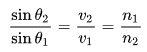
A higher index of refraction means that the wave travels _____________ the speed of light in a vacuum in that medium.
Faster than
Slower than
Equal to
Answer is not here

