
 Worksheets
Waves and Sound Exploration
Total questions: 56
Worksheet time: 45mins
What is the amplitude of a wave?
The amplitude of a wave is the maximum height of the wave from its rest position.
The amplitude is the speed of the wave.
The amplitude is the wavelength of the wave.
The amplitude is the frequency of the wave.
Which of the following is a property of waves?
Waves can reflect and refract.
Waves are always stationary.
Waves cannot carry energy.
Waves can only travel in a straight line.
What is the speed of light in a vacuum?
299,792,458 meters per second
150,000,000 meters per second
299,792 kilometers per second
300,000,000 meters per second
Which part of the electromagnetic spectrum has the longest wavelength?
Ultraviolet waves
X-rays
Infrared waves
Radio waves
What type of wave is sound?
Sound is an electromagnetic wave.
Sound is a surface wave.
Sound is a longitudinal wave.
Sound is a transverse wave.
What is the relationship between frequency and wavelength?
Frequency and wavelength are directly related.
Wavelength increases as frequency increases.
Frequency has no effect on wavelength.
Frequency and wavelength are inversely related.
What happens to sound waves as they travel through different mediums?
Sound waves travel slower in solids than in liquids.
Sound waves do not travel through any medium.
Sound waves travel faster in solids than in liquids, and faster in liquids than in gases.
Sound waves travel at the same speed in all mediums.
Which of the following is NOT part of the electromagnetic spectrum?
Sound waves
Microwaves
Radio waves
Infrared waves
What is the unit of frequency?
Watts (W)
Joules (J)
Volts (V)
Hertz (Hz)
How does the frequency of a wave affect its pitch?
Higher frequency results in a higher pitch, and lower frequency results in a lower pitch.
Lower frequency results in a higher pitch
Frequency has no effect on pitch
Higher frequency results in a lower pitch
What is the primary medium through which sound travels?
Air
Metal
Wood
Water
What is the wavelength of a wave?
The wavelength of a wave is the total energy carried by the wave.
The wavelength of a wave is the distance between consecutive points of the same phase.
The wavelength of a wave is the amplitude of the wave.
The wavelength of a wave is the speed of the wave divided by its frequency.
Which type of electromagnetic wave is used in microwaves?
Radio waves
Microwaves
Ultraviolet waves
Infrared waves
What happens to the speed of sound in warmer air?
The speed of sound decreases in warmer air.
The speed of sound remains the same in warmer air.
The speed of sound is unaffected by temperature changes.
The speed of sound increases in warmer air.
What is the range of human hearing in hertz?
20 Hz to 20,000 Hz
5 Hz to 50,000 Hz
10 Hz to 15,000 Hz
30 Hz to 25,000 Hz
What is the difference between transverse and longitudinal waves?
Transverse waves move perpendicular to wave direction; longitudinal waves move parallel.
Transverse waves are sound waves; longitudinal waves are light waves.
Transverse waves move parallel to wave direction; longitudinal waves move perpendicular.
Transverse waves can travel through solids only; longitudinal waves can travel through all states of matter.
Which electromagnetic waves are used for communication?
Ultraviolet waves
Visible light waves
Radio waves, microwaves, and infrared waves
X-rays
What is the effect of increasing the amplitude of a sound wave?
The sound travels faster.
The pitch of the sound increases.
The sound becomes softer.
The sound becomes louder.
What types of waves can travel through empty space AND mediums?
Longitudinal
Mechanical
Electromagnetic
Which 2 types of waves require a medium to travel?
Electromagnetic
Mechanical
Light
Sound
Which of the following is a mechanical wave?
X-ray
Infrared
Radio waves
Sound
What medium do sound waves travel fastest through?
Solids
Liquids
Gases

The height of a wave from its resting point (B).
Frequency
Wave speed
Wavelength
Amplitude
The length of a wave, from crest to crest or trough to trough. (D)
Frequency
Wave speed
Wavelength
Amplitude
The number of waves passing a given point each second is:
Frequency
Wave speed
Wavelength
Amplitude
What is the correct formula for wave speed?
Wave speed = frequency x wavelength
Wave speed = amplitude x wavelength
Wave speed = amplitude x period
Wave speed = frequency x period
As wavelength decreases, the crests of the wave:
become wider
become shorter
get closer together
get farther apart
If a wave has a long wavelength, it will have __________ energy.
High
Medium
Low
A substance (like solid, liquid or gas) that the energy of a wave can travel through
amplitude
compression
medium
frequency
The highest point on a wave.
frequency
compression
trough
crest

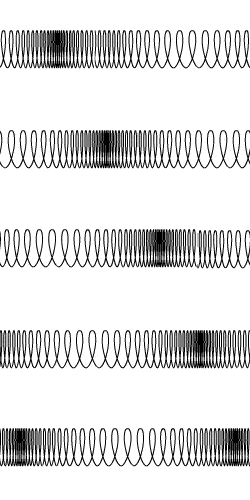
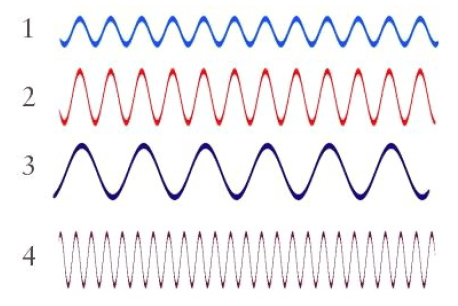

The distance between two consecutive regions of high concentration of air particles (high density and pressure) is the _________ of a sound wave.
Amplitude
Frequency
Speed
Wavelength

As air particles become less crowded a region of lower density and pressure is created. This part of a longitudinal wave is called a:
Crest
Compression
Rarefaction
Frequency

As air particles are pushed together, they create a region of higher density and pressure in a longitudinal wave. These areas are called:
Trough
Compression
Rarefaction
Frequency
What is the pitch of a sound wave?
How loud or soft sound is.
How high or low sound is.
A material that sound travels through.
Back and forth movement of the air particles.
What is the volume of a sound wave?
How loud or soft sound is.
How high or low sound is.
A material that sound travels through.
Back and forth movement of the air particles.

Why can't we hear sound in space?
The helmet blocks the sound and you can't take it off to hear it.
Sound travels so slow in vacuum, that it never gets to your ears.
Sound needs a material to travel through, so it can't travel through vacuum.
Don't know, I've never been to space.

Why do we hear echos?
Sound waves get reflected off a surface and travel back to us.
There is a second sound source emitting sound back at us.
Sound waves get refracted and bend back to us.
Sound waves travel really fast!

Why do we see lightning before thunder?
Lightning happens before thunder.
The speed of light is greater than the speed of sound.
Our eyes trick us.

