wayground logo

Free Printable Worksheets

NEW

Font size

S
M
L
XL
Worksheets

Cell Cycle, Mitosis, Meiosis and Reproduction

Total questions: 59

Worksheet time: 2hrs 51mins

Name
Class
Date
1.

The two hormones that maintain the lining of the uterus are:

a)

FSH and estrogen

b)

LH and estrogen

c)

estrogen

d)

Progesterone and estrogen

2.
What do we call a fertilized egg?
a)
Sperm
b)
Testosterone
c)
Zygote
d)
Egg
3.
On what day of the cycle is ovulation?
a)
Day 4
b)
Day 8
c)
Day 14
d)
Day 28
4.
What is the process called when a sperm and egg produce a zygote?
a)
Reproduction
b)
Excretion
c)
Fertilization
d)
Sneezing
5.

The lining of the uterus coming out through the vagina (sometimes called 'having a period').

a)

Conception

b)

Fertilization

c)

Implantation

d)

Menstruation

6.

The human male reproductive system is adapted for the production of

a)

sperm and the delivery of these cells for internal fertilization

b)

gametes that transport food to the egg

c)

zygotes and the development of these cells into a fetus

d)

hormones that stimulate placenta formation in the male

7.

A diagram of the human male reproductive system is given. Which structure produces cells that become sperm?

a)

A

b)

B

c)

C

d)

D

8.

Which structure is correctly paired with its function?

a)

ovary — provides milk for newborns

b)

testis — development of sperm

c)

placenta — storage of released eggs

d)

uterus — produces estrogen

9.

The diagram GIVEN represents a human reproductive system. Meiosis occurs within structure

a)

A

b)

B

c)

C

d)

D

10.

True or False: The egg is the female reproductive cell.

a)

True

b)

False

11.

In which of the following structures of the female human reproductive system is the blastocyst implanted during normal human development?

a)

Ovary

b)

uterus

c)

vagina

d)

amniotic sac

12.

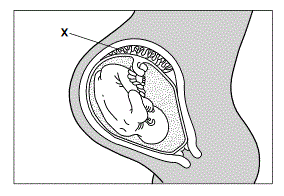
Which statement best describes an important

process carried out by structure X (placenta)

a)

Milk passes from the mother to the fetus

b)

Material are exchanged between fetal and maternal blood.

c)

Maternal blood is converted into fetal blood

d)

Oxygen diffuses from fetal blood to maternal blood.

13.
The cells produced via meiosis are called:
a)
sex cells
b)
somatic cells
c)
body cells
d)
skin cells
14.

If the body cells in cats have 38 chromosomes, how many chromosomes will be in the sperm cells of a cat?

a)

76

b)

19

c)

38

d)

you cannot tell

15.
What causes genetic variation in meiosis?
a)
chromosomes lining up
b)
crossing over of chromosomes
c)
separation of chromosomes
d)
chromosomes pulling apart
16.

Which process does the picture show and what type of cells are produced?

a)

mitosis, gametes

b)

mitosis, body cells

c)

meiosis, gametes

d)

meiosis, body cells

17.
A male shark has 40 chromosomes in each of its sex cells. How many would be present in its body cells?
a)
20
b)
40
c)
80
d)
160
18.
In meiosis, the four resulting cells are 
a)
identical to the starting cell and different from each other.
b)
different from the starting cell and different from each other. 
c)
identical to the starting cell and identical to each other.
d)
different from the starting cell and identical to each other.
19.
After meiosis is complete how many cells will there be?
a)
1
b)
2
c)
3
d)
4
20.
Before cells can divide, what must be copied?
a)
mitochondria
b)
cytoplasm
c)
DNA
d)
Cell Wall
21.
Cells that have only one chromosome from each pair
a)
meiosis
b)
haploid
c)
homologous
d)
diploid
22.
Humans have how may chromosomes ?
a)
112
b)
46
c)
8
d)
67
23.
The chromosomes that pair up during meiosis, are called __________ chromosomes.  
a)
homozygous 
b)
asexual
c)
homologous
d)
genes
24.
What is one reason why we need meiosis?
a)
To double the number of chromosomes going into sex cells
b)
To halve the number of chromosomes going into sex cells
c)
To triple the number of chromosomes going into sex cells
d)
To not change the number of chromosomes going into sex cells
25.
When does replication of chromosomes occur in animal cell meiosis?
a)
Before Meiosis I and Meiosis II
b)
Before Meiosis II Only
c)
Before Meiosis I Only
d)
During Prophase I and Prophase II
26.

A major male sex organ that produces and stores sperm.

a)

Prostate Gland

b)

Testicle

c)

Ovary

d)

Vas deferens

27.

What is the primary sex hormones of males?

a)

Prostate gland

b)

Testosterone

c)

Urine

d)

Semen

28.
The developing embryo is fed by its mother’s blood through a tissue called the
a)
placenta
b)
vagina
c)
amnion
d)
uterus
29.
The developing embryo is connected to the placenta by
a)
the spinal cord
b)
the umbilical cord
c)
the amniotic fluid
d)
the developing nerves
30.
When the blastocyst attaches to the lining of the uterus, this is known as
a)
fertilization
b)
ovulation
c)
implantation
d)
mitosis
31.
Week 9/ 10 the baby acquires features and is then referred to as
a)
an embryo
b)
a fetus
c)
a zygote
d)
a newborn
32.

What structure protects and cushions the fetus throughout its prenatal development?

a)

amniotic sac and fluid

b)

placenta

c)

umbilical cord

d)

vagina

33.
What process does a multi-cellular organism use to replace its damaged body cells?
a)
mitosis
b)
meiosis
c)
replication
d)
transcription
34.
Which of these lists presents the stages of the cell cycle in the correct order?
a)
interphase, mitosis, cytokinesis
b)
cytokinesis, mitosis, interphase
c)
mitosis, interphase, cytokinesis
d)
interphase, cytokinesis, mitosis
35.
Which of these phases of mitosis take place first?
a)
anaphase
b)
telophase
c)
prophase
d)
metaphase
36.
Identify the stage.
a)
interphase
b)
metaphase
c)
anaphase
d)
telophase
37.
Identify the stage of mitosis.
a)
interphase
b)
prophase
c)
metaphase
d)
anaphase
38.
Identify the stage of mitosis.
a)
interphase
b)
prophase
c)
anaphase
d)
cytokinesis
39.
Identify the stage of mitosis. 
a)
interphase
b)
prophase
c)
anaphase
d)
cytokinesis
40.
Division of the nucleus.
a)
Cytokinesis
b)
Mitosis
c)
Prophase
d)
Interphase
41.
Division of the cytoplasm and organelles.
a)
Mitosis
b)
Metaphase
c)
Cytokinesis
d)
Cytoplasm
42.
Time period between cell divisions.
a)
Anaphase
b)
Mitosis
c)
Cytokinesis
d)
Interphase
43.
3 stages of interphase
a)
G1, M, G2
b)
M, C, S
c)
G1, S, G2
d)
P, M, G1
44.
Repeating sequence of growth and division in the life of a cell.
a)
Cell Cycle
b)
Cell Division
c)
Mitosis
d)
Cytokinesis
45.
During which stage of interphase does the DNA duplicate.
a)
M Phase
b)
G1 Phase
c)
S Phase
d)
G2 Phase
46.
What is the nondividing stage or resting stage of the cell cycle called?
a)
G0 Stage
b)
G1 Stage
c)
G2 Stage
d)
G3 Stage
47.
The process of mitosis and cytokinesis produce two identical
a)
daughter cells
b)
strands
c)
chromosomes
d)
chromatids
48.

Why is mitosis important to humans?

a)

Mitosis helps in the death of unnecessary cells.

b)

Mitosis helps in the growth and repair of tissues.

c)

Mitosis helps to maintain healthy number of sex cells.

d)

Mitosis helps in the formation of sex cells.

49.
Which of the following lists, in order, the phases of mitosis?
a)
interphase, metaphase, anaphase, telophase
b)
prophase, metaphase, anaphase, telophase
c)
prophase, metaphase, anaphase, interphase
d)
prophase, anaphase, metaphase, telophase
50.

How many new cells are produced from cell division with mitosis?

a)

1

b)

2

c)

4

d)

6

51.

The uncontrolled division of cells can cause...

a)

meiosis

b)

cancer

c)

nondisjunction

d)

crossing over

52.
Cell division is represented by what letter?
a)
A
b)
B
c)
C
d)
D
53.
A cell spends __% of its cycle in ____.
a)
100, interphase
b)
10, cytokinesis
c)
40, mitosis
d)
90, interphase
54.
Which of the following is correct?
a)
S phase, cell division
b)
M phase, cell growth
c)
G1 phase, DNA replication
d)
G2 phase, preparation for division
55.

Sperm are produced in the

a)

Bladder

b)

Testes

c)

Scrotum

d)

Ovaries

56.

Human eggs are usually fertilized in the

a)

Uterus

b)

Ovary

c)

Oviduct

d)

Cervix

57.

A fertilized egg develops in the

a)

the cervix

b)

the uterus

c)

an ovary

d)

the vagina

58.

Which is the correct order of human development?

a)

fetus, embryo, zygote

b)

zygote, embryo, fetus

c)

embryo, fetus, zygote

d)

zygote, fetus, embryo

59.

The primary role of the reproductive system is...

a)

to ensure the survival of the species.

b)

to produce gametes.

c)

to create offspring.

d)

to excrete liquid wastes.

e)

to determine one’s gender.