wayground logo

Free Printable Worksheets

Font size

S
M
L
XL
Worksheets

Ultimate Review

Total questions: 120

Worksheet time: 2hrs 37mins

Name
Class
Date
1.
The space, conditions and all the living and non-living things around an organism is its _________________.
a)
home
b)
environment
c)
neighborhood
d)
ecosystem
2.
Coloring or another physical characteristic that help an organism blend in with its environment
a)
mimicry
b)
camouflage
c)
hibernation
d)
migration
3.
An inherited trait that helps those organisms that have it to survive
a)
niche
b)
structure
c)
characteristic
d)
adaptation
4.
When an organism copies a characteristic of something else in order to better its chances for survival and reproduction
a)
hibernation
b)
camouflage
c)
mimicry
d)
migration
5.
The seasonal movement of an organism from one place to another
a)
camouflage
b)
migration
c)
hibernation
d)
function
6.
When an organism slows its life functions for a period of time to better its chances for survival during harsh conditions
a)
camouflage
b)
migration
c)
mimicry
d)
hibernation
7.
The place or environment where an organism naturally lives
a)
function
b)
habitat
c)
community
d)
ecosystem
8.
A group of organisms which are similar to each other and can combine to have offspring
a)
species
b)
characteristic
c)
club
d)
organisms
9.
Which feature of a rose helps it grow without being eaten by large animals?
a)
flowers with bright colors
b)
sharp thorns
c)
small seeds
d)
deep roots
10.
An example of a physical adaptation is...
a)
a turtle hiding inside its shell
b)
The spikes on a porcupine fish
c)
a rabbit burrowing underground
d)
a viper biting when threatened
11.
 Which of these BEST describes how some birds survive when the weather gets cold? 

     
a)
 a.   They store twigs and sticks in their nest 
b)
 b. They migrate to a warmer climate 
c)
 c. They grow more feathers to stay warm in the winter 
d)
 d. They hide in bushes and wait for warm weather 
12.
Lions often hide in the tall grass while stalking their prey.  This is an example of...
a)
camouflage
b)
warning coloration
c)
mimicry
d)
hibernation
13.

Which of the following structures is a physical adaptation that helps a penguin live in an icy, wet environment?

a)

webbed feet for swimming

b)

wing shaped flippers for flying

c)

small spines to prevent water loss

d)

transparent eyelids to keep eyes moist

14.

A snake has scaly skin to keep from drying out in the desert. A cactus has sharp spines and a thick stem that keeps water in. Which term describes these traits that help the cactus survive?

a)

hibernation

b)

niche

c)

adaptation

d)

instinct

15.

Which of the following helps polar bears survive in their habitats?

a)

thick fur

b)

long tails

c)

large ears

d)

wide hooves

16.

What does it mean when a plant adapts?

a)

it grows on the rainforest floor or under the water

b)

it changes itself to fit better with its environment

c)

it grows giant leaves and has bright flowers

d)

it converts its surroundings into a kinder climate

17.

Why do plants adapt to their environment?

a)

in order to give the surrounding animals and people enough food to survive

b)

in order to get the water and sunlight they need to survive

c)

in order to block the sunlight from the floors of the ocean and forest

d)

in order to grow tall and colorful

18.

How do underwater plants adapt to their surroundings?

a)

they have flexible leaves and stems

b)

they have an air space in their stems

c)

they have floating seeds

d)

they have very bright colors

19.

How plants like water lilies float on the water?

a)

they have seeds that float

b)

they have slippery leaves

c)

they have an air space in the stems

d)

they have poisonous leaves

20.

Why do some plants in the rainforest have bright flowers and grow close to the ground?

a)

to repel any extra rainfall

b)

to get as much sunlight on their leaves as possible

c)

to keep animals and people away from them

d)

to attract birds and insects for pollination

21.

How have some rainforest plants adapted to receive enough sunlight?

a)

by growing poisonous flowers

b)

by growing giant, slippery leaves

c)

by growing giant, bright flowers

d)

by growing long deep roots

22.

Animal Adaptations


What is another term for inherited behaviors?

a)

hibernation

b)

instinct

c)

physical adaptation

d)

natural selection

23.

A group of living and non-living things that live together.

a)

Ecosystem

b)

community

c)

population

d)

habitat

24.
A behavior that is developed by observing others or by being taught is a 
a)
learned behavior 
b)
inherited trait
c)
adaptation 
d)
function
25.
Characteristics passed from parents to their offspring.
a)
behavior
b)
learned trait
c)
inherited trait
d)
function
26.
Which of these is not an inherited trait?
a)
a bird building a nest
b)
a turtle burying its eggs
c)
a bear hibernating in winter
d)
a horse pulling a plow
27.
Which characteristic would most likely be inherited by a baby?
a)
brown hair
b)
crying a lot
c)
ability to jump high
d)
his ability to talk
28.
A dog rolls over and receives a treat. The dog rolls over again. This is an example of...
a)
learned behavior
b)
adaptive behavior
c)
inherited behavior
d)
instinctive behavior
29.
Which characteristic is inherited?
a)
hair color
b)
sleeping late
c)
enjoying hiking
d)
loving to read
30.
Which best describes an inherited trait?
a)
a characteristic one chooses to express
b)
a characteristic one receives from the food one eats
c)
a characteristic that is passed on from one's parents
d)
a characteristic that is influenced by one's surroundings
31.

A behavior animals are born knowing how to do is an __________.

a)

example

b)

animal

c)

option

d)

instinct

32.
What is an instinct?
a)
Characteristics passed from parents to offspring.
b)
A natural behavior that an organism inherits.
c)
A behavior that an organism obtains from experiences.
33.
Instinct, inherited trait, or learned behavior?
Bears go into hibernation.
a)
Instinct
b)
Inherited trait
c)
Learned behavior
34.
Instinct, inherited trait, or learned behavior?
Anna has a southern accent.
a)
Instinct
b)
Inherited trait
c)
Learned behavior
35.
Instinct, inherited trait, or learned behavior?
Jamal is very tall.
a)
Instinct
b)
Inherited trait
c)
Learned behavior
36.
A girl observes her brother and records some behaviors she saw.
Which is a learned behavior?
a)
blinking
b)
reading
c)
sleeping
d)
swallowing
37.

Which animal observation would be considered an instinct?

a)

a dog jumps 6 ft into the air to catch a Frisbee.

b)

a dog barks when its owner tells it to speak

c)

a dog barks when a stranger approaches it

d)

a dog sits upright and appears to beg for a treat

38.

Which trait below is NOT one that is inherited in puppies?

a)

number of whiskers

b)

length of tail

c)

injured paw

d)

eye color

39.
Example of a consumer
a)
worm
b)
bacteria
c)
mushroom
d)
hawk
40.
Example of a decomposer
a)
fungus
b)
mouse
c)
plants
d)
frogs
41.
A tree is a ....
a)
composer
b)
decomposer
c)
producer
42.
Humans are considered...
a)
consumers
b)
decomposers
c)
producers
43.
What is a producer?
a)
an organism that gets energy from eating other organisms
b)
an organisms that uses sunlight to make its own food
c)
an organism that gets energy from eating dead organisms, non-living material or waste
d)
an organism that uses chemical energy to make its own food
44.
A connection of food chains with many food energy paths in an ecosystem is a ____________
a)
ecosystem
b)
food web
c)
environment
d)
population
45.
An organism that gets energy from breaking down dead organisms, non-living material or waste
a)
producer
b)
consumer
c)
decomposer
d)
autotroph
46.
Which of the following is NOT a consumer
a)
grass
b)
dog
c)
shark
d)
fish
47.
Where do all life forms get their energy?
a)
Earth's Core
b)
Water
c)
Plants
d)
The Sun
48.
The arrows in a food chain or web represents what?
a)
They point to the organism that is being eaten.
b)
It shows how sunlight flows within an ecosystem.
c)
They show what direction the energy is flowing between organisms. 
d)
They represent how water is transferred within a habitat.
49.
If a frog is the prey, what could be the predator?
a)
Grass
b)
Insect
c)
Snake
d)
Snail
50.
What does a food chain represent?
a)
How all living organisms within a habitat are connected.
b)
All of the things that a particular animal eats.
c)
How plants create their own food.
d)
A single path of energy transfer within a habitat.
51.

_____ have molecules that are packed together and hardly move.

a)

solids

b)

liquids

c)

gases

d)

plasma

52.

____ have a definite volume and molecules that are spread out and can move past one another.

a)

solids

b)

liquids

c)

gases

d)

plasma

53.

____ have molecules that can spread out far from each other and move quickly.

a)

solids

b)

liquids

c)

gases

d)

plasma

54.

Which phase of matter has a definite volume and definite shape?

a)

solid

b)

liquid

c)

gas

55.

___ is anything that takes up space and has mass.

a)

Density

b)

Weight

c)

Volume

d)

Matter

56.

____ is the amount of space an object takes up.

a)

Matter

b)

Volume

c)

Density

d)

Mass

57.

Which tool would you use to measure the volume of a liquid?

a)

balance

b)

thermometer

c)

ruler

d)

graduated cylinder

58.

Which tool would you use to measure the temperature of a cup of sand?

a)

thermometer

b)

balance

c)

graduated cylinder

d)

ruler

59.

_____ determines whether an object will sink or float in water.

a)

Mass

b)

Weight

c)

Density

d)

Volume

60.
floating or sinking when compared to water.
a)
volume
b)
solution
c)
relative density
d)
mixture
61.
The water is ______ dense than the boat
a)
more
b)
less
62.
If you poured 3 liquids that do not mix how could you tell which one is the most dense?
a)
The liquid on top
b)
The liquid in the middle
c)
The liquid at the bottom
63.

A bobber floats on the water because it is....

a)

more dense than the water

b)

less dense than the water

c)

the same density as the water

d)

to show you when you have a bite

64.

The ability to sink or float.

a)

volume

b)

mass

c)

solution

d)

relative density

65.

objects that are more dense than water will sink and objects that are less dense than water will float

a)

properties

b)

relative density

c)

physical state

d)

magnetism

66.

Rocks sink because they are

a)

the same density as the water

b)

less dense than the water

c)

more dense than the water

d)

because they're round

67.
A combination of two or more substances that can be easily separated.
a)
dissolve
b)
mixture
c)
solution
d)
physical property
68.
One or more substances dissolve in another and cannot be easily separated.
a)
mixture
b)
solution
c)
dissolve
d)
solute
69.
To break down into tiny pieces to small to be seen.
a)
solute
b)
solvent
c)
dissolve
d)
solution
70.
process where a liquid becomes a gas
a)
condensation
b)
evaporation
c)
physical property
d)
dissolve
71.
the substance to be dissolved in a liquid
a)
solute
b)
solvent
c)
dissolve
d)
mixture
72.
the temperature at which a solid becomes a liquid.
a)
freezing point
b)
melting point
c)
boiling point
d)
condensation point
73.
If I added 27 grams of salt to water and separated the solution with a hot plate, what amount of salt would be left behind?
a)
20 grams
b)
0 grams
c)
27 grams
d)
10 grams
74.
If you spilled nails in a sandbox, what separation tool/method could you use to clean out the sandbox so it would be safe for children to play in?
a)
Filter
b)
Screen
c)
Magnet
d)
Evaporation
75.
Solutions are a type of mixture.  What makes solutions different from other mixtures is....
a)
The elements in a solution react to compounds
b)
One substance dissolves in the other
c)
Two or more substances are combined
d)
There is a chemical change when combined
76.

What causes the light to refract as it passes from air to water?

a)

a change in temperature of the light

b)

a change in illumination of the light

c)

a change in speed of the light

d)

a change in brightness of the light

77.

Light travels

a)

around corners

b)

in straight lines

c)

in zig zags

d)

only when its warm

78.

Light bends when passing through a new substance is called:

a)

refraction

b)

reflection

c)

absorption

79.

Which of the following is a synonym for the phrase "soak up"?

a)

absorb

b)

reflect

c)

refract

d)

transmit

80.

Lenses, like camera lenses, microscopes or magnifying glasses do what?

a)

reflect light

b)

refract light

c)

absorb light

81.

What do smooth, shiny surfaces do?

a)

reflect light

b)

refract light

c)

absorb light

82.
What is the water cycle?
a)
the 3 forms of water
b)
the movement of water on, above, or below the surface of the Earth
c)
when water melts
d)
when clouds form
83.
What part of the water cycle does this picture show?
a)
condensation
b)
precipitation
c)
evaporation
84.
Which is the opposite of condensation?
a)
runoff
b)
evaporation
c)
precipitation
d)
transpiration
85.
Which best explains why runoff is important?
a)
It returns water to other locations on Earth
b)
It increases the chance of flooding
c)
It makes evaporation occur faster
d)
It increases condensation
86.
Snow, sleet, hail, and rain are all examples of  ________________. 
a)
evaporation
b)
condensation
c)
accumulation
d)
precipitation
87.
What is it called when plants give off water vapor as a waste product?
a)
condensation
b)
evaporation
c)
sublimation
d)
transpiration
88.
When water _________, dew forms.
a)
Melts
b)
Evaporates
c)
Condenses
d)
Precipitates
89.
What is the energy source for the water cycle?
a)
the sun
b)
the earth
c)
water
d)
the moon
90.
Precipitation happens when clouds of water droplets are too ______________.
a)
cold
b)
light
c)
heavy
d)
hot
91.

This landform is formed by

a)

water erosion

b)

wind erosion

c)

deposition

d)

glaciers

92.

What is this landform?

a)

delta

b)

canyon

c)

valley

d)

sand dune

93.

This landform is formed by

a)

water erosion

b)

weathering

c)

deposition of sediments

d)

glaciers

94.

Glaciers are masses of ice that move slowly on land. Which of these features was most likely formed by a glacier?

a)

A wide valley

b)

A deep ocean

c)

A lava flow

d)

A mountain range

95.

A triangular landform where a river empties into another body of water.

a)

Landform

b)

Canyon

c)

Delta

d)

Valley

96.

A deep gorge in the surface of Earth formed by the erosion of moving water and sediment.

a)

Valley

b)

Delta

c)

Canyon

d)

Landform

97.

Hills formed by wind blowing, moving and depositing sand.

a)

Valley

b)

Dune

c)

Delta

d)

Canyon

98.

The build up of land by the settlement of sediments and soil in a new location.

a)

Weathering

b)

Erosion

c)

Deposition

d)

River

99.

The movement of sediment down a fast-moving river.

a)

Weathering

b)

Erosion

c)

Deposition

d)

River

100.
An opening in the earth through which lava, rock, ashes, and gases are forced out is a...
a)
mountain
b)
volcano
c)
geyser
d)
bay
101.

What kind of energy transformation needs to occur for drivers to see the flashing warning signal on this school zone sign?

a)

electrical to sound

b)

light to electrical

c)

thermal to electrical

d)

microwave to electrical

102.

Video gaming systems, like Xbox and PlayStation, and TVs need to be plugged into a socket in order for them to work. Which type of energy provides power for these systems?

a)

Electrical

b)

Thermal

c)

Mechanical

d)

Solar

103.

Which type of energy is represented in the image?

a)

Sound

b)

Mechanical

c)

Electrical

d)

Magnetic

104.

Which is NOT an example of the use of mechanical energy?

a)

solar panels powering a building

b)

beating a drum

c)

pushing a shopping cart

d)

playing music on a piano

105.

A music amplifier is intended to convert ______________ energy into sound energy.

a)

light

b)

mechanical

c)

electrical

d)

radiant

106.

You see your friend in class about to shoot this paper across the room. What form of energy is represented when your friend uses the rubber band to launch the paper into the air?

a)

Mechanical

b)

Thermal

c)

Electrical

d)

Sound

107.

When you rub your hands together quickly, you can feel warmth between your hands. Which statement explains why rubbing your hands together produce warmth.

a)

This action captures thermal energy from the environment.

b)

This action produces thermal energy through friction.

c)

This is an example of mechanical energy.

d)

This action produces mechanical energy.

108.

What types of energy can you find in this picture?

a)

Light and mechanical energy

b)

Thermal, light and mechanical energy

c)

Thermal and light energy

d)

Electrical, mechanical, thermal and light

109.

What type of energy transformation needs to occur for these cookies to bake?

a)

Mechanical to thermal

b)

Electrical to light

c)

Thermal to light

d)

Electrical to thermal

110.
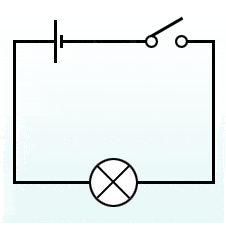
This circuit is .....?
a)
open
b)
parallel
c)
closed
d)
shows the flow of electricity
111.
When all parts of the circuit are connected, it is a ______ circuit. 
a)
open
b)
closed
112.
Which of these best completes the circuit?
a)
rubber band
b)
metal nail
c)
leather shoelace
d)
wooden toothpick
113.
Look at the picture.  Why won't the light bulb light up?
a)
The wires from the light bulb are not connected to the battery
b)
The switch is not closed to form a complete circuit 
c)
The wires from the light bulb are not connected to the switch 
d)
The wires from the battery are not connected to the switch 
114.
Pick the correct sentence.
a)
This circuit will work because it is a closed circuit.
b)
Energy will freely flow in this circuit.
c)
This circuit will not work because there is no energy source.
d)
This circuit will not work because there is no switch.
115.

A push moves things _______ .

a)

Close to you

b)

Away from you

116.

A pull moves things _______ .

a)

Close to you

b)

Away from you

117.
Climate or Weather?
New Hampshire recorded 12 inches of snow yesterday.
a)
Weather
b)
Climate
118.
Climate or Weather?
Florida had its hottest day so far this year at 97 degrees Fahrenheit.
a)
Climate
b)
Weather
119.
Climate or Weather?
It is usually mild during the winter in the southern states of the United States.
a)
Climate
b)
Weather
120.
Climate or Weather?
Oklahoma saw 2 tornadoes, 57 lightning strikes, 9 inches of rain, and high winds every day this week.

a)
Climate
b)
Weather