
 Worksheets
Thermodynamics
Total questions: 72
Worksheet time: 34mins

1200 J of heat are added to a sample of gas while the gas does 400 J of work on the environment. What is the change in internal energy of the gas?
800 J
1600 J
-800 J
-1600 J
During an adiabatic process, a sample of gas does 400 J of work on the environment. What change occurs with the internal energy of the gas?
The internal energy increases by 400 J.
The internal energy doesn't change.
The internal energy decreases by 400 J.
There is not enough information if we don't know how much heat was added or removed.

Process B on the PV diagram is an ______________ process.
adiabatic
isobaric
isochoric
isothermal
Specific Heat is..
the temperature initial minus temperature final
the amount of heat/energy required to raise 1 gram of a substance by 1°C (or K) aka "C"
the temperature final minus temperature initial
the item in a system with given weight in grams
The unit for specific heat
cal/gram degrees Celsius
degrees Celsius
Calories
A thermodynamic system where no exchange of heat takes place between system and surrounding is...
Isothermal process
Adiabatic process
Isobaric process
Isochoric process
In an adiabatic process, what equals zero?
Q
W
ΔU
T
Heat will never flow from a cold object to a hot object on its own describes which law of thermodynamics?
1st Law of thermodynamics
2nd Law of thermodynamics
3rd Law of thermodynamics
4th Law of thermodynamics
Whenever heat is added to a system, it transforms to an equal amount of some other form of energy describes which law of thermodynamics?
1st Law of thermodynamics
2nd Law of thermodynamics
3rd Law of thermodynamics
4th Law of thermodynamics
Which of the following is an intensive property of a thermodynamic system ?
(a) Volume
(b) Temperature
(c) Mass
(d) Energy.
During phase change ____________________ does not change.
pressure
temperature
work
volume

Isolated system can exchange------- with its surroundings.
only energy
both matter and energy
neither matter nor energy
Work and heat are ------function.
state
path
If work is done by the system, the energy of the system decreases, work is taken as--------
-w
+w
Which type of system is always used in the Laws of Thermodynamics?
Open Systems
Closed Systems
Isolated Systems
Skeletal System (obviously)
6. Area under P-V diagram gives
Heat
Internal energy
Work done
Temperature
A reaction has both positive ∆S° and ∆H° values. From this information alone, you can conclude that the reaction
can be spontaneous at any temperature.
cannot be spontaneous at high temperatures.
can be spontaneous only at low temperatures.
can be spontaneous only at high temperatures.
A certain non-spontaneous reaction has ∆H of 12.3 kJ and a ∆S of 42 J/K. At approximately what temperature would the reaction become spontaneous?
-20°C
0°C
20°C
100°C

The process which must be nonspontaneous at all values of temperature is
I.
II.
III.
IV.
Which of these four processes is nonspontaneous at low temperature but becomes more spontaneous as the temperature rises?
I.
II.
III.
IV.
The state of a gas can be described by quoting the relationship between
pressure, volume, temperature
temperature, amount, pressure
amount, volume, temperature
pressure, volume, temperature, amount
Which of the following variables controls the physical properties of a perfect gas
pressure
temperature
volume
all of the above
Intensive property of a system is one whose value
depends on the mass of the system, like volume
does not depend on the mass of the system, like temperature, pressure, etc.
is not dependent on the path followed but on the state
is dependent on the path followed and not on the state
Work done in a free expansion process is
+ ve
-ve
zero
maximum
An isolated system is one in which
mass does not cross boundaries of the system, though energy may do so
neither mass nor energy crosses the boundaries of the system
both energy and mass cross the boundaries of the system
mass crosses the boundary but not the energy
What is the meaning of open system?
No heat & mass transfer across boundary
Only heat transfer across boundary
Heat & mass transfer across boundary
Only mass transfer across boundary
Efficiency of Carnot engine depends on
Cylinder size
Source temperature
Type of gas
Sink temperature
Step two in Carnot engine is
Isothermal expansion
Isothermal compression
Adiabatic expansion
Adiabatic compression
According to Kelvin-Planck's statement of second law of thermodynamics,
it is impossible to construct an engine working on a cyclic process, whose sole purpose is to convert heat energy into work
it is possible to construct an engine working on a cyclic process, whose sole purpose is to convert heat energy into work
it is impossible to construct a device which operates in a cyclic process and produces no effect other than the transfer of heat from a cold body to a hot body
none of the above
Which of the following is the correct statement of the second law of thermodynamics?
It is impossible to construct an engine working on a cyclic process, whose sole purpose is to convert heat energy into work.
It is impossible to transfer heat from a body at a lower temperature to a higher temperature, without the aid of an external source
There is a definite amount of mechanical energy, which can be obtained from a given quantity of heat energy.
all of the above
The efficiency of Carnot cycle depends upon
temperature limits
pressure ratio
volume compression ratio
cut-off ratio and compression ratio
Value of gamma (cp/cv) for monaotomic gas is
1.44
1.67
2.09
1.34
If a system takes heat of 100 J and 100 J work is done on the system . The change in internal energy is
0
200
100
system gains 700 kJ of heat, change in internal energy of the system equal to 200 kJ. How much work is done?
+500
-500
900
-900
If external pressure is zero .the work done will be
Negative
Positive
Zero
In isochoric process work done is
Zero
-ve
+ve
An ideal gas confined in a box initially has pressure P. If the absolute temperature of the gas is doubled and the volume of the box is quadrupled, the pressure is
P/4
P/2
P/8
2P
P

A certain quantity of an ideal gas initially at temperature T0, pressure p0, and volume V0 is compressed to one-half its initial volume. As shown above, the process may be adiabatic (process 1), isothermal (process 2), or isobaric (process 3).
Which of the following is true of the mechanical work done on the gas?
It is greatest for process 1.
It is the same for processes I and 2 and less for process 3.
It is the same for all three processes.
It is the same for processes 2 and 3 and less for process 1.
It is greatest for process 3.
1. The entropy for irreversible process is always
Increases
Decreases
Zero
Remains constant
Exergonic reactions release energy and are ___
spontaneous (-ΔG)
non-spontaneous (+ΔG)
spontaneous (+ΔG)
non-spontaneous (-ΔG)
Endergonic reactions require energy and are ___
spontaneous (-ΔG)
non-spontaneous (+ΔG)
spontaneous (+ΔG)
non-spontaneous (-ΔG)
Which of the following is not the equation for adiabatic process
PVγ = Constant
PV = Constant
P1−γTγ= C. = constant.
A carnot engine operates between 227o C and 127o C. The efficiency of the engine is
10%
20%
40%
50%
what is specific heat at constant volume, cv ?
The energy required to raise the temperature of the unit mass of a substance by one degree as the volume is maintained constant.
The heat required to raise the temperature of the unit mass of a substance by one degree as the volume is maintained constant.
The energy required to raise the temperature of the unit volume of a substance by one degree as the volume is maintained constant.
cv
is related to the changes in internal energy.
TRUE
FALSE
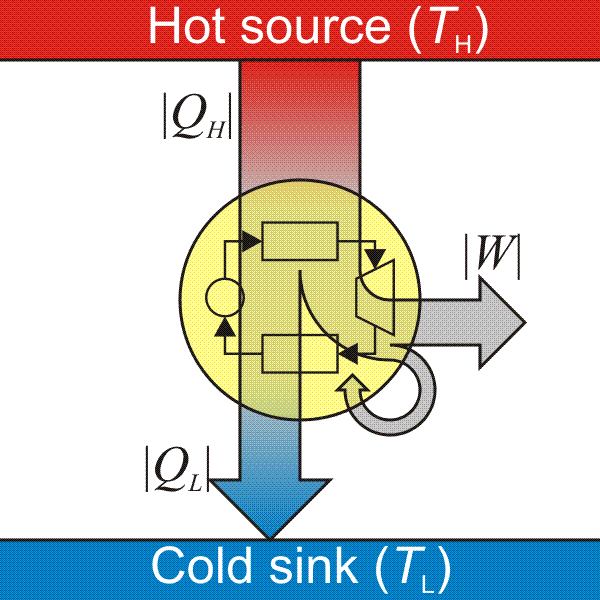
A heat engine
converts heat input to an equivalent amount of work
converts work to an equivalent amount of heat
takes heat in, does work, and loses energy heat
uses positive work done on the system to transfer heat from a low temperature reservoir to a high temperature reservoir
uses positive work done on the system to transfer heat from a high temperature reservoir to a low temperature reservoir

A Carnot cycle
is bounded by two isotherms and two adiabats on a p-V graph
consists of two isothermal and two constant volume processes
is any four sided process on a p-V graph
only exists for an ideal gas
has an efficiency equal to the enclosed area on a p-V diagram
A Carnot engine operates between 200°C and 20°C. Its maximum possible efficiency is
90%
100%
38%
24%
72%
A carnot engine whose low temperature reservoir is in 7 degree Celcius has an efficiency of 50%. It is desired to increase the efficiency to 70%. By how many degrees the temperature of high temperature reservoir be increased?
933.3 K
373,3 K
560 K
280 K
The high reservoir is in 100 degree celcius, and the low reservoir is in 10 degree celcius. The efficiency of this carnot engine is ....
75,9%
24,1%
90%
10%

If Carnot circle has high temperature reservoir is in 673 K and low temperature reservoir is 293 K. Determine the efficiency
43,5%
56,5%
12%
88 %
An engine has efficiency 75% and low temperature reservoir is in 27 degree celcius. Calculate the temperature of high temperature reservoir?
1200 K
927 K
400 K
177 K
207 K
H-TS is known as (a)
Efficiency of Carnot's Engine does not depends upon
Temperature of source
Temperature of sink
working substance
none of the above
What is "Entropy"?
The tendency of objects to warm up
The tendency of energy to spread out
The tendency of energy to make heat
The tendency of objects to do work
The properties associated with ____________ system are called thermodynamic properties
Microscopic system
homogeneous system
macroscopic system
all the above
State function has definite value for each state
True
False
Cyclic integral of inexact differential is
= 0
Exact differential follows
Eulers theorem
cyclic rule
both a and b
If one gram of the substance is considered, the heat capacity is known as
Entropy
Specific heat capacity
free energy
work
If one mole of the substance is considered, the heat capacity is known as
entropy
free energy
specific heat capacity
molar heat capacity
The internal energy change per degree rise of temperature
heat capacity at constant volume
heat capacity at constant pressure
heat capacity at constant temperature
All the above
The enthalpy change per degree rise of temperature
Heat capacity at constant volume
heat capacity at constant pressure
heat capacity at constant temperature
all the above
Cp is always
equal to Cv
Less than Cv
greater than Cv
equal to zero

