wayground logo

Free Printable Worksheets

NEW

Font size

S
M
L
XL
Worksheets

Intro Quiz Review Quizzizz

Total questions: 67

Worksheet time: 3hrs 9mins

Name
Class
Date
1.

100 Celsius is ? Kelvin (K = Celsius + 273)

a)

173 K

b)

373K

c)

273 K

d)

0 K

2.
Convert -89 oC to K
a)
184K
b)
362K
c)
-362K
d)
-184K
3.
Convert 300 K to oC
a)
27oC
b)
0oC
c)
-27oC
d)
573oC
4.
Convert 180oC to K
a)
453 K
b)
-93 K
c)
93 K
5.
The mass of an object is 30 g.  The volume is 5 mL.  What is the density of this object?
a)
6 g/cm
b)
6 g/mL
c)
6
6.
You are given the following information: mass = 48 g; volume = 24 cm3. What is the density of this substance? 
a)
2 g/cm3
b)
1,152 g/cm3
c)
0.5 g/cm3
d)
72 g/cm3
7.
If you have a gold brick that is 2 cm by 3 cm by 4 cm and has a density of 19.3 g/cm3, what is its mass?
a)
463.2 g/cm3
b)
463.2 g
c)
0.804 kg
d)
0.804 g
8.
What units are used to measure mass of an object?
a)
cm
b)
cm3
c)
g
d)
g/cm3
9.
What is the volume of Object X?
a)
10.0 cm3
b)
15.0 cm3
c)
20.0 cm3
d)
25.0 cm3
10.
If a block of wood has a density of 0.6 g/cm3 and a mass of 120 g, what is its volume?
a)
200 cm3
b)
0.005 cm3
c)
200.0 ml
d)
72 ml
11.
What is the volume of 150 grams of lead if it has a density of 11.3 g/cm3?
a)
13.3 g
b)
13.3 cm3
c)
.075 g
d)
1695 cm3
12.

What is the mass of a 25 cm3  liquid if it has a density of 5 g/cm3?

a)

125 g

b)

5 g

c)

5gcm3\frac{5g}{cm^3}  

d)

0.2 cm30.2\ cm^3  

13.

Which box has a higher density?

a)

A

b)

B

c)

They are the same

14.

Which of the following can be a unit for volume?

a)

cm^3

b)

mL

c)

neither

d)

both

15.

Which of the following are units used for mass?

a)

kg

b)

mg

c)

g

d)

All the above

16.

The density of a substance is 2.6 g/mL. If you cut it and half, what is the density of one of the halves?

a)

the same

b)

1.3g/mL

c)

5.2g/mL

d)

None of the above is correct

17.

The volume of water in a graduated cylinder is 50 mL. A marble is placed in the cylinder and the volume goes up to 52 mL. What is the density if the mass of the marble is 1 gram?

a)

1.0 g/mL

b)

1.04 g/mL

c)

2 g/mL

d)

.5 g/mL

18.
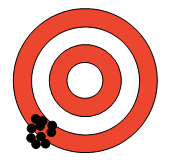
This bullseye demonstrates...
a)
High Accuracy & High Precision
b)
High Accuracy & Low Precision
c)
Low Accuracy & High Precision
d)
Low Accuracy & Low Precision
19.
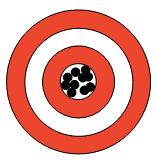
?
a)
High Accuracy & High Precision
b)
High Accuracy & Low Precision
c)
Low Accuracy & High Precision
d)
Low Accuracy & Low Precision
20.
The attendance for the basketball game was estimated to be 15,000 people but 12,500 people attended. What was the percent error?
a)
16.67%
b)
20%
c)
2500%
d)
80%
21.

The students measured length during a science experiment, they got 12 cm. But the actual measurement was 14.25 cm. What was the percent error?

a)

15.79%

b)

18.75%

c)

2.25%

d)

18%

22.

The deer population is estimated to be 17,600 in northern Illinois, but an actual count was 21,300. What is the percent error?

a)

21%

b)

17.37%

c)

17.4%

d)

21.02%

23.
Jessie estimates the weight of her cat to be 8 pounds.  The actual weight of the cat was 10 pounds.  Find the percent error.  
a)
15%
b)
20%
c)
25%
d)
30%
24.
The difference between an experimental value and an accepted value
a)
graph
b)
density
c)
percent error
d)
error
25.

Density was calculated in an experiment and was found to be 86 g/cm3. The actual density was 78 g/cm3. What is the percent error?

a)

12%

b)

10%

c)

8%

d)

6g/mL

26.

Heather performs an experiment to measure the acceleration of an object due to Earth’s gravitational force and discovers the acceleration of an object is 10.91 m/s. The actual acceleration of the object is 9.80 m/s. What is Heather’s percent error?

a)

0.11%

b)

1.11%

c)

11.33%

d)

10.17 m/s

27.

Arlo performs an experiment for his physical science class and finds that the gravitational acceleration due to the Earth is 9.0 m/s2. The actual value is 9.8 m/s2. What is the percent error in Arlo’s measurement?

a)

8.2%

b)

-8.2%

c)

-9.0m/s2

d)

9.4%

28.
Convert from meters to cm:  9 meters
a)
900 cm
b)
90 cm
c)
0.9 cm
d)
0.09 cm
29.
Convert 17 m to cm:
a)
0.17 cm
b)
0.017 cm
c)
1,700 cm
d)
170 cm
30.
Convert 300 meters to centimeters:
a)
3000 cm
b)
0.3 cm
c)
30,000 cm
d)
3 cn
31.
Convert 300 cm to m:
a)
3 m
b)
30 m
c)
0.3 m
d)
0.03 m
32.
240 cm = ___________ m
a)
2400
b)
24
c)
2.4
d)
0.24
33.
Is 20 g greater than, less than, or equal to 2 kg?
a)
greater than
b)
less than
c)
equal to
34.
 68 cm = ___________ mm
a)
0.68
b)
6.8
c)
68
d)
680
35.
 1234 mg = ___________ kg
a)
0.0001234
b)
0.001234
c)
0.01234
d)
0.1234
36.
55 mm = ___________ cm
a)
0.55
b)
5.5
c)
550
d)
5,500
37.

What is 78.5 rounded to one significant figure?

a)

79

b)

78.5

c)

70

d)

80

38.

Round 0.010229 to four significant figures

a)

1022

b)

1023

c)

0.01023

d)

0.01022

39.

What is 0.658 rounded to 1 significant figure?

a)

0

b)

0.66

c)

0.7

d)

0.658

40.

What is 7.555 rounded to two significant figures?

a)

7.6

b)

7.5

c)

70

d)

76

e)

7.60

41.
Round 1235 to 2 significant figures.
a)
12
b)
1200
c)
1200.
d)
1200.00
42.

What is 7.555 rounded to two significant figures?

a)

7.6

b)

7.5

c)

70

d)

76

e)

7.60

43.

Round 1099 to three significant figures.

a)

1.10 x 10³

b)

101

c)

1010

d)

1,000

e)

1100

44.
Round 7256.320004 to 8 significant figures.
a)
7256.3200
b)
7256.0000
c)
72563200
d)
72560000
45.

How many significant figures does the following number have?1.2500 x 10310^3  

a)
5
b)
3
c)

Ambiguous: 3 or 5

d)

7

46.
How many Significant Figures in the number below?
4.56 x 10³
a)
5
b)
4
c)
6
d)
3
47.
How would you write 564,000,000 in scientific notation?
a)
5.64 x 10⁻⁷
b)
5.64 x 10⁶
c)
5.64 x 10⁸
d)
56.4 x 10⁷
48.

How many significant figures are in the number? 4.06 x 10⁻⁵ m

a)

3

b)

7

c)

5

d)

unknown

49.

What is the correct answer for: 1.31 cm x 2.3 cm

a)

3.013

b)

3.01

c)

3.02

d)

3.0

50.

What is the correct answer for: 20.2 cm ÷ 7.41 s

a)

2.726045884

b)

2.72604

c)

2.73

d)

2.7

51.
Calculate 923 g ÷ 20312 cm3 and give your answer with the correct number of significant figures.
a)
0.04 g/cm3
b)
0.045 g/cm3
c)
0.0454 g/cm3
d)
0.05 g/cm3
52.
Calculate 1.23 m x 0.89 m and give your answer with the correct number of significant figures.
a)
1.0 m2
b)
1.1 m2
c)
1.0947 m2
d)
1.095 m2
53.
Calculate 7.987 m - 0.54 m and give your answer with the correct number of significant figures.
a)
7.45 m
b)
7.447 m
c)
7.4 m
d)
7.5 m
54.
Calculate 12.47 m ÷ 3.2 s and give your answer with the correct number of significant figures.
a)
4 m/s
b)
3.9 m/s
c)
3.90 m/s
d)
3.897 m/s
55.
Calculate 0.020 cm x 50 cm x 11.1 cm and give your answer with the correct number of significant figures.
a)
10 cm3
b)
11.1 cm3
c)
11 cm3
d)
11. cm3
56.
Which of the following numbers have four significant figures?
a)
56.75 g
b)
40.01 g
c)
0.6000 g
d)
all of the choices
57.
All of the following have one significant figure except:
a)
100 cm
b)
0.0001 cm
c)
2 cm
d)
2.00 cm
58.
calculate the following to the correct number of sig figs.
32.451 - 21.5
a)
11.0
b)
10.951
c)
11
d)
10.95
59.
Solve and round accordingly.
1.256 - 0.004 + 123.09 = ?
a)
100
b)
124.3
c)
124.34
d)
120
60.

If you divide 100 by 3.0, how many significant figures should the result have?

a)

1

b)

2

c)

3

d)

4

61.

When subtracting 15.5 from 20.00, how many decimal places should the answer have?

a)

3

b)

4

c)

2

d)

1

62.

Goggles are worn in the laboratory

a)

A. to avoid eye strain.

b)

B. to improve your vision

c)

C. only if you don’t have corrective glasses.

d)

D. any time chemicals, heat, or glassware are used.

63.

If you do not understand a direction or part of a lab procedure, you should—

a)

Figure it out as you do the lab

b)

Try several methods until something works

c)

ask the instructor before proceeding

d)

skip it and go on to the next part

64.

What should not be worn during specified experiments?

a)

Safety goggles

b)

Contact lenses

c)

Lab coat

d)

Gloves

65.

Ava accidentally dropped a glass in the kitchen. How should she handle the broken glass?

a)

Pick it up with bare hands

b)

Leave it on the floor

c)

Use a broom and dustpan

d)

Ask a friend to pick it up

66.

If you have been injured in a laboratory by a cut or burn, first you should—

a)

Visit the school nurse after class

b)

See a doctor after school

c)

Tell the science teacher at once

d)

Apply first aid to yourself

67.

If a harmful chemical splashes in your eyes or on your skin, you should—

a)

ignore it and hope it goes away.

b)

wipe it off with a paper towel and finish the lab.

c)

flush with water at the eyewash station or in the lab shower and tell the teacher.

d)

run to the bathroom.