
 Worksheets
8 Sci LEAP Part 2 (Units 4, 5, 6)
Total questions: 50
Worksheet time: 30mins

What is the ratio between carbon hydrogen, and oxygen in rubbing alcohol?
3:8
3:8:1
11:1
1:8:3

Gold was deposited when meteorites hit Earth. So...
it is found in the center of the Earth at the core.
it is found in gaseous form throughout the atmosphere.
it is found more in certain cities and countries than others.
it is found buried deep within the mantle.
Select the statements that describe the collection of nonrenewable resources.
A mountainous landmass is exploded to collect coal.
Cutting down trees reduces the available habitat for wildlife.
Energy from nuclear fusion in the sun is transformed into electrical energy.
A hole is dug deep within Earth’s surface to find gold ores.
An extraction technique is used to trap methane gas for use.

a and b are 10 map units apart
b and c are 2 map units apart
a and c are 8 map units apart
What is the order of genes on the chromosome from left to right?
b, a, c
c, a, b
a, c, b
a, b, c
__ is a code.
__ reads the code.
Ribosomes read the RNA and put __ together.
__ are formed from the amino acids.
RNA; DNA; amino acids; Proteins
DNA; RNA; Proteins; amino acids
DNA; RNA; amino acids; Proteins
RNA; DNA; Proteins; amino acids
The genetic code of an organism contained in chromosomes are dependent on the __ bases on its DNA.
sequence of
number of
size of
reactivity of
Insects and crabs are both animals that have a hard exoskeleton that develops during the larval stages of these organisms. Most insects live on land and crabs live in the water, so how is it possible that their larval stages show this relationship?
Both organisms have different ways of producing their shells from different materials.
All insects are born in the water and then move onto land.
Both organisms share a common ancestor that had the hard shell.
Crabs evolved from insects millions of years ago.

Any organ that, during the course of evolution, has become reduced in function -- and usually size.
homologous
analogous
vestigial
phenotypic

The theory of _ holds that populations of organisms change over time to become better suited to survive and reproduce in their specific environment.
Plate tectonics
Evolution
Pangaea
Unnatural selection

_ structures include traits that appear in several different organisms having similar arrangement and are good indicators that species are related and share a common ancestor.
vestigial
homologous
analogous
cryptic

The fact that whales have similar DNA is great evidence that all whales...
competed with one another.
evolved from separate ancestors.
have the same diet.
shared a common ancestor.

Many organisms share similar traits during their early _ development.
gastric
embryonic
abdominal
pelvic

What two characteristics allowed humans to use tools and advance their ability to survive?
a wide pelvis
a large brain capacity
large toes
opposable thumbs
small canine teeth

In an experiment, suppose that the wings of fruit flies were clipped short for fifty generations. The fifty-first generation emerged with normal-length wings. This observation would tend to disprove the idea that evolution is based on...
inheritance of natural variations.
inheritance of acquired characteristics.
natural selection.
survival of the fittest.

Three plants are shown in separate pots, each being given a different liquid. Plant A receives regular water. Plant B receives polluted water from the local river. Plant C receives polluted water from the ocean. A ruler is set up to measure the plants’ heights. A scientist sets up the following lab to test how water pollution affects the growth of plants. What is the dependent variable (outcome variable)?
the type of water
the type of pollution
the color of the plant
the growth of the plant

Which choice displays the correct order (1-5) of the genetic components?
cell, nucleus, chromosome, DNA, gene
nucleus, cell, chromosome, gene, DNA
cell, nucleus, gene, DNA, chromosome
gene, DNA, chromosome, nucleus, cell

According to the chart, a dog has the same number of chromosomes as what other organism?
cat
sheep
human
chicken
donkey

Which type of natural selection (which leads to speciation) is being displayed in the illustration?
stabilizing
disruptive
retroactive
directional
In a laboratory exercise in an eighth grade classroom, students tested beak mutations with 1/2 spoon, spoon, and fork variations. Each team used the simulated beaks to scoop rice, beans, or salt into a cup to represent the amount of food that could be delivered to the offspring. The amount of "food" for each was then weighed on a triple beam balance and recorded on a chart. Each 10 milligrams of food represented one offspring produced for that breeding season. After the trials, a graph was produced to display what type of selection was possible. Which two of the following statements would represent bad scientific procedure?
Teams scooped the sample with the simulation beaks in the exact same way for the same amount of time for every trial.
A team scooped salt in one trial, beans in a second trial, and salt in a third trial. they then recorded the weights of each.
A team made sure that the same person scooped food samples the same way in each of the trials.
A team of three allowed each member to control one of the beak samples in each of the trials so as to be fair.
The weights were all recorded in the same milligram unit for each food sample.

All other factors being equal, male moose with which antlers would in all likelihood have the strongest neck muscles?
A
B
C
D

The image shows the Great Ocean Conveyor Belt. Which best describes what this model represents?
how the density of water differs between the North Atlantic and other parts of the ocean.
how ocean currents change the salinity of water.
how ocean currents move thermal energy around Earth.
how the salinity of water affects its density.
What are renewable resources?
Resources that can be used up and cannot replenish themselves over time
Resources that cannot be used up and can replenish themselves over time
Non-living resources that are available in unlimited quantities
Man-made resources that are created for energy production
Which of the following is a characteristic feature of a covalent bond?
Transfer of electrons
Sharing of electrons
Attraction between opposite charges
High electrical conductivity in solid state
What is the primary mechanism of heat transfer in fluids such as air and water?
Conduction
Convection
Radiation
Insulation
What is the primary process by which thermal energy is transferred from the Sun to the Earth?
Conduction
Convection
Radiation
Insulation
In thermal equilibrium, which statement is true?
Objects are at different temperatures.
Heat flows from the cooler object to the warmer one.
No net heat flow between objects.
Only one object is at a constant temperature.
Which of the following best describes the concept of natural selection?
Organisms evolve based on use and disuse of organs.
Individuals with traits better suited to their environment are more likely to survive and reproduce.
Species spontaneously generate to fill ecological niches.
All organisms have an innate tendency to evolve towards complexity.
What evidence supports the theory of common descent?
The fossil record showing a progression of forms over time.
Direct observation of species changing over a single human lifespan.
Computer simulations predicting future evolutionary changes.
Philosophical arguments about the nature of life.
How do genetic mutations contribute to the process of evolution?
By ensuring that all individuals within a population are genetically identical.
By decreasing genetic diversity within a population.
By introducing new genetic variations that can be acted upon by natural selection.
By preventing species from adapting to changing environmental conditions.
Which of the following mechanisms explains how antibiotic resistance can spread through a bacterial population?
Genetic drift leading to uniform susceptibility.
Gene flow introducing resistance genes from other populations.
Natural selection favoring resistant individuals.
Artificial selection by human intervention.
What role do vestigial structures play in supporting the theory of evolution?
They demonstrate an organism's ability to adapt to new environments.
They are examples of optimal design in organisms.
They provide evidence of an organism's ancestral traits.
They show the immediate utility of all physical traits.
What is the maximum number of electrons that can occupy the second shell of an atom?
2
8
18
32

A species from which a modern species evolved.
descendant
offspring
ascendant
ancestor

A _ tree is a branching diagram showing the inferred evolutionary relationships among various biological species based upon similarities and differences in their physical or genetic characteristics.
cladograph
embryological
phylogenetic
character
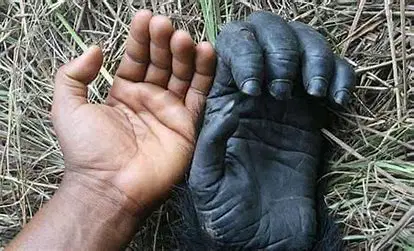
Approximately 2 million years ago our ancestor's genome experienced a mutation that produced an opposable thumb (great for gripping tools). The trait provided a major advantage for survival and reproduction. What type of trait would it be considered?
adaptive
neutral
non-adaptive
maladaptive

Histograms: the first histogram displays the starting population of a species of lizards. The lizards display a wide range of tail lengths that have equal numbers. The second histogram displays the lizard population after 50 years. Choose the explanation that best describes what has occurred to the second population.
Something in the environment favored the short tail length which allowed them to survive and reproduce.
Something in the environment favored none of the tail lengths which caused the population to go extinct.
Something in the environment favored the long tail length which allowed them to survive and reproduce.
Something in the environment favored the medium tail length which allowed them to survive and reproduce.
Something in the environment favored both short and long tail length, but not medium, which allowed them to survive and reproduce.
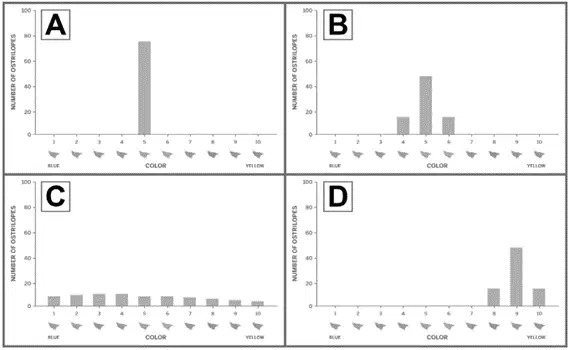
Which choice above would seem to indicate that the color of the organism did NOT provide an advantage for survival and reproduction?
A
B
C
D

Base your answer to the question on the diagram above, which shows insulated styrofoam cups of water connected by an aluminum bar. The thermometers show the temperatures of the cups A and B at the beginning of a heat flow experiment. Over the next 15 minutes, which changes would most likely occur?
The temperature in cup A will decrease and the temperature in cup B will increase.
The temperature in cup A will decrease and the temperature in cup B will decrease.
The temperature in cup A will increase and the temperature in cup B will increase
The temperature in cup A. will increase and the temperature in cup B will decrease.
The measure of the average kinetic energy of particles in an object is its
temperature
heat
thermal energy
hotness
A material that doesn’t allow heat to pass through it easily is a/an
conductor
insulator
metal
rock
The total kinetic and potential energy of all particles in an object is called...
mechanical energy
kinetic energy
potential energy
thermal energy

Based on the fossil layers shown, what can you infer about the past environment at this location?
The environment at this location has never changed
The organisms at this environment became simpler over time
The environment began as a dry land environment, then evolved into an ocean or water environment.
The environment began as an ocean or water environment, then evolved into a dry land environment.

If you brought sample A and B close together , in what direction would heat be transferred?
From sample A to sample B
From sample B to sample A
Heat would not be transferred.
sample A and sample B would both transfer heat to each other.
Thermal Energy depends upon the energy of the particles as well as the number of particles.
Which would have more thermal energy, a small cube of Ice at zero Celsius or a large cube of ice at zero Celsius?
The large ice cube because it has more particles than the small ice cube
The small cube of ice because it will melt faster than the large ice cube
Neither, they are cold so they do not have thermal energy
both have the same thermal energy because they are both at zero Celsius.

If a door was left open between the bedroom (74 degrees) and the living room (68 degrees), what would likely happen to the temperatures after several hours?
nothing, they would not change
both rooms would become hotter
both room would become colder
the bedroom temp. would lower and the living room temp. would rise

