
 Worksheets
Unit 7 Evolution Review GEN BIO
Total questions: 62
Worksheet time: 34mins
The difference in the physical trait of an individual from others in the group.
Variation
Natural selection
Speciation
Evolution
The formation of a new species.
Artificial selection
Speciation
Gene flow
Genetic drift
His theory on populations & competition helped Darwin develop his theory of Natural Selection.
Lyell
Wallace
Malthus
Lamarck
The study of embryology states that species with similar stages of development show _______.
Speciation
Convergent evolution
No relation at all.
Common ancestry
Species with large amounts of similar DNA sequences are considered _____ related to each other.
More
Less
No more or less
Which factor(s) increases genetic variation in populations? Select all that apply.
Mutations
Sexual reproduction
Gene flow
Genetic drift
Pelvises in whales & tail bones in humans are examples of which structure?
Vestigial structures
Homologous structures
Analogous structures
Forelimbs in quadrupeds
A random change in the DNA of an organism.
Natural selection
Mutation
Genetic drift
Gene flow
Which structures show common ancestry between species?
Analogous structures
Homologous structures
Vestigial organs
Alleles
Structures that appear similar on the outside but have a different origin.
Analogous structures
Homologous structures
Vestigial organs
Alleles
Changes in the DNA of species over time.
Natural selection
Artificial selection
Evolution
Populations
Which of the following is not an cause of reproductive isolation?
Geographical isolation
Behavioral isolation
Sexual reproduction
Mechanical isolation
A group of organisms on a cladogram that share a close common ancestor.
Gene pool
Mutation
Species
Clade
Chart that measures how groups of organisms relate to each other through evolution over time.
Cladogram
Clade
Population
Species
Process where organisms better adapted to the environment survive & produce more offspring.
Artificial selection
Sexual selection
Natural selection
Reproductive isolation
Reproductive isolation that is caused by different mating seasons or different awake schedules.
Mechanical isolation
Geographical isolation
Behavioral isolation
Temporal isolation
Reproductive isolation that occurs when two species are kept apart by their environment.
Mechanical isolation
Geographical isolation
Behavioral isolation
Temporal isolation
Structures that appear different on the outside but are similar on the inside are called _____.
Forelimbs
Analogous
Vestigial
Homologous
Wings in insects are birds are examples of which type of structures?
Analogous
Homologous
Vestigial
Alleles
Which structures indicate a common ancestor between two species?
Vestigial structures
Homologous structures
Analogous structures
Adaptations
Biological fitness is measured by how well an organism ___________ & ___________.
Reproduces & adapts
Adapts & overcomes
Survives & reproduces
Survives & adapts
True of false: An organism can acquire adaptations over a lifetime.
True
False

Which two organisms are more closely related?
Salamander and hagfish
Chimpanzee and lizard
Mouse and salamander
Hagfish and perch
Which of the following are evidence for evolution? Check all that apply
Embroylogy
Fossils
Molecular biology
Analogous structures
Biogeography
Evolution between 2 or more non-breeding species that have a close relationship with each other.
Coevolution
Natural selection
Divergent evolution
Convergent evolution
The appearance of apparently similar structures in organisms of different lines of descent.
Divergent evolution
Coevolution
Natural selection
Convergent evolution
The process by which a species evolves into two or more descendants or different forms.
Convergent evolution
Natural selection
Coevolution
Divergent evolution

What does a node represent?
A common ancestor.
A derived trait.
A branching point.
A modern species.
Variation in the physical traits of organisms that allow them to survive in their environment.
Mutations
Natural selection
Trait
Adaptations
Members of populations that can breed with each other in nature.
Reproductive isolation
Biological species concept
Mutatation
Natural selection
Hummingbirds have a beak just the right length to reach the nectar in a cardinal flower and as they feed their foreheads bump into the pollen structure. Cardinal flower’s pollen structure is just the right length for the hummingbird to pick up pollen as it feeds. Which type of evolution is this?
Convergent
Divergent
Adaptive radiation
Coevolution
The Galloti atlantica and Galloti galloti lizards evolved through natural selection from a common ancestor into a wide variety of different looking lizards. Which type of evolution is this?
Convergent
Divergent
Adaptive radiation
Coevolution
Whales, sharks, and penguins all have streamlined bodies and fins/flippers for moving in water even though they belong in different classes of animals (mammals, fish, and birds). Which type of evolution is this?
Convergent
Divergent
Adaptive radiation
Coevolution
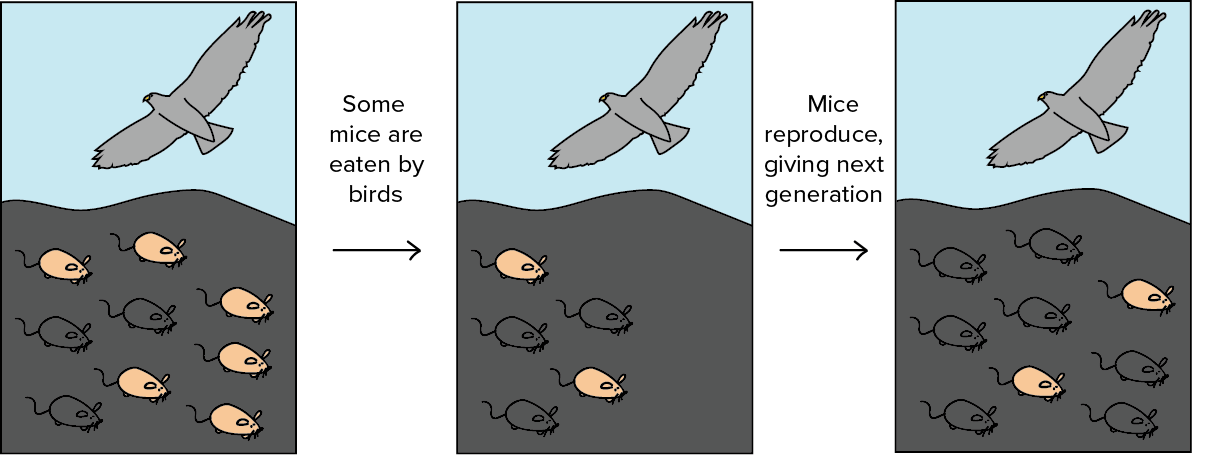
1. The process of choosing parent organisms for desired characteristics is called
natural selection
Artificial selection
random selection
genetic manipulation
What is an example of artificial selection?
Letting dogs choose their own mate
Letting plants pollinate on their own
Crossing a labrador and a poodle to create a labradoodle
The measure of an organism's ability to survive and produce offspring relative to other members of a population .
Biological Fitness
Which of the following are evidence for evolution? Select all that apply.
Fossil Record
Biogeography
Anatomical Structures
Embryology
Molecular Biology
All of the alleles for all the different genes in an population.
Gene Pool
Gene Flow
Genetic Drift
Allele Frequency
Frequency of an allele at a particular locus in a population, expressed as a fraction or percentage.
Gene Pool
Gene Flow
Genetic Drift
Allele Frequency
Body parts on different species that have similar internal structure but may be used for different purposes.
Homologous Structures
Analogous Structures
Vestigal Structures
Variation
Body parts on different species that have similar external use but do not have similar internal structure.
Homologous Structures
Analogous Structures
Vestigal Structures
Variation
Structures and/or organs present in modern species that no longer serve a function or purpose.
Homologous Structures
Analogous Structures
Vestigal Structures
Variation

The forelimbs in quadrupedal (4 limbed) animals is an example of...
Homologous Structures
Analogous Structures
Vestigial Structures
Variation

Wings in bats, birds, and butterflies are examples of...
Homologous Structures
Analogous Structures
Vestigial Structures
Variation

Hip and femur bones in whales and snakes are an example of...
Homologous Structures
Analogous Strucutres
Vestigial Structures
Variation
Which of the following were part of Darwin's/Wallace's Theory of Evolution? Select all that apply.
Populations have naturally occurring variation.
Populations produce more offspring than the environment can support.
Organisms compete for resources.
Organisms better suited for the environment will survive & pass their traits onto their offspring.
Populations do not change over time.
Random change in a population's gene pool that decreases genetic variation.
Natural Selection
Gene Flow
Artificial Selection
Genetic Drift
Type of genetic drift where a small group of organisms colonizes an area and starts a new, smaller, population.
Bottleneck Effect
Founder Effect
Sexual Selection
Natural Selection
Type of genetic drift caused by drastic reduction in population size due to natural disasters.
Bottleneck Effect
Founder Effect
Artificial Selection
Natural Selection
Natural selection arising through preference by one sex for certain characteristics in individuals of the other sex.
Artificial Selection
Sexual Selection
Genetic Drift
Gene Frequency

The science of describing, classifying, and naming living things is called:
Geology
Biology
Taxonomy
Chemistry
derived


Which species is most closely related to species C?
A
B
D

Which letter represents the most recent common ancestor of sponges and mushrooms?
A
B
C
D
E
Relative dating describes
The comparison of decay rates of radioactive isotopes.
The comparison of multiple layers of rock and the ages when they were deposited.
The analysis of the half-life of an isotope relative to carbon-12.
The analysis of one stratum of rock in isolation.
A radioactive isotope's half-life is defined as
The amount of time it takes for an element to lose 50% of its mass as heat.
The amount of time it takes for a 50% of a daughter isotope to decompose into the parent isotope.
The amount of time it takes for 50% of an element's original mass to decay into a more stable isotope.
Its abundance in 50% of rock layers that were deposited on Earth's observable surface.
What is Radiometric Dating?
Arrangement of geological events and rocks left behind in a sequence
Materials found on the rock surface that indicate its age
Observation of strata to comparatively determine their age
Technique used to numerically determine the approximate age of fossils or rocks

