wayground logo

Free Printable Worksheets

Font size

S
M
L
XL
Worksheets

Waves Review

Total questions: 103

Worksheet time: 1hrs 24mins

Name
Class
Date
1.
Mechanical waves are created when a source of energy causes a medium to...
a)
Move
b)
Expand
c)
Vibrate
d)
Compress
2.
Waves that move the particles of the medium parallel to the direction in which the waves are traveling are called
a)
Surface Waves
b)
Combination Waves
c)
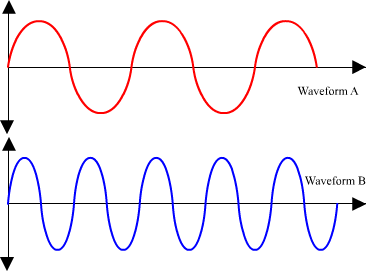
Longitudinal Waves
d)
Transverse Waves
3.
What occurs when vibrations traveling through an object match the object’s natural frequency?
a)
Refraction
b)
Reflection
c)
Diffraction
d)
Resonance
4.
The maximum distance that the particles of a medium move from the rest position is the
a)
Wavelength of the Wave
b)
Frequency of the Wave
c)
Amplitude of the Wave
d)
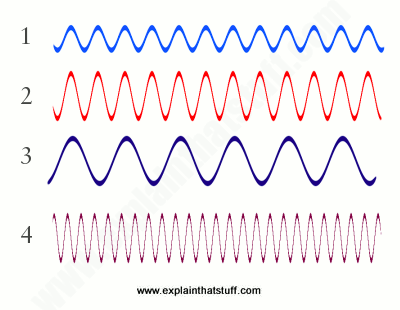
Speed of the Wave
5.
The distance between two corresponding parts of a wave is the wave’s
a)
Wavelength
b)
Frequency
c)
Amplitude
d)
Speed
6.
The interaction between two waves that meet is called
a)
refraction
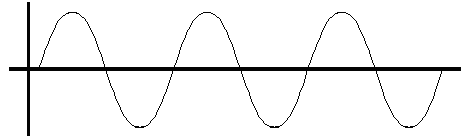
b)
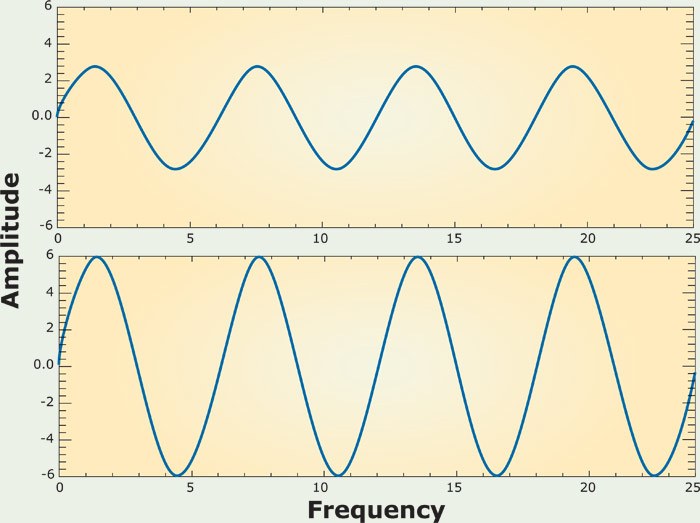
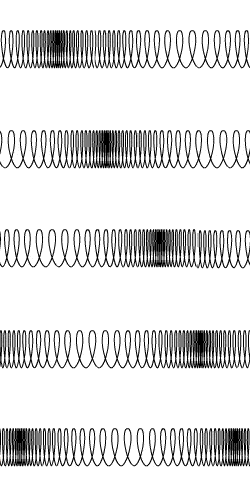
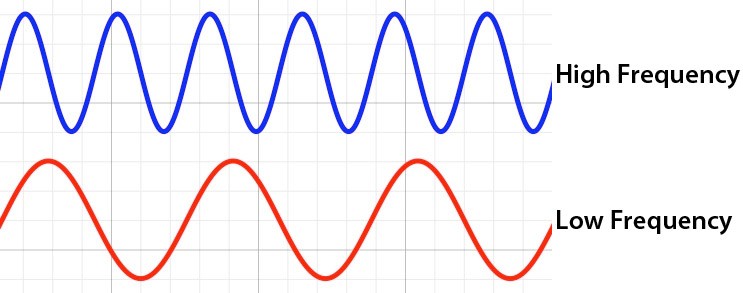
reflection
c)
diffreaction
d)
interference
7.
The speed of a wave is its wavelength multiplied by its
a)
Vibration
b)
Frequency
c)
Amplitude
d)
Reflection
8.
Why do you see lightning from a distant storm before you hear thunder?
a)
Your eyes react faster than your ears
b)
Light travels faster than sound
c)
The thunder is produced after the lightening
9.
Mechanical waves are classified according to
a)
how they move
b)
their source
c)
their shape 
d)
their size
10.
The crests and troughs of a standing wave are called ____________________.
a)
wavelength
b)
energy
c)
antinodes
d)
rarefaction
11.
As the frequency of a wave traveling at constant speed increases, its ____________________ decreases.
a)
wavelength
b)
amplitude
c)
speed
d)
reflection
12.
The more ____________________ a mechanical wave has, the greater its amplitude.
a)
reflection
b)
energy
c)
speed
d)
frequency
13.

A wave bending as it passes a point of land is an example of refraction

a)

True

b)

False

14.

In transverse waves, the particles of the medium move at right angles to the direction in which the wave is traveling

a)

True

b)

False

15.

Waves that require a medium through which to travel are called

electromagnetic waves.

a)

True

b)

False

16.

How can you measure the wavelength of a transverse wave?

a)

crest to crest

b)

amplitude

c)

frequency of the wave in a given time

d)

Speed

17.
What does this diagram represent?
a)
Diffraction
b)
Reflection
c)
Interference
d)
Refraction
18.
Why do green plants look green?
a)
Reflect blue and yellow wavelengths
b)
Absorb green wavelengths
c)
Transmit green light
d)
They reflect green wavelengths of the visible spectrum
19.
Which of the following would reflect rather than refract? 
a)
Magnifying Glass
b)
Lens
c)
Mirror
d)
Prism
20.
A substance or material that carries a wave.
a)
Medium
b)
Amplitude
c)
Crest
d)
Mechanical Wave
21.
Waves consist entirely of ?
a)
Energy
b)
Water
c)
Light
d)
Sound
22.
What is the top of a wave called?
a)
Crest
b)
Trough
c)
Amplitude
d)
Wavelength
23.
What is the bottom of a wave called?
a)
Crest
b)
Trough
c)
Amplitude
d)
Wavelength
24.
The distance between on crest/trough and the other crest/trough is called?
a)
Wavelength
b)
Amplitude
c)
Wave Speed
d)
Frequency
25.
What type of waves don't require a medium?
a)
Electromagnetic Waves
b)
Seismic  Waves
c)
Mechanical Waves
d)
Ocean Wave
26.
What is the bending of waves called?
a)
Refraction
b)
Diffraction
c)
Wave
d)
Medium
27.
When light, sound, or heat bounces off a surface that does not go through.
a)
Interference
b)
Doppler Effect
c)
Reflection
d)
Refraction
28.
A change in frequency of a wave for an observer moving relative to its source?
a)
Doppler Effect
b)
Interfernce
29.
What is interference?
a)
The combining of two waves to form a single wave.
b)
The combining of crests.
c)
The combining of troughs. 
30.
What is the measure of how many waves pass a point in a certain amount of time?
a)
frequency
b)
wavelength
c)
midpoint
d)
crest and trough
31.
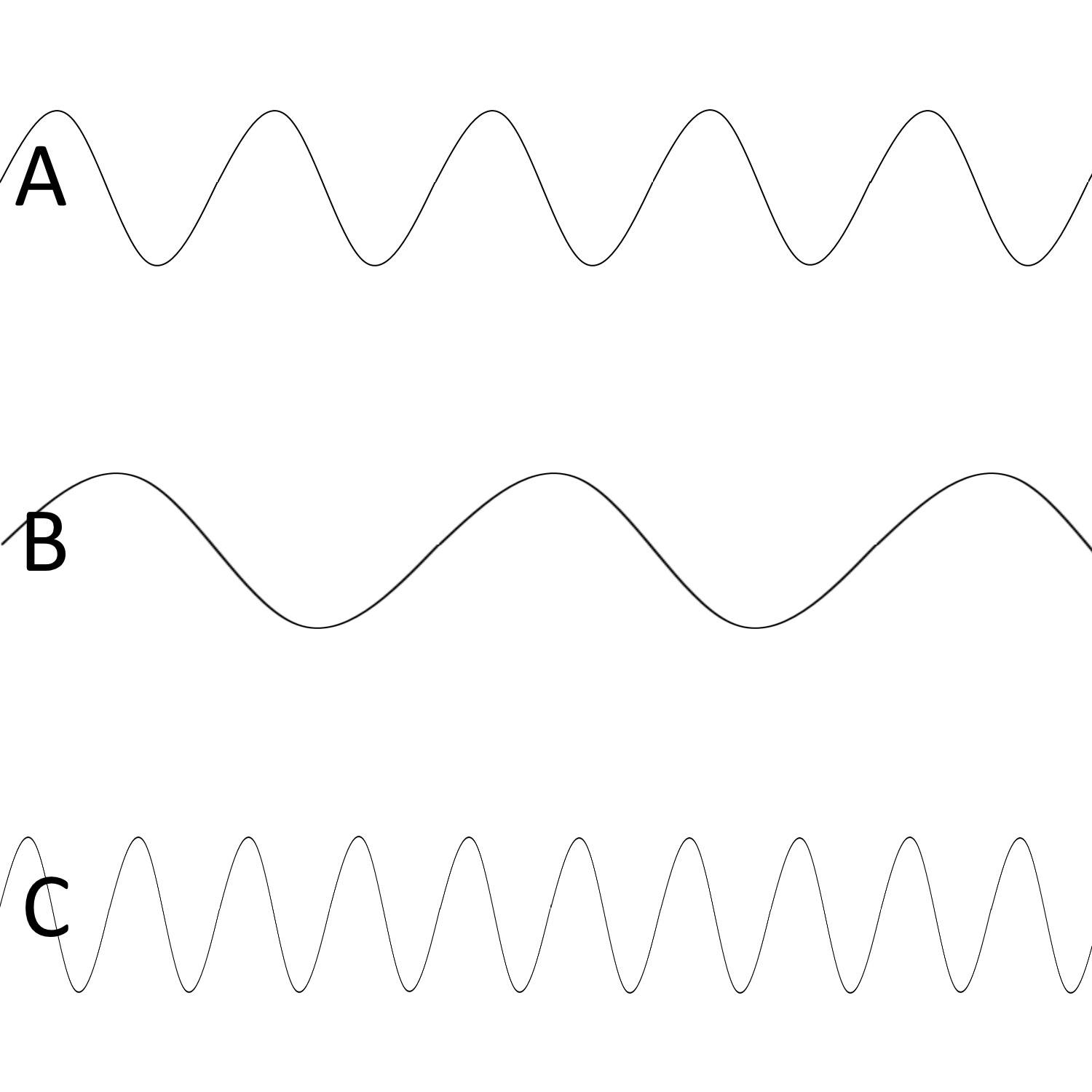
Which wave has a greater frequency?
a)
A
b)
B
32.
Which letter represents amplitude?
a)
A
b)
B
c)
C
d)
D
33.
What is this called?
a)
refraction
b)
reflection
c)
reconstroction
d)
retraction
34.
Why does the lower part of the child appear so much different in size from the upper part?
a)
The light rays that travel through water and then into air are refracted.
b)
The light rays that travel through water and then into air are enlarged.
c)
The light rays that travel through air and then into water are reflected.
d)
The light rays that travel through air and then into water are reduced.
35.
Does the frog reflect or absorb green?
a)
Reflect
b)
Absorb
36.

A _________ forms when the path of light is blocked?

a)

sun

b)

circle

c)

line

d)

shadow

37.

The change in ________ of light causes it to bend

a)

speed

b)

distance

c)

length

d)

color

38.

Materials that let some of the light pass through is?

a)

transparent

b)

opaque

c)

clear

d)

translucent

39.

Materials that let the most light pass through are?

a)

translucent

b)

opaque

c)

transparent

d)

dark

40.
The pictures shows what a student observed when he looked through a hand lens at a penny.
What happens to light passing through a hand lens that makes the image of the penny appear larger? The light is-
a)
absorbed
b)
reflected
c)
refracted
d)
stopped
41.

How is wavelength measured?

a)

From trough to crest (B to D)

b)

From the center line to the crest (B to C)

c)

From the crest of one wave to the crest of the next (B to F)

d)

From one end of the wave to the far end of the wave (A to H)

42.
True or False: 
Frequency is how many waves pass per second. 
a)
True
b)
False
43.
If you increase frequency what happens to the wavelength?
a)
Wavelength increases
b)
Wavelength decreases
c)
Wavelength remains the same
44.
When amplitude is increased how will it effect a light wave?
a)
Increase fequency
b)
Increased brightness
c)
Increases volume
d)
Decreases brightness 
45.

How do you measure amplitude?

a)

From the bottom of a wave to the top of a wave

b)

From the middle of a wave to the top of a wave

c)

From the crest of one wave to the crest of the next wave

d)

From the beginning to the end of the wave

46.
The interaction between two waves that meet is called
a)
reflection
b)
refraction
c)
diffraction
d)
interference
47.
why can't sound travel through a vacuum?
a)
there is no matter in a vacuum
b)
the wavelength is too long
c)
the amplitude is too high
d)
a vacuum is too hot
48.
Mechanical waves are created when a source of energy causes a medium to
a)
move
b)
compress
c)
expand
d)
vibrate
49.
What occurs when vibrations traveling through an object match the object's natural frequency
a)
reflection
b)
refraction
c)
diffraction
d)
resonance
50.
What type of wave is a sound wave?
a)
high frequency
b)
compressional
c)
low frequency
d)
surface
51.

echos are created when sound waves are _________

a)

absorbed

b)

reflected

c)

compressed

d)

transmitted

52.
When the frequency of a wave increases, what happens to the wavelength?
a)
The wavelength is not directly affected by the frequency of a wave.
b)
The wavelength increases.
c)
The wavelength decreases.
d)
More specific information is needed to form a conclusion about the wavelength.
53.

Which wave has the shortest wavelength?

a)

1

b)

2

c)

3

d)

4

54.

Which wave has highest frequency?

a)

A

b)

B

c)

C

d)

D

55.

Which of these waves has the smallest amplitude?

a)

P

b)

Q

c)

S

d)

T

56.

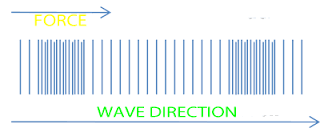
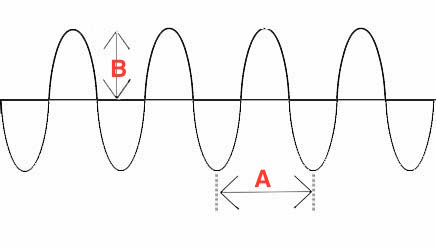
Which statement is correct about the wave shown in the diagram?

a)

It is a transverse wave because the particles are moving perpendicular to the motion of the wave.

b)

It is a transverse wave because the particles are moving parallel to the motion of the wave.
c)

It is a longitudinal wave because the particles are moving perpendicular to the motion of the wave.

d)

It is a longitudinal wave because the particles are moving parallel to the motion of the wave.
57.
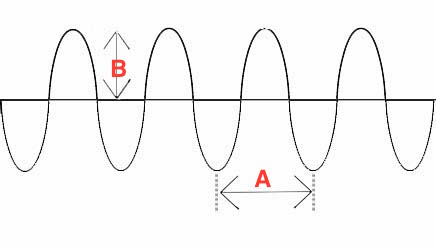
What property of this wave is represented by the letter "A"
a)
amplitude
b)
crest
c)
trough
d)
wavelength
58.
What property of the wave is represented by the letter "B"?
a)
amplitude
b)
crest
c)
trough
d)
wavelength
59.

The red dot represents the _____.

a)

trough

b)

crest

c)

frequency

d)

amplitude

60.

The red dot represents the _____.

a)

trough

b)

crest

c)

frequency

d)

amplitude

61.

The green line represents the _____.

a)

amplitude

b)

wavelength

c)

frequency

d)

crest

62.

The yellow section represents the _____.

a)

amplitude

b)

wavelength

c)

crest

d)

trough

63.

True or False:

The higher the amplitude, the lower the amount of energy.

a)

True

b)

False

64.

Which graph shows the wave with the greatest amplitude?

a)

A

b)

B

c)

C

d)

D

65.

Which graph shows the wave with the shortest wavelength?

a)

A

b)

B

c)

C

d)

D

66.
What type of waves don't require a medium?
a)
Electromagnetic Waves
b)
Seismic  Waves
c)
Mechanical Waves
d)
Ocean Wave
67.
Which letter represents amplitude?
a)
A
b)
B
c)
C
d)
D
68.
What type of wave is this?
a)
Longitudinal
b)
Transverse
69.
Which property of these waves differs?
a)
Frequency
b)
Wavelength
c)
Amplitude
d)
Pitch
70.
Which waves do NOT need a medium?
a)
Sound
b)
Ocean
c)
Seismic
d)
Light
71.
A high energy wave is considered to have a high 
a)
amplitude
b)
frequency
c)
wavelength
d)
period
72.
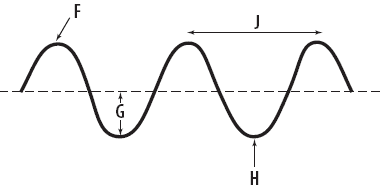
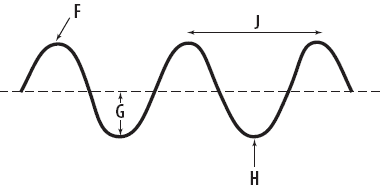
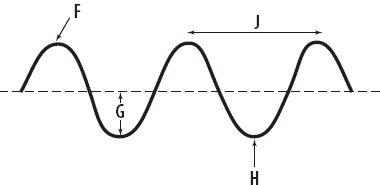
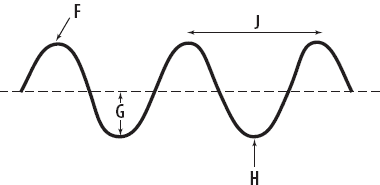
Which letter is a crest?
a)
F
b)
G
c)
H
d)
J
73.
What type of waves have compressions and rarefactions?
a)
longitudinal
b)
transverse
74.
Which letter is a trough?
a)
F
b)
G
c)
H
d)
J
75.
Which letter shows amplitude?
a)
F
b)
G
c)
H
d)
J
76.
Which letter identifies the wavelength?
a)
F
b)
G
c)
H
d)
J
77.
What type of wave is this?
a)
Longitudinal
b)
Transverse
78.
Which wave has the highest frequency?
a)
1
b)
2
c)
3
d)
4
79.
Frequency is
a)
Amount of time it takes for one wavelength
b)
How many wavelengths are completed in one second
c)
Distance between two crests or two troughs
d)
Amount of energy in a wave
80.
What is the material waves travel through?
a)
Period
b)
Frequency
c)
Medium
d)
Hertz
81.
Which part of a longitudinal wave is where particles are packed closely together?
a)
compression
b)
rarefaction
c)
crest 
d)
amplitude
82.
What do all waves transfer?
a)
Light
b)
Sound
c)
Heat
d)
Energy
83.
Frequency is measured in
a)
Newtons
b)
Joules
c)
Hertz
d)
Decibels
84.
Which is the correct equation for calculating the speed of a wave?
a)
T = 1/f
b)
Speed= Wavelength x Period
c)
Speed = Wavelength/Frequency
d)
Speed= Wavelength x Frequency
85.
A period is
a)
Amount of time it takes a wavelength to complete one cycle.
b)
How many wave lengths happen in a second.
c)
An indication of the amount of energy in a wave.
d)
The distance between two crests or two troughs.
86.
Sound travels best through
a)
solids
b)
liquids
c)
gases
d)
colloids
87.
These waves have the same
a)
amplitude
b)
frequency
c)
period 
d)
wavelength
88.
Which wave has the largest wavelength?
a)
A
b)
B
c)
C
d)
None (same wavelength)
89.
Which wave has the largest frequency?
a)
A
b)
B
c)
C
d)
None (same frequency)
90.
If all three are waves of light, which wave has the largest speed?
a)
A
b)
B
c)
C
d)
None (same speed)
91.

Which particle is a wave of light?

a)

proton

b)

neutron

c)

electron

d)

photon

92.
Which type of light has the lowest energy of this group?
a)
Radio
b)
Microwave
c)
Infrared
d)
Ultraviolet
93.
Which type of light has the largest wavelength of this group?
a)
X-rays
b)
Microwave
c)
Infrared
d)
Ultraviolet
94.
Which type of light has the highest energy of this group?
a)
red
b)
yellow
c)
green
d)
blue
95.
Which type of light has the smallest frequency of this group?
a)
red
b)
yellow
c)
green
d)
blue
96.
When an electron absorbs a photon of light, it also...
a)
gains positive charge
b)
gains negative charge
c)
increases energy level
d)
decreases energy level
97.
When an electron emits a photon of light, it also...
a)
gains positive charge
b)
gains negative charge
c)
increases energy level
d)
decreases energy level
98.

Radio waves and _______ are used in communication

a)

Microwaves

b)

Gamma rays

c)

Visible light

d)

Ultraviolet

99.
This color in the visible part of the spectrum has the lowest energy. 
a)
Blue
b)
Green
c)
Red
d)
Violet
100.
This color in the visible part of the spectrum has the highest energy.
a)
Blue
b)
Red
c)
Violet
d)
Yellow
101.
This color in the visible part of the spectrum has the smallest wavelength.
a)
Blue
b)
Red
c)
Violet
d)
Yellow
102.
This color in the visible part of the spectrum has the largest frequency.
a)
Orange
b)
Yellow
c)
Blue
d)
Green
103.

The following path of an electron emits a light wave that our eyes can detect.

a)

Ground -> Excited

b)

Excited -> Ground

c)

One full orbit of the nucleus

d)

Protons emit light. The question is misleading.