
 Worksheets
Kinetics and equilibrium Practice
Total questions: 37
Worksheet time: 40mins
A reaction is most likely to occur when reactant particles collide with
proper energy, only
proper orientation, only
both proper energy and proper orientation
neither proper energy nor proper orientation
Copper catalyses the reaction between zinc and dilute sulfuric acid.
Zn(s) + H2SO4(aq) → ZnSO4(aq) + H2(g)
Why does copper affect the reaction?
Decreases the activation energy
Increases the activation energy
Increases the enthalpy of reaction
Decreases the enthalpy of reaction
According to collision theory, particles must collide with ____ and ____ for a reaction to occur.
sufficient rate and sufficient energy
sufficient surface area and correct orientation
sufficient catalyst and sufficient energy
sufficent energy and correct orientation
More collisions correspond to a:
faster reaction rate
slower reaction rate
unchanged reaction rate
Which of the following would lead to a slower reaction rate?
Place the reactants in hot water
Place the products in an ice bath
Place the reactants in an ice bath
Stirring the reactants with a stirring rod
SO2 + O2 ↔ SO3
If the equilibrium shifts to the right, the concentration of O2 will ___________.
SO2 + O2 ↔ SO3
If the concentration of SO2 is increased, the equilibrium of the reaction will shift ___________.↔
SO2 + O2 ↔ SO3
If the equilibrium shifts to the right, the concentration of SO3 will ___________.
heat + N2 + O2 ↔ 2NO
If O2 is removed, the concentration of N2 will _______.
heat + N2 + O2 ↔ 2NO
If the heat is added to the chemical system, the equilibrium will shift _______.
heat + N2 + O2 ↔ 2NO
If the heat is removed to the chemical system, the equilibrium will shift _______.
H2 (g) + Cl2 (g) ↔ 2HCl (g) + heat
If the temperature is cooled, the _________ reaction will be favored.
N2 (g) + 3 H2 (g) ↔ 2 NH3 (g)
If the pressure in the system is increased, _______ reaction will be favored.
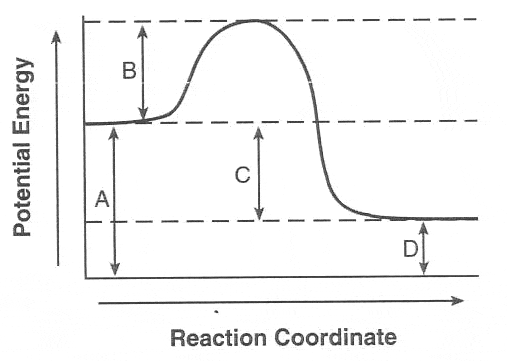
The forward reaction points towards the __________.
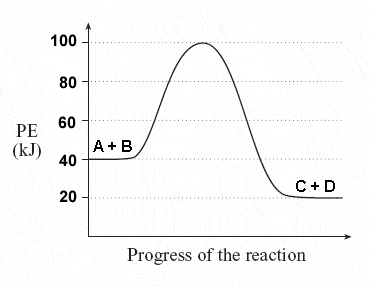
What is the change of the heat of the reaction (ΔH)?
40 kJ
20 kJ
-20 kJ
-40 kJ

A solution at equilibrium must be
concentrated
saturated
unsaturated
diluted
At STP, which 4.0-gram zinc sample will react fastest with dilute hydrochloric acid?
sheet metal
powdered
bar
granules

Which quantity can be changed by the use of a catalyst?
I and II only
I and III only
II and III only
I, II and III

Which graph best represents the relationship between the average kinetic energy of molecules of a gas and temperature in K?
A
B
C
D
Consider the reaction between gaseous iodine and gaseous hydrogen.
I2(g) + H2(g) ⇄ 2 HI(g) ΔH∅=-9 kJ
Why do some collisions between iodine and hydrogen not result in the formation of the product?
The I2 and H2 molecules do not have sufficient energy.
The system is in equilibrium.
The temperature of the system is too high.
The activation energy for this reaction is very low.
2Mg(s) + O2 (g) −> 2MgO(s).
The reaction begins because the reactants
Compared to the rate of inorganic reactions, the rate of organic reactions generally is
slower because organic particles are ions
slower because organic particles contain covalent bonds which take a long time to break
faster because organic particles are ions
faster because organic particles contain covalent bonds
What will happen if a catalyst is added to the system at equilibrium?
A + B <--> AB
The equilibrium concentration of AB will increase.
The equilibrium concentration of AB will decrease.
The rates of the forward and reverse reactions will change.
The equilibrium constant for the reaction will change.

