wayground logo

Free Printable Worksheets

Font size

S
M
L
XL
Worksheets

Life Science Review

Total questions: 54

Worksheet time: 2hrs 0mins

Name
Class
Date
1.

Herbivores only gain their energy by consuming animals.

a)

True

b)

False

2.

An organism that gains its energy from consuming producers and consumers is a(n) _________.

a)

Producer

b)

Consumer

c)

Decomposer

d)

Omnivore

3.

What level consumer is the hawk?

a)

Primary

b)

Secondary

c)

Tertiary

d)

Quaternary

4.

Why is the sun so important to life?

a)

It allows animals to see and play.

b)

It provides the original source of energy it most ecosystems.

c)

It gives off heat that causes things to energize.

d)

Life doesn't need the sun.

5.

As a rule, about _____% of energy makes it to the next trophic level in any given energy pyramid.

a)

10

b)

20

c)

40

d)

80

6.

What are the products of photosynthesis?

a)

Oxygen and Hydrogen

b)

Oxygen and ATP

c)

Oxygen and Glucose

d)

Oxygen and Carbon Dioxide

7.

What are the products of Cellular Respiration?

a)

Oxygen and Glucose

b)

Oxygen, Water, ATP (energy)

c)

Carbon Dioxide, Water

d)

Carbon Dioxide, Water, ATP (energy)

8.

Which of the following is an abiotic factor in the environment? Choose all that apply.

a)

Sun

b)

Water

c)

Plants

d)

Weather

9.
What structures distinguish a plant cell from an animal cell?
a)
Plant cells have cell walls and ribosomes.
b)
Plant cells have cell walls and chloroplasts.
c)
Plant cells have chloroplasts and ribosomes.
d)
Plant cells have chloroplasts and mitochondria.
10.
The Cell Theory states...
a)
atoms create all matter
b)
living things evolve
c)
the cell is the backbone of all matter
d)
cells are the basic unit of structure and organization of organisms
11.
Which statement is a part of the cell theory?
a)
all cells come from preexisting cells
b)
bacteria are prokaryotic cells
c)
eukaryotic cells are complex
d)
humans are multicellular
12.
In what organelle is the genetic material found inside?
 
a)
Endoplasmic Reticulum
b)
Golgi Complex
c)
Ribosomes
d)
Nucleus
13.
What is the function of the vacuole?
a)
Sac that stores water, nutrients, and waste products
b)
Sac filled with digestive chemicals
c)
Jelly-like substance within the plasma membrane
d)
stack of membranes that packages chemicals
14.
having two of the same genes for the trait (sometimes called purebred).
a)
homozygous
b)
hetrozygous
c)
protein
d)
chromosome
15.
having two different genes for a trait (sometimes called hybrid).
a)
protein
b)
homozygous
c)
heterozygous
d)
genotype
16.
G = green, g = yellow
The genotype for a yellow plant is...
a)
GG
b)
Gg
c)
gg
d)
all of the choices result in yellow
17.

The Eukarya Domain has which organisms?

a)

Bacteria that causes diseases

b)

Bacteria found in volcanoes

c)

plants, animals., fungi and protists

d)

none of the above

18.

Autotrophs

a)

Make their own food

b)

Get their food from others

c)

are Fungi

d)

are none of the above

19.

Heterotrophs

a)

make their own food

b)

get their food from others

c)

are fungi

d)

none of the above

20.

Multicellular organisms belong in which kingdom?

a)

Archaebacteria

b)

Fungi

c)

Protist

d)

Eubacteria

21.

Which Kingdom is the virus in?

a)

Protists

b)

Animalia

c)

Fungi

d)

It is not in a kingdom because it isn't living.

22.

Which domain has organisms that live in extreme environments (vocanoes, Yellowstone hot pools, deep under water with no light)

a)

Eubacteria

b)

Archae

c)

Eukarya

d)

No organism can live in those conditions

23.

What is a cell boundary that controls what enters and leaves the cell?

a)

Cell Membrane

b)

Central Vacuole

c)

Ribosomes

d)

Plasmids

24.

Two kingdoms that contain cells that are prokaryotic.

a)

Archaebacteria

b)

Eubacteria

c)

Protista

d)

Fungi

25.
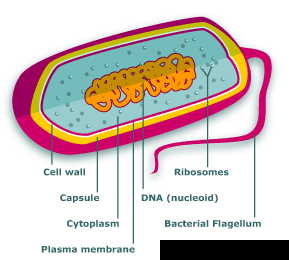
Which type of cell?
a)
Prokaryote
b)
Eukaryote
26.
Which type of cell?
a)
Prokaryote
b)
Eukaryote
27.
A single-celled organism that lacks a membrane-bound nucleus, mitochondria, or any other membrane -bound organelle .
a)
Prokaryote
b)
Eukaryote
c)
Nucleus
d)
Single-celled organism
28.
oxygen is a gas produced by _ and used by  _ 
a)
plants and animals 
b)
photosynthesis and carbon dioxide 
c)
animals and plants 
d)
carbon dioxide and photosynthesis
29.
All of the carbon in existence is continually recycled in the carbon cycle
a)
True
b)
False
30.
How is the burning of fossil fuels related to global warming?
a)
Magic
b)
Fuels are hot
c)
Greenhouse effect
d)
Photosynthesis
31.
Which of the following is an example of a decomposer?
a)
Owl
b)
Fish
c)
Tree
d)
Mushroom
32.
Which process converts carbon in the form of sugar into carbon dioxide gas?
a)
Bioremediation
b)
Photosynthesis
c)
Respiration
d)
Transpiration
33.

If the plant population decreased, the amount of carbon in the atmosphere would _________.

a)

Stay the same

b)

Increase

c)

Decrease

34.
The purpose of photosynthesis is ...
a)
to make glucose
b)
to break glucose
c)
to capture energy from the sun
d)
to change carbon dioxide
35.
The purpose of cellular respiration is to
a)
make glucose
b)

break glucose for energy

c)
capture the energy in sunlight
d)
change carbon dioxide
36.
What are the reactants of photosynthesis?
a)
glucose and oxygen
b)
water and carbon dioxide
c)
water and oxygen
d)
carbon dioxide and glucose
37.
What are the products of photosynthesis?
a)
glucose and oxygen
b)
glucose and carbon dioxide
c)
water and carbon dioxide
d)
water and oxygen
38.
What are the reactants in cellular respiration?
a)
glucose and oxygen
b)
glucose and carbon dioxide
c)
water and carbon dioxide
d)
oxygen and glucose
39.
What are the products in cellular respiration?
a)
water and carbon dioxide
b)
water and glucose
c)
carbon dioxide and oxygen
d)
glucose and oxygen
40.

There are three tenets of the Cell Theory. Which of the following is NOT a tenet?

a)

Cells are the basic structure and function of life.

b)

All living things are made of one or more cells.

c)

The cell is the basic unit of matter.

d)

All cells come from preexisting cells.

41.

This is any close relationship between any two different species in an ecosystem

a)

symbiosis

b)

parasitism

c)

mutualism

d)

commensalism

42.

Both species benefit

a)

symbiosis

b)

parasitism

c)

mutualism

d)

commensalism

43.

One species benefits, the other is unaffected

a)

symbiosis

b)

parasitism

c)

mutualism

d)

commensalism

44.

One species benefits, the other species is harmed

a)

symbiosis

b)

parasitism

c)

mutualism

d)

commensalism

45.

Barnacles create home sites by attaching themselves to whales. As the barnacle is a filter feeder, it also gets access to more water (and more food) due to the relationship. Whale is unaffected.

a)

symbiosis

b)

parasitism

c)

mutualism

d)

commensalism

46.

Ostriches and gazelles feed next to each other. They both watch for predators. Because the visual abilities of the two species are different, they can each identify threats that the other animal may not see as readily.

a)

symbiosis

b)

parasitism

c)

mutualism

d)

commensalism

47.

Mistletoe extracts water and nutrients from the spruce tree to the detriment (ill effect) to the spruce

a)

symbiosis

b)

parasitism

c)

mutualism

d)

commensalism

48.

Epiphytes are a class of plants that grow in the crooks of tree branches. They simply use the tree branches as a way to be higher—closer to the sunlight needed for photosynthesis. The trees aren’t affected by this relationship.

a)

symbiosis

b)

parasitism

c)

mutualism

d)

commensalism

49.

The tick feeds off the blood of the deer.

a)

symbiosis

b)

parasitism

c)

mutualism

d)

commensalism

50.
the genetic code for the gene
a)
phenotype
b)
genotype
c)
homozygous
51.
when you have two different genes
a)
heterozygous
b)
dominant
c)
homozygous
52.
the physical look of a trait
a)
phenotype
b)
genotype
c)
recessive
53.
Dd letters are an example of....
a)
heterozygous genes
b)
homozygous genes
c)
dominant genes
d)
recessive genes
54.
DD is an example of
a)
homozygous recessive
b)
dominant
c)
Homozygous dominant
d)
recessive