

wayground logo

Free Printable Worksheets

Font size

S
M
L
XL
Worksheets

Laws of Motion Review

Total questions: 105

Worksheet time: 2hrs 38mins

Name
Class
Date
1.
Two objects are connected by a rope over a pulley.  According to Newton's Second Law of Motion, the masses will start to move if the
a)
acceleration of object 1 is greater than acceleration of object 2
b)
acceleration of object 2 is greater than acceleration of object 1
c)
mass of object 1 is greater than the mass of object 2
d)
mass object 2 is greater than the mass of object 1
2.
Which statement best explains Newton's Third Law of Motion?
a)
An object at rest tends to stay at rest.
b)
For every action there is an equal and opposite reaction.
c)
The acceleration of an object is based on the force applied.
d)
An object continues its motion until an unbalanced force is applied.
3.
Which is the best example of Newton's First Law of Motion?
a)
a basketball thrown in the air falls to the ground
b)
a soccer ball remains motionless until it is kicked by a player
c)
a baseball player swings at an approaching ball
d)
an ice skater pushes back from a wall and moves backwards
4.
An object is resting motionless on a surface. According to Newton's 1st Law, the object will only start to move if
a)
the net forces on the object equal zero
b)
an unbalanced force is applied to the object
c)
the upward force of the object is equal to its acceleration
d)
two forces that are equal and opposite are applied to the object
5.
As the wheels of a train push down on the track, the track pushes back against the wheels. Which of Newton's laws is used to explain these forces.
a)
An object at rest tends to stay at rest unless acted upon by an unbalanced force.
b)
The net force of an object is its mass times its acceleration.
c)
For every action, there is an equal and opposite reaction.
d)
Any 2 objects exert a gravitational force of attraction on each other.
6.
Which example best explains Newton's Third Law of Motion?
a)
When a glass slid across a table, it spilled water when it stopped suddenly.
b)
An engine used less work to move a lighter car than when it moved a heavier car.
c)
When you sit on a chair, your body exerts a downward force on the surface of the chair, while the chair exerts an equal and upward force on your body. 
7.
A truck that is travelling at a constant speed is carrying some boxes.  If the truck comes to a sudden stop, what will most likely happen to the boxes?
a)
They will stay in the middle of the truck.
b)
They will slide toward the front of the truck.
c)
They will slide toward the back of the truck.
d)
They will fall off the side of the truck.
8.
A student throws a ball against a wall.  Which statement best explains what is happening in the picture.
a)
The energy of the ball is destroyed as it strikes the wall.
b)
The energy of the ball becomes negative as it hits the wall.
c)
The force from the wall on the ball is equal and opposite to the force from the ball on the wall.
d)
The force exerted by the ball on the wall is greater than the force exerted by the wall on the ball.
9.
Object X has twice the mass of Object Y.  Both objects are accelerating at the same rate.  Which statement best describes the motions of Object X and Object Y.
a)
Object X is travelling at twice the speed as Object Y.
b)
Object X is travelling at half the speed as Object Y.
c)
Object X requires twice the force to accelerate at the same rate as Object Y.
d)
Object X requires half the force to accelerate at the same rate as Object Y.
10.
A person steps out of the boat and onto the dock.  As the person moves forward onto the dock, the boat moves backward.  Which statement best describes the backward motion of the boat as the person steps forward?
a)
For every action there is an equal and opposite reaction.
b)
Every mass exerts a force on every other mass.
c)
An object at rest tends to stay at rest.
d)
Friction opposes the motion of an object.
11.
The force that draws all objects towards Earth.
a)
friction
b)
gravity
c)
mass
d)
acceleration
12.
A rubbing together force that slows things down and stops them.  It works against motion.
a)
acceleration
b)
mass
c)
gravity
d)
friction
13.
Who invented the 3 Laws of Motion?
a)
Sir Francis Bacon
b)
Sir Isaac Newton
c)
Johannes Kepler
d)
Galileo Galilei
14.
If you are shooting a basketball, the basketball pushes on your hand as your hand pushes on the basketball.  This is Newton's 3rd law of motion that says
a)
for every action there is an equal and opposite reaction
b)
an object at rest will stay at rest unless acted on by an unbalanced force
c)
acceleration is produced when a force acts on a mass, the greater the mass, the greater the amount of force needed to accelerate the object
d)
an object in motion will remain in motion unless acted on by an unbalanced forece
15.
When did Isaac Newton first become interested in forces and motion?
a)
at birth
b)
in his old age
c)
in college
d)
when he met Mrs. Carter
16.
The soccer ball is sitting on the half line and Zach runs up to kick it.  What law will occur when he kicks it?
a)
An object at rest will remain at rest unless acted on by an unbalanced force.
b)
An object will remain motionless until it decides to move.
c)
The harder Zack kicks the ball, the less distance it will travel.
d)
Time travel has always been possible.  You just have to believe.
17.
If Brandon wants the  baseball to go far, he must use _________ force when he swings the bat.
a)
no
b)
equal
c)
less
d)
more
18.
If Hank is near hole 9, he will need to use a _____ amount of force so that the ball doesn't roll past hole 9.
a)
small
b)
large
c)
equal
d)
crazy
19.
Newton's first law that says an object at rest will remain at rest unless acted upon by an unbalanced force is also called the law of 
a)
acceleration
b)
inertia
c)
action and reaction
d)
may the force be with you
20.
There is a natural tendency of objects to ________ .  All objects resist changes in their motion.
a)
keep doing what they are doing
b)
love to stop what they're doing and change
c)
accelerate slowly
d)
to do what they are told
21.

Which is an accurate restatement of Newton's third law?

a)

objects in motion will stay in motion, objects at rest will stay at rest unless acted on by an unbalanced force

b)

to make an object go faster, apply more force

c)

for every action, there is an equal and opposite reaction

d)

love your neighbor as yourself

22.

What is a force pair?

a)

the forces two objects apply to each other

b)

the balanced forces acting on an object

c)

the net force acting on an object

d)

the unbalanced forces acting on an object

23.

A measure of how hard it is to stop a moving object:

a)

inertia

b)

momentum

c)

mass

d)

friction

24.

Why don't force pairs cancel each other out?

a)

they are not equal

b)

they are not opposite

c)

they are not acting on the same object

d)

they do not obey the laws of motion

25.

You kick a football with a force of 10 N. The ball exerts a force of ______ N back on your foot.

a)

10

b)

0

c)

20

d)

5

e)

it is impossible to tell

26.

An object's velocity can be changed by changing its:

a)

speed

b)

weight

c)

color

d)

mass

27.
A change in velocity over time is called ___________.
a)
speed
b)
force
c)
acceleration
d)
direction
28.
The increasing speed of a falling object is caused by _____________.
a)
force
b)
mass
c)
speed
d)
gravity
29.
One kg multiplied by m/scan also be expressed as 1 __________.
a)
direction
b)
mass
c)
kilogram2
d)
newton
30.
Newton's second law of motion describes acceleration as force divided by __________.
a)
mass
b)
inertia
c)
speed
d)
direction
31.

A 20 kg bike accelerates at 10 m/s2. What is the force acting on the bike?

a)

25 Newtons

b)

20 Newtons

c)

200 Newtons

d)

10 Newtons

32.

An object with a mass of 10 kg is accelerated upward at 2 m/s2. What force is required?

a)

20 N

b)

2 N

c)

5 N

d)

0 N

33.
Football A has a greater mass than football B.  Which football will have greater acceleration when both are thrown with the same force in the same direction?
a)
Football A
b)
Football B
c)
They will have the same acceleration
d)
Mass has no effect on acceleration
34.
Will it take more force to push an empty shopping cart or a shopping cart that is full?
a)
The empty shopping cart
b)
The full shopping cart
c)
They will take the same amount of force
35.

How much force is needed to accelerate a 2 kg physics book to an acceleration of 6 m/s2?

a)

36 N

b)

12 N

c)

3 N

d)

0.33 N

36.

When force is 20 N, mass is 5 kg, what is acceleration?

F = ma

a)

25 m/s2

b)

5 m/s2

c)

100 m/s2

d)

4 m/s2

37.

If a force of 50 Newton's was applied to an object with a mass of 500 grams, what will the object's acceleration be?

a)

10 m/s2

b)

.1 m/s2

c)

100 m/s2

d)

1 m/s2

38.

Newton's first law is also called the Law of ...

a)

Friction

b)

Inertia

c)

Unbalanced forces

d)

Newtons

39.
An object in motion tends to stay in motion unless an ___ force acts on it.
a)
unbalanced
b)
balanced
40.
The tendency of an object to resist a change in motion is...
a)
inertia
b)
kinetic energy
c)
vector
d)
net force
41.
Objects with greater _________ also have greater inertia.
a)
speed
b)
mass
c)
temperature
d)
friction
42.

Newton's first law applies

a)

to both moving and nonmoving objects

b)

only to moving objects

c)

only to objects that are not moving

43.

Because of inertia, a moving object will keep ________ unless acted on by an unbalanced force.

a)

at rest

b)

moving

c)

in one spot

d)

inertia

44.
Because of inertia, a resting object will remain at ________.
a)
rest
b)
a constant speed
c)
school
d)
inertia 
45.
What kind(s) of objects have inertia?
a)
all objects with mass
b)
only objects at rest
c)
only objects in motion
d)
only objects whose motion is being changed
46.
You push on a car and it does not move.  What is true about the inertia?
a)
The inertia is changing
b)
The inertia of the car is too great 
c)
The inertia of the person is equal to the car
d)
There is not inertia because of no movement
47.
Why is the net force 0 in the image?
a)
Because the elephants are the same size
b)
Because they are both pulling the same amount of force in opposite directions
c)
Because they are elephants
d)
Because they are pulling away from each other.
48.

Find the net force: 15 N to the right, and another 15 N to the right.

a)

0 N Right

b)

0 N Left

c)

30 N Left

d)

30 N Right

49.

8 N to the left , and 4 N to the right. Find the net force. Is this balanced?

a)

12 N Right No

b)

4 N Left No

c)

12 N Right Yes

d)

4 N Left Yes

50.

You and your friend, are playing tug of war. Your friend pulls with a force of 55 N to the right. You pull with a force of 65 N to the left. What is the net force on the rope?

a)

10 N, to the left

b)

20 N

c)

10 N, to the left

d)

10 N, to the right

51.
Which one is balanced?
a)
top
b)
bottom
c)
both
52.
What is the net force?
a)
5 N
b)
45 N to the left
c)
5 N to the right
d)
45 N to the right
53.
Which type of force(s) will cause a change in an object's motion?
a)
gravity
b)
zero net force
c)
balanced forces
d)
unbalanced forces
54.
With unbalanced forces, the object will move in the direction of the _______ force.
a)
larger 
b)
smaller 
c)
equal 
55.
__________ is the sum of all forces acting on an object. It is capable of accelerating a mass. 
a)
velocity
b)
gravity
c)
net force
d)
distance
56.

A bowling ball is rolled across the parking lot. Which statement about it is true?

a)

the bowling ball will only stop if it strikes something

b)

the bowling ball will never stop

c)

the bowling ball will eventually stop because of friction

d)

the bowling ball will eventually stop because of inertia

57.

If the net force on an object is zero, the object will:

a)

start moving

b)

stop moving

c)

change direction

d)

there will be no change in the object's motion

58.
One object has twice as much mass as another object. The first object also has also twice as much...
a)
velocity
b)
gravitational acceleration
c)
inertia
d)
all of these
59.
When a heavy football player and a light one run into each other, who exerts more force?
a)
The heavy one
b)
The light one
c)
They are equal
d)
there is no such thing as force
60.
Which one needs a greater net force to move, a kilogram of feathers or a kilogram of iron? 
a)
feathers 
b)
iron
c)
same
d)
depends on their friction
61.
If a 10 kilogram object accelerates suddenly at 15 m/s2, how much force was applied to the object?
a)
150 Newtons
b)
15 Newtons
c)
150 kilograms
d)
100 kilograms
62.
A(n) __________ is a push or pull.
a)
newton
b)
acceleration
c)
force
d)
momentum
63.
Which best explains why we are able to accelerate forward when starting to run?
a)
As one leg moves backward, it provides an equal and opposite force for the other foot to move forward.
b)
No acceleration takes place. Runners are always at a fixed velocity.
c)
The striking foot pushes backward against the ground. The friction with the ground provides an equal and opposite force forward.
d)
The runner's upper body quickly leans forward, causing the entire body to begin accelerating forward
64.
When a large truck pushes a small car with a given force, the small car is applying an equal and opposite force on the truck.
a)
True
b)
False
65.
What is Newton's First Law
a)
F=ma
b)
Every action has an equal and opposite reaction
c)
An object at rest stays at rest, an object in motion stays in motion. 
d)
Friction 
66.
The measure of the pull of gravity on an object is ___________________.
a)
motion
b)
weight
c)
speed
d)
friction
67.
The faster an object moves, the ________ kinetic energy it has. 
a)
more
b)
less
c)
none of the above
d)
all of the above 
68.
The faster an object moves, the ________ kinetic energy it has. 
a)
more
b)
less
c)
none of the above
d)
all of the above 
69.
A bowling ball is rolled with a certain speed and strikes a bowling pin with a force indicated by the arrow in this illustration. When the bowling ball strikes the bowling pin, the force applied by the pin to the ball -
a)
depends on the mass of the bowling pin.
b)
is equal to the force applied by the ball.
c)
must be zero, since the pin is not moving.
d)
is equal to the force of gravity on both.
70.

According to Newton's Second Law, How do you calculate force?

a)

Multiply mass and acceleration

b)

Divide mass by acceleration

c)

Divide acceleration by mass

d)

Divide force by mass

71.

According to Newton's Second Law, How do you calculate mass?

a)

Multiply mass and acceleration

b)

Divide force by acceleration

c)

Divide acceleration by mass

d)

Divide force by mass

72.
The momentum of an object depends upon the object's ___________&_____________.  
a)
size and shape
b)
mass and speed
c)
mass and veloctiy
d)
mass and energy
73.

What is the unit to MEASURE force?

a)

Kilogram

b)

Meter

c)

Pounds

d)

Newton

74.
When forces are _________ the object DOES NOT move.
a)
unbalanced
b)
balanced
c)
heavy
d)
light
75.

The diagram shows a box being pulled up the ramp. Which letter represents the frictional force?

a)

A

b)

B

c)

c

d)

d

76.

Which is needed to determine the amount of gravitational force between two objects?

a)

distance and mass

b)

weight and time

c)

area and weight

77.

A student drops a bowling ball and an apple from a third-story window. Both objects hit the ground at the same time. From the experiment, the student should conclude that

a)

the apple weighs more than the bowling ball

b)

more air friction is acting on the apple than on the bowling ball

c)

gravity pulls on both objects, causing them to fall at the same time.
78.
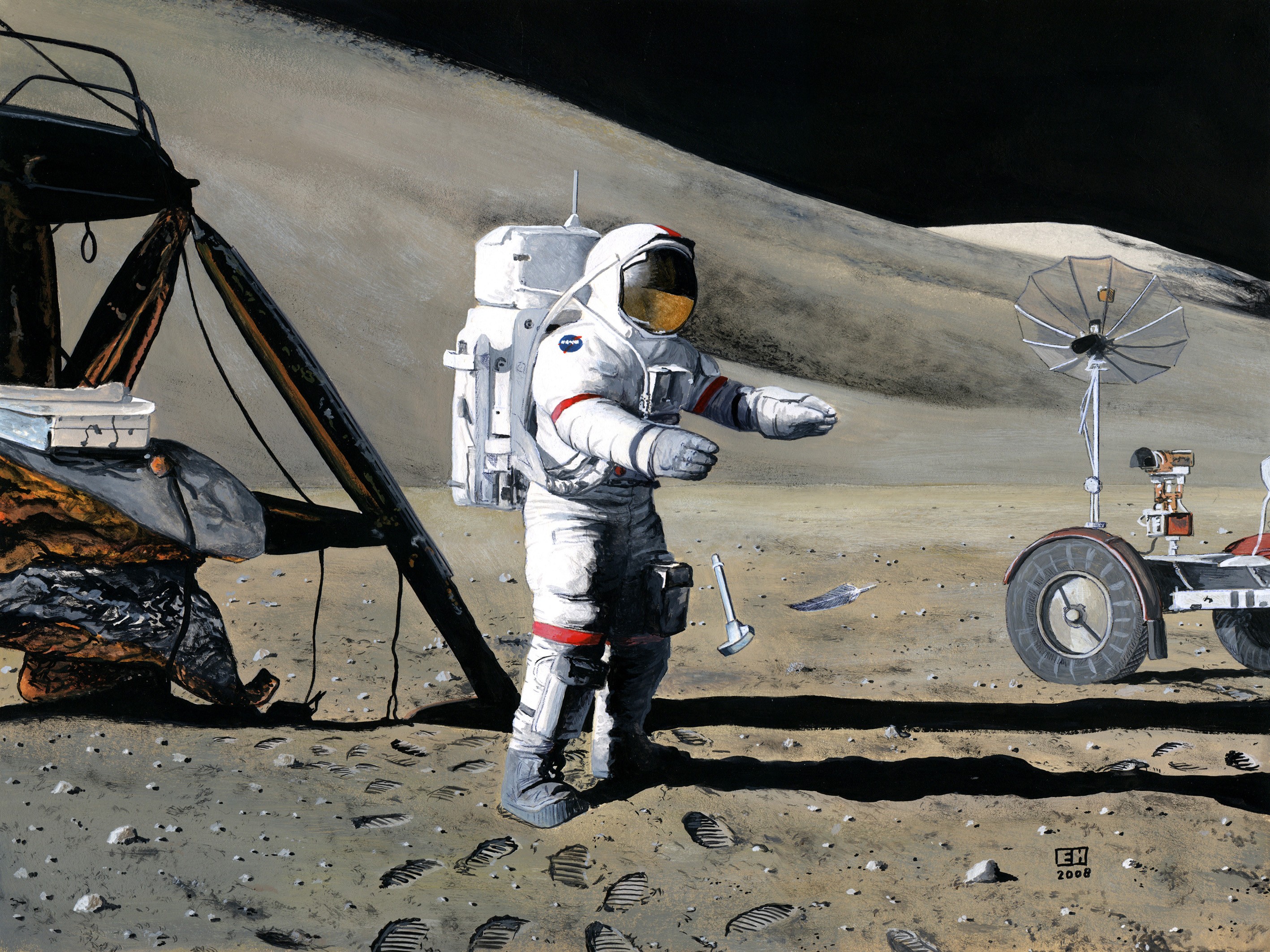
If a feather and a hammer are dropped at the same time on the moon, where there is no atmosphere, which one will hit the ground first?
a)
Neither, there is no gravity on the moon.
b)
hammer because it has more mass
c)
feather because it has less mass
d)
both will hit at the same time
79.
A ball and a car are rolling down hill what type of energy is used
a)
potential
b)
kinetic
c)
chemical
d)
thermal
80.
Definition of Velocity?
a)
any change in velocity
b)
specific speed
c)
speed in a specific direction
d)
speed in a specific number
81.
definition of motion?
a)
an object in motion changes position
b)
affected by the motion of the observer
c)
It happens instantly
d)
A change in position over time
82.
The faster an object moves, the ________ kinetic energy it has. 
a)
more
b)
less
c)
none of the above
d)
all of the above 
83.
__________ is stored energy. 
a)
Potential
b)
Kinetic
c)
None of the above 
d)
All of the above 
84.
As a baseball flies through the air after being hit, it is in the air and is moving.  Which of the following best describes what type of energy it has?
a)
potential energy
b)
kinetic energy
c)
chemical energy
d)
nuclear energy
85.

Calculate the total force from the diagram above. Which direction will they move and by how much force?

a)

25 N west

b)

25 N east

c)

375 N West

d)

No motion

86.

Calculate the total force acting on this box. Where will it move based on these forces?

a)

upward and to the left

b)

upward and the to right

c)

downward and to the left

d)

downward and to the right

87.

If a car is in an accident, air bags and seat belts may help reduce injury to a passenger by

decreasing the force that stops the passenger’s motion. The force is reduced because the seat belts or air bags decrease the -

Group of answer choices

a)

acceleration of the passenger

b)

mass of the passenger

c)

reaction time of the driver

d)

speed of the vehicle

88.

The picture above shows a student about to throw a ball while standing on a skateboard. Which direction will the skateboard move when she throws the ball?

a)

backward

b)

foward

c)

no motion

d)

upward

89.

A boulder falls freely from point A to point B as shown in the diagram below. Which statement best explains the relationship between the height of the boulder and its potential and kinetic energy as it falls?

a)

Its potential energy decreases and its kinetic energy increases.

b)

Its potential energy increases and its kinetic energy decreases.

c)

Its potential energy and kinetic energy both decrease.

d)

Its potential energy and kinetic energy both increase.

90.

The diagram below shows the steps necessary to produce the energy needed to run a hair dryer. Which energy transformations occur from steps A to B to C?

a)

mechanical to thermal to electrical

b)

Chemical to thermal to mechanical

c)

thermal to chemical to mechanical

d)

chemical to mechanical to electrical

91.

The graph below shows the movement of an object at several points in time. What is the average speed of the object?

a)

2 minutes per meters

b)

4 minutes per meters

c)

25 meters per minute

d)

2 meters per minute

92.

The illustration shows a rollercoaster and indicates four different positions the car might be at as it moves along the track. At which point in the rollercoaster's journey is its potential energy the greatest?

a)

W

b)

X

c)

Y

d)

Z

93.

The picture shows an aerialist walking on a tightrope and holding a balancing bar.


An action-reaction pair of forces exists between-

a)

the rope and the balance bar

b)

the aerialist's feet and the rope

c)

the aerialist's arms and legs

d)

the two ends of the rope

94.

Alex pushed against two grocery carts with the same amount of force. Cart A moved but Cart B remained stationary. Which statement best describes why Cart B didn't move?

a)

The more force applied to an object, the harder it is to accelerate the object.

b)

The more mass an object has, the harder it is to accelerate the object.

c)

The less mass that an object has

d)

The less force applied to an object, the easier it is to accelerate the object.

95.

What unit is mass measured in?

a)

kilograms

b)

meters per second squared

c)

Newtons

d)

kilometers

96.

What is the tendency for an object to resist a change in motion?

a)

speed

b)

velocity

c)

acceleration

d)

inertia

97.

According to Newton’s Second Law of Motion, if you increase the force applied to an object __________________.

a)

it decelerates

b)

it does not move

c)

it accelerates more

d)

you get more inertia

98.

Mass x Acceleration =

a)

Velocity

b)

Friction

c)

Force

d)

Inertia

99.

Action and reaction forces work in _____________.

a)

pairs

b)

mass

c)

pressure

d)

gravity

100.

Which law? The dishes on a table do not move when the tablecloth is pulled.

a)

Newton's First Law

b)

Newton's Second Law

c)

Newton's Third Law

101.

Which law? When you paddle your canoe, the canoe goes backwards.

a)

Newton's First Law

b)

Newton's Second Law

c)

Newton's Third Law

102.

Which law? A person traveling in a car that suddenly stops, the loose packages continue to move forward.

a)

Newton's First Law

b)

Newton's Second Law

c)

Newton's Third Law

103.

Which law? An ice skater pushes harder with his leg muscles, and he begins to move faster.

a)

Newton's Frist Law

b)

Newton's Second Law

c)

Newton's Third Law

104.

Which law? A rocket lifting off the ground into space can be explained by _____________________.

a)

Newton's First Law

b)

Newton's Second Law

c)

Newton's Third Law

105.

Which law? A soccer ball remains motionless until it is moved by the unbalanced force of a player's foot.

a)

Newton's First Law

b)

Newton's Second Law

c)

Newton's Third Law
