Worksheets
Continental Drift/Plate Tectonics Review
Total questions: 100
Worksheet time: 1hrs 20mins
What is the driving force behind plate tectonics?
convection currents in the mantle
Earth's magnetic field
Strong winds from storms
waves and tides
Which of the following was evidence Wegner provided for Plate Tectonics
Identical fossils of plants and animals on different continents
Weather patterns
ocean tides
erosion
What is the name of the supercontinent Alfred Wegner used?
Pangea
Laurasia
Euamerica
Wakanda
Which is not a plate boundary in plate tectonics
Vibranium
Transform
Divergent
Convergent
Which Plate boundary shows plates sliding past each other?
Transform
Divergent
Convergent
Conduction
Which is a land feature created by transform boundaries
Fault Lines
Rift- Valleys
Mid-Ocean ridges
Islands
Which is an example of Divergent Boundaries
Mid- Atlantic Ridge
Himalayas
Aleutian Islands
San Andreas Fault
When more dense oceanic crust collide with less dense continental crust which will sink into the mantle
Oceanic crust will sink because it is more dense
Continental crust will sink because it is more dense
Oceanic crust will rise because it is less dense
Neither plate will sink
Which is an example of continental/ continental convergent boundaries
Himalayan (Mountains)
San Andreas fault
Iceland
Aleutian Islands
Which is an example of subduction?
Andes Mountains
Himalayan Mountains
Aleutian Islands
San Andreas Fault
At the Mid-Atlantic Ridge the new crust is...
Closer to the opening of the ridge
Far away from the ridge
On land
There isn't any new crust being formed
Transform boundaries create
Earthquakes
Mountains
Valleys
Mid-ocean ridges
The lithosphere is broken up into different pieces called ______________.
Borders
Countries
Plates
Volcanoes

Tectonic Plate movement is caused by ______________.
the rotation of the Earth
ocean tides
convection currents in the mantle
the moon's gravity
Process where 1 tectonic plate bends & slides beneath another plate at a convergent boundary
conduction
convection
subduction
abduction
Continental mountain ranges are usually associated with
seafloor spreading
convergent boundaries
transform boundaries
divergent boundaries
Why does oceanic crust typically subduct under continental crust when the two converge?
The oceanic crust is denser.
The oceanic crust is less dense.
The oceanic crust is thinner.
The oceanic crust is colder.
Why do most volcanoes on Earth exist along the "Ring of Fire?"
The volcanoes are in the middle of a tectonic plate.
The crust is thinner in that area.
Earth's layers are hotter in that area.
Tectonic plate boundaries are near.
A subduction zone creates a _____ and a _____.
mid-ocean ridge; mountains
continent; oceans
trench; volcanoes
earthquake; tsunamis
What is the difference in how volcanoes and mountains are formed?
They are formed the same way
Mountains are formed form subducted plates
Volcanoes are formed from subducted plates
Volcanoes are formed from converging continental plates
What is the difference between a rift valley and a trench?
Rift valleys are from subducted plates
Trenches are from converging crusts
They are they same, they just have different names
Trenches are from subducted, rift valleys are from divergent
Oceanic crust near the mid-ocean ridge is _____ than crust farther away from the ridge.
younger
older
colder
more dense
The theory that pieces of Earth's lithosphere are in constant motion, driven by convection currents in the mantle is called
Continental Drift
Plate Tectonics
Pangaea
Earthquake
A volcanically active area of the Earth's surface far from a tectonic plate boundary
Fault
Crust
Core
Hot Spot
A break in the earth's crust
Earthquake
Fault
Tectonic plates
Boundary
He is the German scientist who theorized that Pangaea split apart and drifted into different locations
Alfred Wagner
Harry Hess
Alfred Wegener
Alfred Wagoner
This earth's layer is made up of the crust and a tiny bit of the upper mantle
astenosphere
inner core
lithosphere
geosphere
As the melted rock cools and hardens,
it forms new ________.
volcanoes
hope
core
crust
___________ is the hypothesis that states that the continents once formed a single landmass, broke up, and drifted to their present locations.
Continental drift
Sea-floor spreading
Plate tectonics
Mid-ocean range

The lithosphere (crust) is broken into sections called
plates
faults
ridges
trenches
Which of the following reasons is why tectonic plates move?
The mantle has convection currents and the crust float and moves with these currents.
The gravitational pull of the moon pulls differently on the different thicknesses of the plates.
The inner core is spinning and moves the tectonic plates.
The daily move of people, car, buses, trains, and ships create tectonic plate movement
The majority of earthquakes and volcanoes occur at which of the following locations?
The Pacific Ring of Fire
Mid-Atlantic Ridge
San Andreas Fault
The Great Barrier Reef
Where do Earthquakes usually occur?
The central regions of very large continents
Groups of islands farthest from any continents
The steep slopes of the very oldest mountains
The boundaries between continents and oceans
A type of rock that forms when particles from other rocks or the remains of plants and animals are pressed and cemented together.
sedimentary rock
igneous rock
metamorphic rock
Which statement best compares the theories of plate tectonics and continental drift?
Plate tectonics and continental drift are two names for the same theory
Continental drift proposes that the continents move; plate tectonics proposes the mechanism for how the continents move.
Plate tectonics proposes that the continents move; continental drift proposes the mechanism for how the continents move.
Continental drift proposes that the continents move; plate tectonics proposes that the continents are stationary.
According to Wegener’s hypothesis of continental drift,
Earth’s surface is made up of seven major landmasses.
the continents were once joined together in a single landmass.
Earth is slowly cooling and shrinking.
the continents do not move.
Any trace of an ancient organism that has been preserved in rock is called a
landform
landmass
continent
fossil
Most geologists rejected Alfred Wegener's idea of continental drift because
Wegener could not prove how the continents moved
Wegener was interested in what Earth was like millions of years ago.
They were afraid of a new idea.
Wegener used several different types of evidence to support his hypothesis.
Which type of evidence was not used by Alfred Wegener to support his continental drift hypothesis?
evidence from fossils
evidence from human remains
evidence from landforms
evidence from climate
Tectonic plates are constantly moving. Why can't we sense this movement?
The plates only move during the night.
The plates only move a few centimeters a year.
The convection currents causing the movement are in the mantle, and we cannot directly access that layer.
Tectonic plate movement happens with oceanic crust, and we live on continental crust.

The San Andres Fault is an example of a
convergent boundary
divergent boundary
transform boundary
subduction zone
Which additional piece of evidence does Plate Tectonics have that Continental Drift did not?
An explanation of what drives the motion
Fossil Evidence
Erosional features
Rock correlations
Why is continental crust so old compared to oceanic crust?
Oceanic crust gets recycled when it reaches subduction zones
Continental crust is never located near trenches
Continental crust is usually located closer to ridges
Oceanic crust gets recycled when it spreads to the ridges
A tectonic plate is made of what layer of earth?
Crust
Lithosphere
Asthenosphere
Mantle
Alfred Wegener proposed the Theory of Continental Drift. Which one of these does NOT support the theory Wegener proposed?
Fossils that were similar were found on different continents.
Bacteria was found all over the world.
Shape of continents fit together to form a supercontinent called Pangea
Climate seen as glacial or ice sharring are found all over the world.


Which of the following features are evidence that many continents were at one time near Earth's south pole?
glacial deposits
earthquakes
volcanoes
battery magnets
When tectonic plates of more density and less density collide, what happens?
The plate that is more dense fractures.
The plate that is more dense rises.
The plate that is less dense subducts.
The more dense plate subducts.
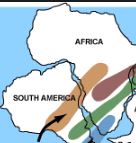
What do these color strips show between South America and Africa with the Theory of Plate Tectonics?
Similar cultures
Similar fossils
Similar languages
Similar weather

What type of plate boundary is shown in this picture
a convergent oceanic-oceanic boundary
a divergent oceanic-oceanic boundary
a convergent oceanic-continental boundary
a divergent oceanic-continental boundary

What is the difference between a rift valley and a trench?
Rift valleys are from subducted plates
Trenches are from converging crusts
They are they same, they just have different names
Trenches are from subducted, rift valleys are from divergent
Why do most volcanoes on Earth exist along the "Ring of Fire?"
The volcanoes are in the middle of a tectonic plate.
The crust is thinner in that area.
Earth's layers are hotter in that area.
Tectonic plate boundaries are near.
What process continually adds new crust to the ocean floor?
subduction
convection
seafloor spreading
magnetic reversals
What do we call the sections the lithosphere is broken into?
blocks
plates
tectonics
crust
A break in the earth's crust
Earthquake
Fault
Tectonic plates
Boundary
The gradual movement of the continents across the Earth's surface through geological time
Plate tectonics
Continental Drift
Earthquake
Sea-floor Spreading
Which earth layer is the LEAST dense?
crust
mantle
outer core
inner core
Which earth layer is the MOST dense?
crust
mantle
outer core
inner core
Which earth layer is the THICKEST?
crust
mantle
inner core
outer core
Which earth layer is the thinnest?
crust
mantle
outer core
inner core

Which layer is represented at A?
crust
mantle
outer core
inner core
Which layer is represented at B?
crust
mantle
outer core
inner core
Which layer is represented at C?
crust
mantle
outer core
inner core
Which layer is represented at D?
crust
mantle
outer core
inner core
The tectonic plates float on which semiliquid layer?
Asthenosphere
Crust
Inner Core
Lithosphere
A tsunami is caused by what?
tectonic plates moving underwater
inactive volcanoes building up pressure
tectonic plates sinking
the crust melting into the mantle


Old-earth (or deep-time) geologists believe the earth to be ______________ years old.
millions of
several thousand
billions of
hundreds of
What is the correct order of earths layers from outside to inside?
crust, mantle, outer core, inner core
mantle, outer core, inner core, crust
inner core, outer core, crust, mantle
crust, outer core, inner core, mantle
Which is true about oceanic crust?
It is thinner and less dense than continental crust.
It is thinner and more dense than continental crust.
It is thicker and more dense than continental crust.
It is thicker and less dense than continental crust.
Which is true about continental crust?
It is thinner and more dense than oceanic crust.
It is thinner and less dense than oceanic crust.
It is thicker and more dense than oceanic crust.
It is thicker and less dense than oceanic crust.
Which diagram shows how continetal mountains form?


The motion of tectonic plates can cause both slow and rapid changes, which is an example of rapid change?
earthquake
seafloor spreading
mountain building
ocean trench formation
Which option below best describes how the flow of heat through the mantle affect the movement of the Earth's tectonic plates?
heat is transferred from the mantle to the curst by radiation which then causes the plates to move on the surface
earth's tectonic plates move due to the graviational pull at eath's core and the flow of heat due to conduction in the mantle
in thematle heated materal cools and becomes less dense as it rises to the surface froming a heated cell which causes the crust to harden and move the plates
in the mantle heated materical expandes and rises towards the crust where it then cools, becomes denser and sinks, forming a convection current which casues plate motion
What type of boundary are you most likely to find a volcano at?
diverging
converging ocean and contiental
converging continental and contiental
transform
What is the difference between CONTINENTAL CRUST and OCEANIC CRUST?
Oceanic crust is beneath the continents while continental crust is under the oceans.
Oceanic crust is part of the mantle while continental crust is part of the outer core.
Continental crust is above the continents while continental crust is under the oceans.
Continental crust is beneath the continents while oceanic crust is under the oceans.

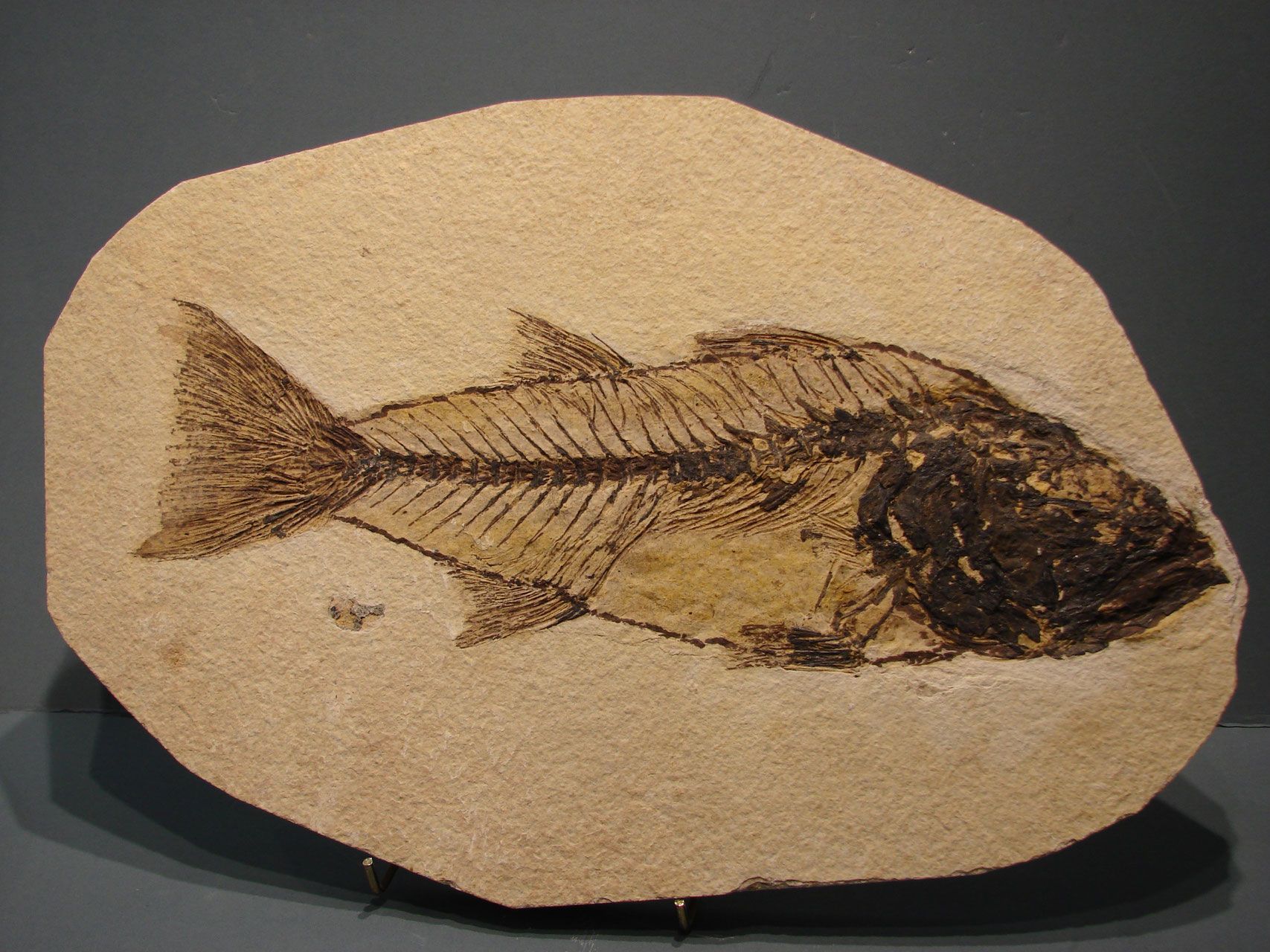
If a scientist found a fish fossil in the desert, what can they infer?
An animal ate the fish.
That water covered the area long ago.
Today's fish looks the same
The fish is endangered.