
 Worksheets
Ecology Test 1 Review
Total questions: 95
Worksheet time: 2hrs 34mins

Bees are insects that belong to the group of:
BIOTIC
ABIOTIC

The Sun is the source of all energy within an ecosystem. Plants depend on light from the sun in order to perform the process of photosynthesis. Sunlight is an example of what type of factor?
BIOTIC
ABIOTIC

Up to 60% of an adult human is made up of water. Water is an example of what type of factor?
BIOTIC
ABIOTIC

Air is a mixture of colorless gases. Air is an example of which type of factor?
BIOTIC
ABIOTIC

Is a DOG an abiotic or biotic factor?
BIOTIC
ABIOTIC
All living things or organisms in an ecosystem are
None
biotic factors
abiotic factors

Is temperature a biotic or abiotic factor?
biotic
abiotic

Are producers biotic or abiotic factors?
biotic
abiotic

Are decomposers biotic or abiotic factors?
biotic
abiotic

Are consumers biotic or abiotic factors?
biotic
abiotic
Abiotic factors are ___________.
non-living parts of an ecosystem
living parts of an ecosystem
things that once were alive, but now are dead
not important parts of ecosystems.
Biotic factors are ___________.
non-living parts of an ecosystem
living parts of an ecosystem
things that once were alive, but now are dead
not important parts of ecosystems.

An angler fish has a fleshy growth on its head that gives off light. This part acts as a lure to help the angler fish catch its prey. An anglerfish is an example of which type of factor?
Biotic
Abiotic

Water is a compound that consists of 2 hydrogen atoms and 1 oxygen atom. Up to 60% of an adult human is made up of water. Water is an example of what type of factor?
Biotic
Abiotic
Which is an example of an abiotic factor in a pond environment?
The water
A frog
A grasshopper
A snake
Which of the following is an example of symbiosis?
A mother bear taking care of her cub
A married couple who agree to split their rent and share housework duties.
A worm living in a cow's intestine.
One chimp cleaning and grooming the hair of another chimp.
Which of the following is an example of a parasite?
A flea
An orchid
An Egyptian plover
The bacteria that live in human intestines
How is commensalism different from mutualism?
In commensalism, one species benefits while the other is unharmed; in mutualism, both species benefit
In commensalism, one species is harmed while the other benefits; in mutualism, both species benefit
In commensalism, neither species is harmed; in mutualism, one species is harmed
In commensalism, both species benefit; in mutualism, one species is harmed
When a honeybee pollinates flowers, the bee gets access to nectar, while the flowers gain the chance to reproduce. This is an example of:
Amensalism
Commensalism
Parasitism
Mutualism
Remoras are fish that swim alongside sharks, eating scraps that the sharks leave behind. This is an example of:
Amensalism
Commensalism
Parasitism
Mutualism


Which of the following shows the symbiotic relationship between the Rodent and the Bird?
Mutualism
Commensalism
Competition

Hermit Crabs live in shells made and then abandoned by snails.
Commensalism
Parasitism
Competition


When two organisms compete with each other for mates, it is an example of :
Interspecific competition
Intraspecific competition
both
When two organisms compete for food, it is an example of:
interspefic competition
intraspecific competition
both
When two different species compete for the same resources.
Interspecific Competition
Intraspecific Competition
Organisms fighting for resources within their own species.
Interspecific Competition
Intraspecific Competition
Two male big horn sheep ram their heads together to win a mate. What type of interaction is this?
Intraspecific Competition
Interspecific Competition
Mutualism
Commensalism
Organism
Something that is not alive
A complete living thing
Many living things
Where something lives
Species
Broadest groups of taxonomy
The taxonomic group that follows domains
Same type of organism
A living thing
Which of the following correctly lists the levels of organization from most complex to least complex?
Community, Organism, Population, Ecosystem
Population, Community, Ecosystem, Organism
Ecosystem, Community, Population, Organism
Organism, Population, Community, Ecosystem
The biotic and abiotic factors that work together in an area
Community
Ecosystem
Organism
Population
All the organisms that are the same type in a certain area
Population
Organism
Community
Ecosystem
All the different types of organisms living in a certain area
Community
Ecosystem
Organism
Population
The most specific (least complex) level of organization within an ecosystem
Community
Population
Organism
Ecosystem
Jacob is going out to his grandparents farm. On the farm is a stream that he likes to fish at. When he is fishing he sees many differernt speacies of fish as well as maple and oak trees and dragonflies. What Jacob is seeing is an example of what level of organization?
organism
population
community
ecosystem
A population must be of the same ________________?
Color
Gender
Age
Species
A community of organisms interacting with the abiotic factors in their environment.
microhabitat
Which of the following is NOT an example of an ecosystem?
A prairie
A lake
A termite colony
A park
The system that contains all living things on Earth.
Biosphere
Atmoshpere
Hydrosphere
Geosphere

According to the graph, what is causing the deer population to decrease
They got sick
The wolf population is decreasing
The wolf population increased
They ran out of food

Predator population lags behind prey population because......
Increase in predators leads to decrease in prey
Increase in predators leads to increase in prey
Increase in predators leads to decrease in producers
Increase in producers leads to increase in prey
What is likely to happen to the population of a prey species if the population of its predator decreases?
It will decrease
It will stay the same
It will increase
It will become extinct

The snake is the _______.
Predator
Prey
The bird is the _______.
Predator
Prey


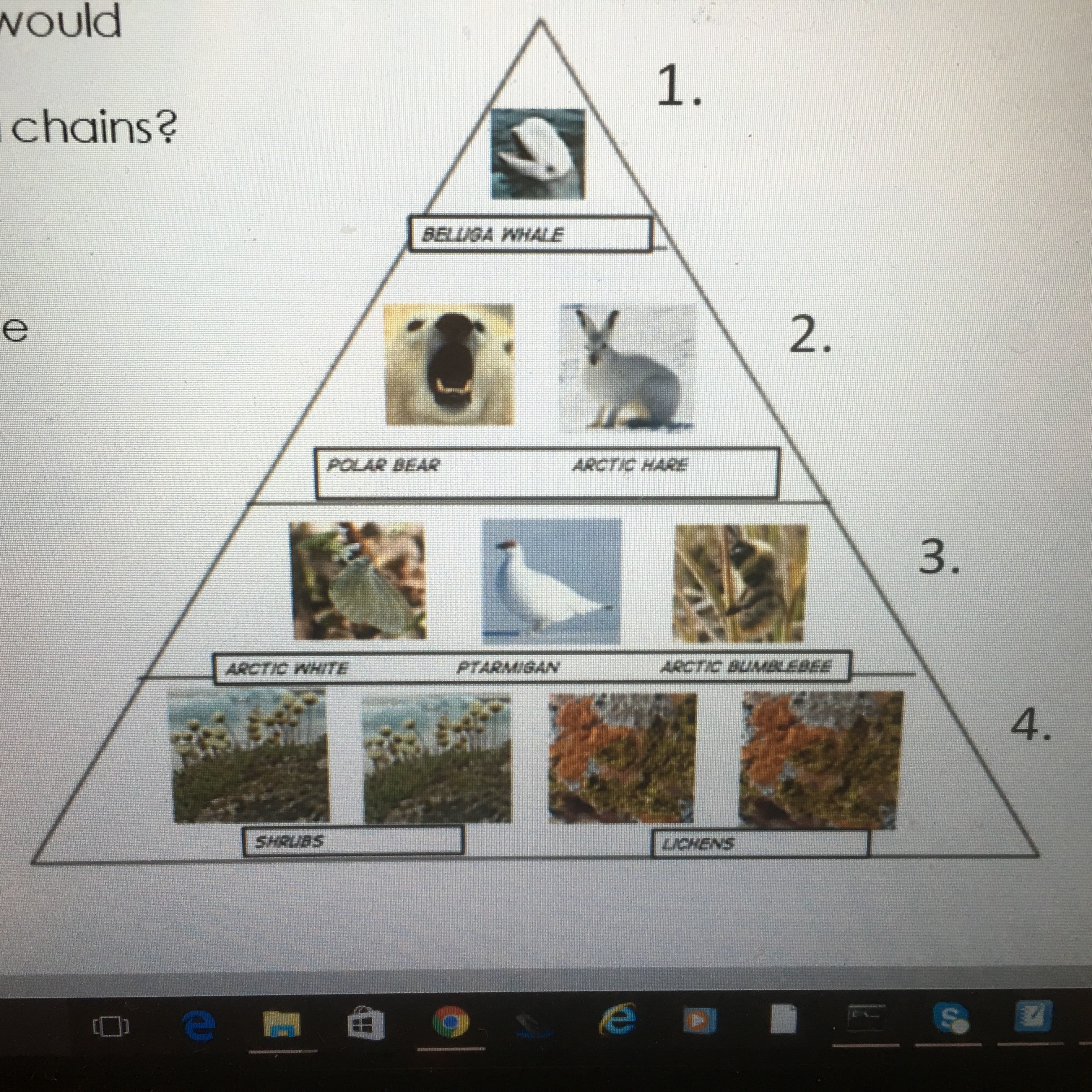
Consumers get their energy by eating food.
True
False

Frog. It is a....
Consumer


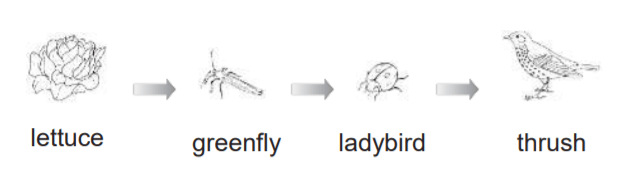
Who is the producer?
lettuce
greenfly
ladybird
thrush


The fox in this food web would be considered a:
3rd level Consumer
Producer
2nd level Consumer
Primary Consumer

The Mayfly is a food source for which 3 organisms?

Which organisms compete for food in the food web to the
right?
Orca and Herring
Seal and Copepod
Killifish and Snapper
Mackerel and Bluefish

What is the primary consumer?
grass
grasshopper
mouse
snake
red hawk
What is the tertiary consumer?
grass
grasshopper
mouse
snake
red hawk
What is the secondary consumer?
grass
grasshopper
mouse
snake
red hawk
What is the 4th order consumer?
grass
grasshopper
mouse
snake
red hawk
Energy that is not passed from one trophic level to the next is usually lost as?
sugar & undigested food
waste & heat
food & sugar
heat & sugar

Where does the rabbit get its energy from?
snake
shrub
cricket
robin
Which organism is a primary consumer in the above diagram?
deer
snake
hawk
shrew
Which organism is a secondary consumer in the above diagram?
deer
rabbit
squirrel
shrew
Which organism gives its energy to 4 organisms?
grass
fungi
shrub
grasshopper
Which organism gets its energy from 3 organisms?
mountain lion
hawk
squirrel
snake
Which organism is at the 3rd trophic level?
grass
grasshopper
mouse
snake
red hawk

The skylark meadow pipit is a predator to how many organisms?
4
5
6
7

