
Font size
 Worksheets
Climate and Weather
Total questions: 66
Worksheet time: 43mins
Weather is the condition of the atmosphere at a particular place and time, such as the temperature, and if there is wind, rain, sun, etc.
True
False
Choose 3 factors that affect climate:
Altitude
Distance from the equator line
Clouds
Trees and plants
Air temperature
Funnel shaped clouds with very high winds that touch the ground are called _____________ .
hurricanes
tornadoes
tsunamis
What type of severe weather forms over warm ocean water?
hurricane
thunderstorm
tornado
The average conditions of an area over time describes the area's ___________ .
climate
weather
atmosphere
When the ocean is warmer than normal, this can sometimes bring more ____________.
thunderstorms
hurricanes
tornadoes
Tornadoes, thunderstorms and hurricanes are powered by ________ pressure systems.
high
low
stationary
Sunny weather is associated with _________ pressure system.
high
low
stationary
What is necessary for a thunderstorm to form?
an ocean breeze
a land breeze
rising warm air and sinking cool air

high pressure
cold sinking air causes this type of zone
warm sinking air causes this type of zone
putting too much air into a tire

low pressure
Warm rising air causes this type of zone
Cold sinking air causes this type of zone
when your tire is low of air

land breeze
Occurs at the beach during the night
Occurs at the beach during the day
the breeze you feel at a park on a windy day

sea breeze
Occurs at the beach during the day
occurs at the beach during the night
a water animal

la nina
ocean temperatures decrease
ocean temperatures increase
a little sister
ocean temperatures magically change colors
el nino
ocean temperatures decrease
ocean temperatures increase
a little brother
ocean temperatures magically change colors

coriolis effect
On the earth, the effect tends to deflect moving objects to the right in the northern hemisphere and to the left in the southern and is important in the formation of cyclonic weather systems. Affects ocean currents, weather patterns, and even air travel!
On the earth, the effect tends to deflect moving objects to the left in the northern hemisphere and to the right in the southern and is important in the formation of cyclonic weather systems.
effect on coriola fish in the ocean

greenhouse effect
the trapping of the sun's warmth in a planet's lower atmosphere, due to the greater transparency of the atmosphere to visible radiation from the sun than to infrared radiation emitted from the planet's surface.
the trapping of the sun's warmth in a planet's upper atmosphere, due to the greater transparency of the atmosphere to visible radiation from the sun than to infrared radiation emitted from the planet's surface.
the trapping of the sun's warmth in a planet's middle atmosphere, due to the greater transparency of the atmosphere to visible radiation from the sun than to infrared radiation emitted from the planet's surface.
What is the main difference between hurricanes and tornadoes?
Tornadoes form only over warm water, and hurricanes form only over cold water.
Hurricanes rotate counterclockwise, and tornadoes rotate clockwise.
Tornadoes can form over land, but hurricanes only form over the ocean
None of these
The wind appears to travel clockwise around high pressure systems in the Northern Hemisphere and counterclockwise in the Southern Hemisphere. What phenomenon does this describe?
Coriolis Effect
Sea Breeze
Angle of Incidence
Anticyclonic Tornado
Which of the following occurs because of unequal heating of the Earth's surface?
gravity
moon phases
tides
winds
Which of the following best describes the movement of air in coastal areas?
Warm air usually blows inland during the day and out to sea at night.
Warm air usually blows out to sea at night and inland during the day
Cool air usually blows inland during the day and out to sea at night
Cool air usually blows out to sea during the day and inland during the night
Region between the Tropic of Cancer and the Tropic of Capricorn. The sun's rays are most intense and the temperatures are always warm.
tropical zone
temperate zone
polar zone
warm front
The regions covering the north and south poles (66.5° north and south latitudes and the poles). The sun's rays strike at a very small angle.
tropical zone
temperate zone
polar zone
eye
The heating of the Earth's surface and atmosphere from solar radiation being absorbed and emitted by the atmosphere, mainly by water vapor and carbon dioxide
warm front
tropical zone
greenhouse effect
global warming
An increase in the average temperature of the earth's atmosphere (especially a sustained increase that causes climatic changes)
global warming
greenhouse effect
warm front
air mass
The condition in the atmosphere over a short period of time is called
climate
weather
global warming
atmospheric pressure
All of the following impact climate EXCEPT
latitude
ocean currents
prevailing wind
tectonic plates
atmospheric pressure


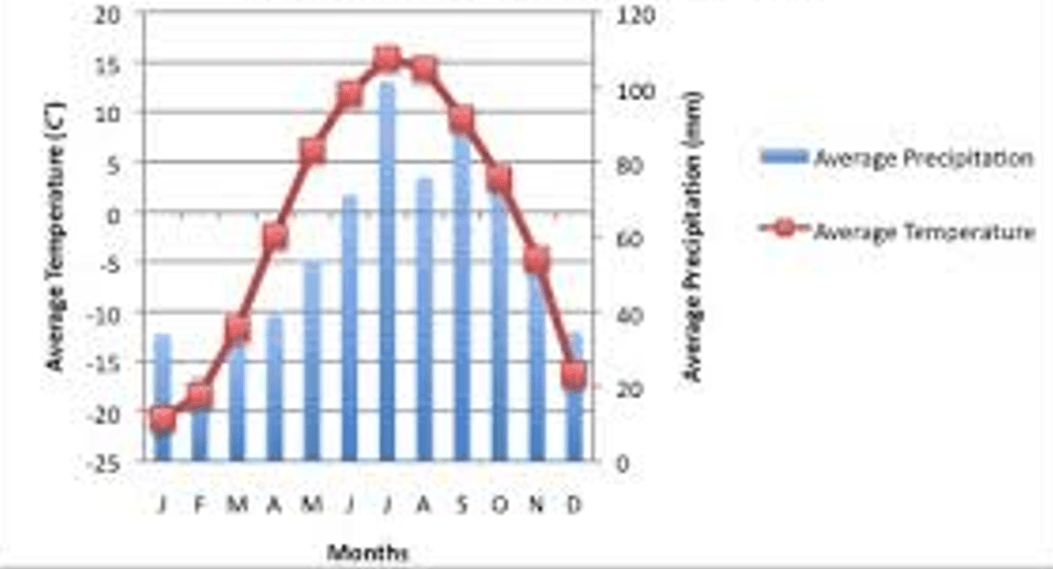
Which of the following is a TRUE conclusion of the climograph above?
December through February are the wettest months of the year.
The temperature in November is around 80 degrees.
In July Mumbai receives around 50 inches of precipitation.
May is the driest month

According to the graph, what is the average temperature of Mumbai in January?
60
80
95
75
The temperature of a polar climate is?
warm and cool
consistently moderate
consistently cold
consistently hot
The temperature of a tropical climate is?
consistently hot
consistently cold
consistently moderate
warm and cool
Which climate zone do we live in?
Temperate
Tropical
Polar
Savanna

Which month has the highest average temperature in the following graph?
August
July
June
May

Which statement describes why the Earth has seasons?
The Earth's axis is titled as it revolves around the sun.
The Earth's distance changes as it revolves around the sun.
The moon revolves around the Earth.
The sun's axis is tilted.
What is the term used for when water is falling from the sky (rain, snow, or hail)?
evaporation
condensation
transpiration
precipitation
Which of the following can influence wind currents?
Temperature difference between air over land and air over the ocean.
Temperature difference between air in the tropical zone and air in the polar zones.
Temperature difference between air close to the ground and air high up in the atmosphere.
All of the above.
Which causes the subtropical jet stream to bring wet winter weather to the southeastern United States?
El Niño
La Nina
Coriolis effect
Santa Anna Winds
How does the heat capacity of water affect the climate of a city on the coast of the Gulf of Mexico?
The water reflects heat from the sun and warms the atmosphere in the area.
The water absorbs a large amount of heat and cools the atmosphere in the area.
The water absorbs heat without evaporating causing frequent droughts in the area.
The water evaporates as small amounts of heat are absorbed causing frequent rain showers in the area.
Which statement describes a role that oceans play in climate?
Condensation of warm ocean water influences rain patterns.
Evaporation of warm ocean water influences rain patterns.
Precipitation of warm ocean water includes rain patterns.
Transpiration of warm ocean water influences rain patterns.
How do currents such as the Gulf Stream affect regional climates?
Currents absorb heat as they move from low latitudes to high latitudes.
Currents distribute heat from offshore regions to coastal regions.
Currents distribute heat from the equator to higher latitudes.
Currents remove heat from higher latitudes and distribute it at the equator.

Data collected from ice cores have been compared in the diagrams illustrated above taken from a research station in Antarctica. What climate relationship can most likely be concluded from the information shown in these two graphs?
Higher ice CO2 levels are the result of higher temperatures.
Lower ice CO2 levels are the result of higher temperatures.
Higher atmospheric CO2 levels leads to higher temperatures.
Lower atmospheric CO2 levels leads to higher temperatures.
Which of the following is most likely a human cause of climate change?
recycling activities
volcanic eruption
car emissions
lightning-started wildfire
measure the distance from the equator, and explains why Climates tends to become cooler as
you move farther from the equator
distance form the sea
latitude
altitude
atmospheric temperature

Compared to the subtropical jet stream, the polar front jet stream is at a...
Lower altitude and lower latitude
Lower altitude and higher latitude
Higher altitude and lower latitude
Higher altitude and higher latitude
The general surface wind circulation associated with a high-pressure system is most likely...
Clockwise and outward
Clockwise and inward
Counterclockwise and outward
Counterclockwise and inward
Identify the layer of the atmosphere in which a thunderstorm would most likely form.
Troposphere
Stratosphere
Mesosphere
Thermosphere
As latitude increases, the sun shines more obliquely and
provides more warming energy
provides less wind energy
provides less warming energy
provides less nuclear energy
The Earth's tilt affects the
angle of incident sunlight on a particular location,
angle of incident moonlight on a particular location,
angle of incident rain direction on a particular location,
angle of incident moonlight on a given evening.
Average temperatures cool with increasing latitude, producing
well-defined heat zones on the planet.
well-defined pollution zones on the planet.
well-defined cold zones on the planet.
well-defined climatic zones on the planet.

