wayground logo

Free Printable Worksheets

Font size

S
M
L
XL
Worksheets

Cells & Transport

Total questions: 47

Worksheet time: 49mins

Name
Class
Date
1.
Which sequence of terms is in the correct order from simplest to most complex?
a)
cells --> tissues--> organs -->> organ systems
b)
tissues --> organisms --> cells --> organ systems
c)
cells --> tissues --> organ systems --> organs
d)
organs --> organisms --> organ systems --> cells
2.
Which organelle is the storehouse for most of a cell's genetic information (DNA)?
a)
mitochondrion
b)
chloroplast
c)
centriole
d)
nucleus
3.
Which organelles supply energy to the cell?
a)
ribosomes
b)
centrosomes
c)
mitochondria
d)
vacuoles
4.
Which organelles are unique to plant cells?
a)
ribosomes
b)
vacuoles
c)
chloroplasts
d)
centrosomes
5.
Which cell structure directly controls the movement of molecules into and out of the cell?
a)
A
b)
B
c)
C
d)
D
6.
Which structure in the cells below produces energy in the form of ATP?
a)
A
b)
B
c)
C
d)
D
7.
Which organelle is correctly paired with its specific function?
a)
cell membrane - storage of hereditary information
b)
chloroplast - transport of materials
c)
ribosome - sythesis of proteins
d)
vacuole - production of ATP
8.
The diagram represents levels of organization in living things.
Which term would best represent X?
a)
stomach
b)
organelle
c)
tissue
d)
human
9.
In a cell, information that controls the production of proteins must pass from the nucleus to the
a)
chloroplasts
b)
ribosomes
c)
mitochondria
d)
cell mebrane
10.
A structure that performs a specialized function within a cell is known as an
a)
a tissue
b)
an organ
c)
an organelle
d)
a system
11.
Which substance can enter a cell by diffusion without having to be digested?
a)
water 
b)
protein
c)
starch
d)
fat
12.
State the process that organelle X performs.
a)
photosynthesis
b)
cellular respiration
c)
protein synthesis
d)
information storage
13.

What type of cell is a plant cell?

a)

Prokaryotic

b)

Eukaryotic

14.

What type of cell is a bacterial cell?

a)

Prokaryotic

b)

Eukaryotic

15.

How do eukaryotes reproduce?

a)

Sexually

b)

Asexually

c)

Both

16.

What is the smallest unit of an organism that can perform life functions?

a)

Organ system

b)

Organ

c)

Tissue

d)

Cell

17.
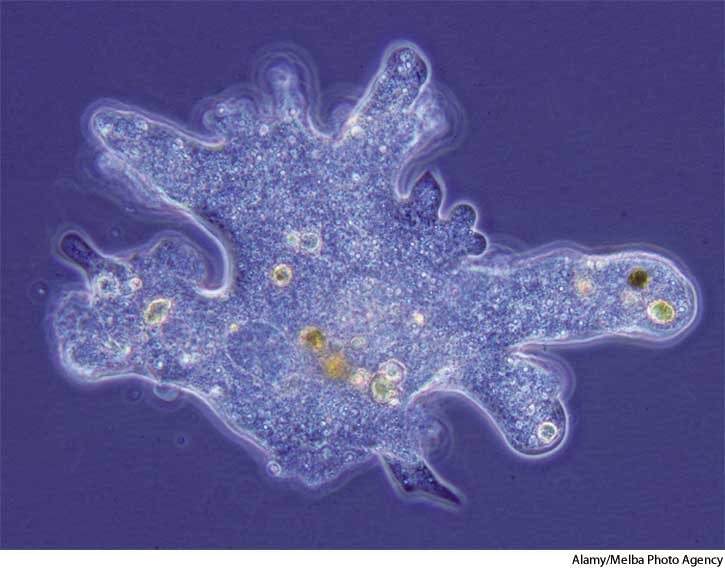
An Amoeba is a unicellular, animal-like protist that lives in ponds and streams. According to cell theory, where did this cell come from?
a)
another pre-existing amoeba cell.
b)
energy from sun that allowed the protist to reproduce.
c)
a multicellular organism.
d)
the nonliving environment.
18.
Rocks are not living because
a)
they never move
b)
they aren't needed for humans
c)
they are not made of cells
d)
they don't break down
19.
What is found in both plant and animal cells but is much larger in plant cells?
a)
Nucleus
b)
Mitochondria
c)
Chloroplast
d)
Vacuole
20.

There are three tenets of the Cell Theory. Which of the following is NOT a tenet?

a)

Cells are the basic structure and function of life.

b)

All living things are made of one or more cells.

c)

The cell is the basic unit of matter.

d)

All cells come from preexisting cells.

21.

Which of the following statements is true?

a)

Plants and animal cells have cell walls for protection.

b)

Animal cells have one large vacuole; the plant cell has tiny ones.

c)

Plant cells contain chlorophyll; animal cells have lysosomes.

d)

Animal cells are box shaped; plant cells are circular

22.

diffusion of water

a)

osmosis

b)

diffusion

c)

active transport

d)

passive transport

23.

Active transport moves materials in which direction?

a)

From high to low

b)

From low to high

c)

In either direction

24.

In passive transport, molecules move from an area of __________ concentration to an area of __________ concentration.

a)

active, passive

b)

water, salt

c)

low, high

d)

high, low

25.
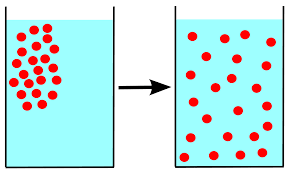
The picture below is an example of _________________.
a)
osmosis
b)
isotonic
c)
diffusion
d)
active transport
26.
Permeable means
a)
things can pass through
b)
the concentration levels are different
c)
it is permanent
d)
things are stuck
27.
Osmosis is the movement of _____ across a membrane.
a)
food
b)
energy
c)
oxygen
d)
water
28.
Passive transport requires no
a)
concentration gradients
b)
osmosis
c)
motion
d)
energy
29.
What is diffusion?
a)
when molecules move 
b)
when molecules move from a high concentration to a low.
c)
no movement 
d)
molecules move everywhere
30.
The diffusion of water across a membrane is called
a)
equilibrium.
b)
osmosis.
c)
facilitated diffusion.
d)
active transport.
31.
Someone sprays air freshener.  The scent fills the room.  This is an example of
a)
active transport
b)
osmosis
c)
diffusion
d)
cellular respiration
32.
Which transport does not require energy?
a)
Passive
b)
Active 
33.

passive transport is most like

a)

driving a car

b)

driving a submarine

c)

biking up a hill

d)

biking down a hill

34.

Passive Transport uses ____ energy

a)

no

b)

a lot of

c)

a little bit of

d)

some

35.
Osmosis is the movement of _____ across a membrane.
a)
food
b)
energy
c)
oxygen
d)
water
36.
The picture is an example of...
a)
active tranport
b)
passive transport
c)
diffusion
d)
osmosis
37.

The student sitting next to you just came from gym class and forgot to shower and you can tell. What process is this?

a)

diffusion

b)

osmosis

c)

active transport

d)

exocytosis

38.

Robert sprays water on the veggies in the produce section to “plump them up”. What process is this?

a)

diffusion

b)

osmosis

c)

active transport

d)

carrier proteins

39.

Allow only certain particles to cross into or out of the cell

a)

Homeostasis

b)

semi-permeable

c)

passive transport

d)

osmosis

40.

Maintenance of a constant internal state in a changing environment

a)

Homeostasis

b)

Semi-permeable

c)

passive transport

d)

osmosis

41.

Process by which a cell membrane surrounds a particle and encloses the particle to bring into the cell

a)

diffusion

b)

endocytosis

c)

osmosis

d)

exocytosis

42.

Process in which a cell releases a particle by enclosing the particle in a vesicle that then moves to the cell surface and fuses with the cell membrane

a)

diffusion

b)

endocytosis

c)

osmosis

d)

exocytosis

43.

the process in which a cell releases a particle so that it exits the cell

a)

exocytosis

b)

diffusion

c)

endosytosis

d)

osmosis

44.

____________ controls how materials or substances move into and out of the cell.

a)

Osmosis

b)

Lysosome

c)

Cell membrane

45.

Diffusion is the process by which molecules move from an area of higher concentration to an area of lower concentration.

a)

True

b)

False

46.

___________ is the process by which large molecules are engulfed by the cell membrane.

a)

Diffusion

b)

Endocytosis

c)

Osmosis

47.

The diffusion of water

a)

osmosis

b)

photosynthesis

c)

cellular respiration

d)

active transport