
 Worksheets
World Hist Sem 2 Review
Total questions: 60
Worksheet time: 37mins
The Cold War refers to the period of tension between the United States and the Soviet Union from
the end of World War II to the fall of the Soviet Union.
the end of World War I to the bombing of Pearl Harbor.
the Cuban Missile Crisis to the fall of the Berlin Wall.
the Bolshevik Revolution to the end of World War I.
Which of the following was a primary cause of the Cold War between the United States and the Soviet Union?
direct, armed conflict between the two nations
the founding of the United Nations
a deep reduction in military expenditures
a competition for political influence over other countries
The United States followed a policy of containment during the Cold War in response to the spread of communism.
How did the Marshall Plan reflect containment policy?
It blocked Soviet missiles from from arriving in communist Cuba.
It provided economic aid to European countries in order to prevent the spread of communism.
It authorized the use of military force against communist forces in Vietnam.
It stopped communist efforts to control the Korean Peninsula.
What was one major goal of the Soviet Union during the early years of the Cold War?
to expand individual liberties in the Baltic republics
to attract foreign economic investments
to create a defensive buffer zone in Eastern Europe
to establish a competitive market economy
Which statement explains how the Truman Doctrine guided U.S. foreign policy in Europe following World War II?
The United States provided financial aid to noncommunist governments fighting communist rebels
The United States divided countries and cities recovering from the war into zones occupied by international forces.
The United States established satellite governments in countries that share borders with the Soviet Union.
The United States boycotted international events held in countries allied with the Soviet Union.
What was the main foreign policy of the U.S. government during the 1950s and 60s?
fighting the threat of terrorism
securing new trade relationships
prosecuting human rights violations
containing the spread of communism
The "Iron Curtain" refers to a divide between which two groups?
colonies and colonial powers
Allied- and Axis-controlled territory
industrialized and nonindustrialized nations
US and Soviet spheres of influence
What were the Marshall Plan and Truman Doctrine intended to do?
prevent a nuclear arms race
halt the spread of communism
help Asian countries recover from war
support former European colonies

What American policy provided Western European countries financial assistance so they could recover from WWII?
Marshall Plan
Domino Theory
Truman Doctrine
Big Stick Policy
Which group was created in response to the formation of NATO?
Warsaw Pact
Central Intelligence Agency
Office of Strategic Services
Southeast Asia Treaty Organization
Why did the Soviet Union put a blockade on the city of Berlin in 1948?
place Soviet missiles within range of targets in Western Europe
prevent the United States from distributing Marshall Plan funds
pressure the Allies to completely withdraw from East Germany
stop aid from reaching anti-communist rebels in Eastern Europe

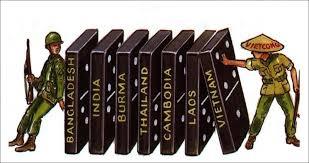
Which term best describes this image?
Domino Theory
Massive Retaliation
Flexible Response
Covert Activities
How do we know that the Korean War was a proxy war?
North Korea was fighting South Korea.
The people in Korea were fighting one another.
Foreign countries were fighting in the war.
The UN tried to establish peace in Korea.
How do we know that the Korean War was a civil war?
The USA helped South Korea.
The UN got involved in the war.
North Korea was fighting South Korea.
The USSR sent help to North Korea.
How did the USA get involved in the Korean War?
They dropped nuclear bombs to force North Korea into surrendering.
They saved South Korea after it was invaded, then chased the North Korean forces into China.
They helped to negotiate for South Korea to surrender.
They fought directly with the USSR in Korea.
The president of the USA during the Korean War was
Franklin Roosevelt
Woodrow Wilson
Harry Truman
Joseph Stalin
What happened when China decided to join the Korean War?
They managed to conquer Korea.
They helped North Korea push the USA and South Korean forces back across the 38th parallel.
They could not defeat the USA and South Korea, so North Korean forces remained in China.
They were attacked by the USA with nuclear weapons.
When did the fighting during the Korean War end?
1945
1950
1953
1965
Who was the leader of the Soviet Union during the Cuban Missile Crisis?
Leon Trotsky
Vladmir Lenin
Joseph Stalin
Nikita Khrushchev
Who was the leader of the US during the Cuban Missile Crisis?
Lyndon B. Johnson
John F. Kennedy
Robert Kennedy
Harry S. Truman
Why did the USSR want to put missiles on Cuba?
To have more missiles because they couldn't match the nuclear power of the US
To counter the Warsaw Pact countries that were overthrowing communism
To counter the US missiles in Italy and Turkey
To counter the power of NATO
What did Kennedy's "Quarantine" of Cuba actually do?
ally
shun
blockade
attack
What was the resolution of the Cuban Missile Crisis?
The ambassadors from both countries came to an agreement to remove missiles from the countries each were concerned about
The President and Soviet Premier decided that they would both agree to disagree without fighting
Kennedy lifted the blockade but Cuba still had missiles on it
Khrushchev decided to remove missiles from Cuba to get the blockade lifted without talking to the US first, as an act of good faith



The 1956 invasion of Hungary and the 1968 invasion of Czechoslovakia by the Soviet Union were attempts to
keep Communist governments in power in Eastern Europe
decrease Cold War tensions between Eastern Europe and the United States
prevent German militarism from spreading throughout Europe
provide humanitarian aid to the ethnic minorities of these nations
The events that took place in Hungary in the 1950s and in Czechoslovakia in the 1960s demonstrated the Soviet Union’s
support of nationalism among satellite nations
influence on the economies of developing nations
determination to maintain political control over Eastern Europe at that time
attempts to promote its artistic and literary achievements in Western Europe
The Soviet Union’s reaction to the 1968 revolt in Czechoslovakia was to
permit limited political and economic reforms in Czechoslovakia
withdraw Soviet troops from Eastern Europe
send Soviet troops to occupy Czechoslovakia
bring the matter to the attention of the United Nations
What was the effect of the Soviet's massive military spending on the Soviet economy?
Soviet GDP grew throughout the 80s
The Soviet economy collapse in the 80s
The Soviets abolished the economy
The Soviet economy dipped into recession but quickly recovered
What were Gorbachev's reforms called?
Glasnost
Davai Davai
Kommunizm
Perestroika
Glasnost means -
openness
reform
restructuring
enclosure
Perestroika means -
openness
reform
restructuring
enclosure
Who was the leader of Solidarity?
Lech Walesa
Lech Wales
General Jaruzelski
Emry Nagy
Why was Solidarity significant?
Undermined communism's claim to be a system which benefited ordinary people
Showed that the USSR was stronger than ever before
Proved to the West that Poland loved communism
Showed that communist governments could be threatened by people power
In which year did the Baath party stage a coup to take over the government?
1958
1968
1978
1913
Which political party was Saddam a member of?
Pool Party
Baath Party
Communist Party
Capitalist Party
When did Saddam Hussein become President of Iraq ?
1978
1977
1979
1969
Who is Saddam Hussein's model?
Stalin
Woodrow Wilson
Vladimir Lenin
Mao Zedong
Why did the Ayatollah criticize the Shah?
Mexico forced him to
The Shah was too Westernized and not Islamic enough
Bacon
Shifting economic policies overemphasized market share growth over stable percent raises through dummy corporations
The Iranian Revolution took place in
England
France
Mexico
Iran
The Ayatollah managed to overthrow the Shah by taking advantage of
Amazing deals at Walmart
The student-led Iranian Revolution
Shifting tones of communist command economics over supply-side ones
Newly developed military technology
After overthrowing the Shah the Ayatollah established a
Chuck-e-Cheese franchise in Texas
New constitution that gave the right to vote to women
Fundamentalist, traditional, Islamic theocracy
Democratically-elected triumpart of local governors
Iran went to war with Iraq in order to determine
The World Heavyweight Boxing Champion
The border between them
The role of women in politics
The relationship between Sunni and Shiite Muslims
What was the only real impact of the Iran-Iraq War?
The United States gained territory in the Middle East
The Soviet Union took control of a warm water port
The economies of both nations were ruined
Trade throughout Eastern Europe increased

