

Wayground logo

Free Printable Worksheets

Font size

S
M
L
XL
Worksheets

Q2 Chemistry CFE Review

Total questions: 100

Worksheet time: 2hrs 40mins

Name
Class
Date
1.
Elements which are shiny, conduct electricity and heat are called
a)
metal
b)
nonmetal
c)
metalloid
d)
nonexistent
2.
The atomic number tells you what?
a)
number of electrons
b)
number of protons
c)
number of neutrons
d)
both electrons and protons in an atom.
3.
Which is a halogen?
a)
Helium
b)
Chlorine
c)
Oxygen
d)
Neptune
4.
Which is an alkali metal?
a)
Magnesium
b)
Iron
c)
Sodium
d)
Europium
5.
If an atom had the same properties as fluorine (F), it would probably be located in
a)
period 1.
b)
period 2.
c)
group 2.
d)
group 17.
6.
Atoms with similar properties are most likely located...
a)
in the same period.
b)
in the same group.
c)
in different periods.
d)
to the right and left of each other.
7.
Each element is unique based on its number of protons, also known as the...
a)
atomic mass
b)
valence number
c)
atomic symbol
d)
atomic number
8.
The atomic number of this pictured element is
a)
28
b)
58.6934
c)
Ni
d)
Nickel
9.
what does the 6 represent?
a)
Atomic mass
b)
atomic number
c)
chemical symbol
d)
element name
10.
Group Name and Number for Neon
a)
Alkaline Earth Metals 2 or 2A
b)
Noble Gases 18 or 8A
c)
Halogens 17 or 7A
d)
Alkali Metals 1 or 1A
11.
Group Name and Number for Flourine
a)
Transition Metals 3-12
b)
Noble Gases 18 or 8A
c)
Halogens 17 or 7A
d)
Alkali Metals 1 or 1A
12.
A proton is....
a)
A negatively charged subatomic particle
b)
A positively charged subatomic particle
c)
A neutrally charged subatomic particle
d)
The only subatomic particle located in the nucleus
13.
A neutron has a charge of
a)
+2
b)
No charge
c)
-1
d)
+1
14.
What is the atomic mass of Neon?
a)
10
b)
30
c)
10.18
d)
20.18
15.
Who first developed the Periodic Table?
a)
Mendeleev
b)
Mosely
c)
Mendella
d)
Murphy
16.
What is the formula to solve for the neutron?
a)
Mass + Atomic Number= Neutrons
b)
Mass x Atomic Number = Neutrons
c)
Mass - Atomic Number = Neutrons
d)
Mass + Number of Protons = Neutron
17.

What is the name of group number 1?

a)

halogens

b)

noble gases

c)

alkali metals

d)

alkaline earth metals

18.

What is the name of group number 2?

a)

transition metals

b)

halogens

c)

metaloids

d)

alkaline earth metals

19.

Periodic law states that the elements are arranged according to their atomic ________ so that elements with similar chemical properties are in the same ________ and properties repeat periodically.

a)

numbers, rows

b)

masses, rows

c)

masses, column

d)

numbers, column

20.

A grouping of elements based on similar chemical properties, arranged by columns in the periodic table; also known as a group

a)

family

b)

period

c)

row

d)

isotope

21.

A row on the Periodic Table of Elements

a)

family

b)

period

c)

row

d)

isotope

22.
___________ is the only metal that is a liquid at room temperature.
a)
Platinum
b)
Water
c)
Tin
d)
Mercury
23.

Which element is found in group 2, period 6?

a)

Oxygen (O)

b)

Barium (Ba)

c)

Selenium (Se)

d)

Carbon (C)

24.

Metals (select all that apply)

a)

are found on the right side of the periodic table.

b)

are found on the left side of the periodic table.

c)

are good conductors of heat and electricity.

d)

are brittle.

e)

are malleable and ductile.

25.

Nonmetals (select all that apply)

a)

are found on the right side of the periodic table.

b)

are found on the left side of the periodic table.

c)

are good conductors of heat and electricity.

d)

are brittle.

e)

can be solid, liquids, or gases at room temperature.

26.

Elements that have the same number of energy levels are said to be in the same ______.

a)

group

b)

period

c)

family

d)

classification

27.

choose the correct statement

a)

the vertical column in the periodic table is called period

b)

the vertical column in the periodic table is called group

c)

the horizontal row in the periodic table is not called period

d)

none of the above

28.

Number of valence electrons in halogens is ..........

a)

1

b)

4

c)

3

d)

7

29.

D block elements are known as .............

a)

Actinides

b)

Transition elements

c)

Lanthanides

d)

Noble gases

30.

In which block, does the element Iron stand?

a)

d block

b)

p block

c)

s block

d)

f block

31.

which element is this ?

a)

Neon

b)

Potassium

c)

Calcium

d)

Argon

32.
As you move down the periodic table atoms get bigger.  This is because ____________.
a)
The atoms have more mass.
b)
The atoms have more protons.
c)
The atoms have more energy levels
d)
The atoms have more nuetrons
33.
Electronegativity is...
a)
how good an atom is at attracting electrons
b)
the ability of an atom to lose electrons
c)
the energy required to remove an electron from a specific atom
d)
how easy it is to make friends. 
34.
Electronegativity __________ from left to right within a period and __________ from top to bottom within a group.
a)
decreases, increases 
b)
increases, increases
c)
increases, decreases 
d)
stays the same, increases
35.

Which of the following elements has the smallest atomic radius?

a)

Sulfur

b)

Chlorine

c)

Aluminum

d)

Sodium

36.

Which atom has the largest atomic radius?

a)

potassium

b)

rubidium

c)

francium

d)

cesium

37.

Which of the following will have a higher electronegativity than arsenic (As)?

a)

Carbon (C)

b)

Neon (Ne)

c)

Antimony (Sb)

d)

Germanium (Ge)

38.
The element with the largest electronegativity in the halogens is - 
a)
At
b)
F
c)
Cl
d)
Br
39.

The element with the lowest electronegativity in Period 3 is -

a)

Na

b)

Cl

c)

Ar

d)

Mg

40.

As you look from left to right across a period, electronegativity

a)

increases

b)

decreases

41.
Atomic radius generally increases as we move __________.  
a)
down a group and from right to left across a period 
b)
up a group and from left to right across a period 
c)
down a group and from left to right across a period 
d)
up a group and from right to left across a period 
42.
Ionization energy is...
a)
the energy required to add an electron to a specific atom
b)
how much energy it takes to remove an electron from an atom
c)
the energy required to shield the outer electrons from the nucleus
d)
a measure of the ability of an atom to attract electrons
43.
The minimum energy required to remove an electron from the ground state of an atom
a)
electron configuration
b)
energy levels
c)
ionization energy
d)
ionic bond
44.

How many protons does oxygen have?

a)

8

b)

16

c)

32

d)

4

45.

How many electrons does oxygen have when it is neutral?

a)

8

b)

16

c)

32

d)

4

46.

How many electrons does oxygen have when it is neutral?

a)

8

b)

16

c)

32

d)

4

47.

How many valence electrons does oxygen have?

a)

2

b)

8

c)

6

d)

18

48.

How many electrons does oxygen want to gain?

a)

1

b)

2

c)

3

d)

4

49.

Based on oxygen's location on the periodic table, predict its electronegativity:

a)

low electronegativity

b)

medium electronegativity

c)

high electronegativity

d)

no electronegativity

50.

Based on oxygen's location on the periodic table, predict its relative atomic size:

a)

small

b)

medium

c)

large

d)

no size

51.

What type of element is oxygen?

a)

metal

b)

nonmetal

c)

metalloid

d)

transition metal

52.

Which of these best describes the periodic trends for electronegativity:

a)

Increases across a period and down a group

b)

Increases across a period and up a group

c)

increases across a period and down a group with a drop-off at the halogens

d)

increases across a period and up a group with a drop-off at noble gases

53.
Metals tend to 
a)
gain electrons
b)
lose electrons
54.
Nonmetals tend to 
a)
gain electrons
b)
lose electrons
55.
When metals bond with non-metals they form what type of bonds
a)
covalent
b)
ionic
c)
cooperative
d)
lewis
56.
How do the following two elements bond together?
Cr3+  O2-         
a)
CrO
b)
Cr3O2
c)
Cr2O3
d)
CrO3
57.
PbS2
a)
lead sulfide
b)
lead sulfur
c)
lead II sulfide
d)
lead IV sulfide
58.
AgF
a)
silver fluoride
b)
silver fluorine
c)
monosilver monofluoride
d)
silver monofluorine
59.
When a nonmetal gains electrons, it becomes this type of ion.
a)
Anion
b)
Cation
60.
When a metal loses electrons, it becomes this type of ion.
a)
anion
b)
cation
61.
The proper formula for magnesium hydroxide:
a)
MgOH
b)
Mg2OH
c)
Mg(OH)2
d)
Mg2OH2
62.
Name the following ionic compound: Cr(NO2)3
a)
chromium nitrite
b)
chromium nitride
c)
chromium III nitride
d)
chromium III nitrite
63.
Which of the following is NOT an ionic compound:
a)
CaO
b)
NaOH
c)
BaCl2
d)
Br2
64.
How do the following two elements bond together?
Al3+  O2-         
a)
AlO
b)
Al2O3
c)
Al3O6
d)
Al3O2
65.
What is the correct formula for the compound, lithium oxide?
a)
LiO
b)
Li2O
c)
LiO2
d)
Li2O2
66.
The name for CrN:
a)
Chromium nitride
b)
Chromium (I) nitride
c)
Chromium (III) nitride
d)
Chromium nitride (III)
67.
Name this compound: 
NH4F
a)
Ammonia fluoride
b)
Ammonium fluorite
c)
Ammonia fluorate
d)
Ammonium fluoride
68.
How do the following two elements bond together?
Na1+  F1-         
a)
NaF
b)
NaF3
c)
Na3F
d)
Na1F2
69.
A ________ is a model of an atom in which each dot represents a valence electron.
a)
Valence electron
b)
Electron dot diagram/Lewis dot structure
c)
Lewis bond structure
70.
How many valence electrons does nitrogen have?
a)
3
b)

2

c)
5
d)
1
71.
A covalent bond involves a __________ of electrons.
a)
sharing
b)
borrowing
c)
exchanging
d)
switching
72.
Low melting point and low solubility in water are general properties of ______________________ compounds
a)
ionic
b)
covalent
c)
chemical
d)
glucose
73.
What is the name of N2O3
a)
Nitrogen trioxide
b)
Dinitrogen oxide
c)
Dinitrogen trioxide
d)
Nitrogen oxide
74.
What is the chemical formula for Tetrasulfur pentoxide?
a)
SO
b)
S4O
c)
S4O5
d)
S5O4
75.
What is the name of C3Cl8 ?
a)
Carbon octachloride
b)
Tricarbon octachloride
c)
Carbon trichloride
d)
Octacarbon trichloride
76.
What is the chemical formula for Nitrogen triiodide?
a)
NI
b)
N3I
c)
NI3
d)
None of these
77.
What is the name of Br6F10 ?
a)
Bromium fluoride
b)
Hexabromine fluoride
c)
Bromium decafluoride
d)
none of the above
78.
What is the name of CO
a)
Carbon oxide
b)
Carbon dioxide
c)
Carbon monoxide
d)
Carbon II oxide
79.
A binary covalent bond exists between
a)
2 metals
b)
1 metal and 1 nonmetal
c)
2 nonmetals
d)
Any 2 elements
80.
Why do atoms share electrons?
a)
To attain the electron configuration of a noble gas.
b)
To become ions and take a charge
c)
to increase the mass
d)
it's a nice thing to do.
81.
How do covalent bonds form?
a)
Donating & receiving valence e- between atoms.
b)
Opposite slight charges attract each other between compounds.
c)
Scientists are still not sure how they form.
d)
Sharing valence e- between atoms.
82.
What is the formula for Hydrosulfuric Acid?
a)
H2(SO3)
b)
H2S
c)
H2(SO2)
d)
H2(SO4)
83.
Name HF
a)
hydrofluoric acid
b)
Hypofluoric acid
c)
hydrogen fluorine acid
d)
fluoric acid
84.
What is the formula for hydrochloric acid?
a)
HCl
b)
HClO
c)
H3ClO3
d)
HClO3
85.
What is the formula for nitric acid?
a)
HNO2
b)
HNO3
c)
HNO4
d)
H2NO3
86.

When naming binary acids, the ending always changes to:

a)

-ate

b)

-ite

c)

-ic

d)

-ous

87.

When naming oxyacids, change "-ite" to:

a)

-ate

b)

-ic

c)

-ous

d)

-ite

88.

When naming oxyacids, change "-ate" to:

a)

-ate

b)

-ic

c)

-ous

d)

-ite

89.
What explains the very high melting and boiling point of water
a)
Strong dipole-dipole bonds between water molecules
b)
Strong hydrogen bonds between water molecules
c)
Dispersion forces which are present in all molecules
d)
Asymmetrical shape of the polar bonds.
90.
Hydrogen bonding occurs when hydrogen is bonded to N, O, or F.  Which of the following has hydrogen bonding?
a)
CBr4
b)
NO2
c)
H2S
d)
NH3
91.
Does HCl have hydrogen bonding?
a)
yes
b)
no
92.
Does CH4 have hydrogen bonding?
a)
yes
b)
no
93.
Does NH3 have hydrogen bonding?
a)
yes
b)
no
94.
Which is the second strongest intermolecular force, after hydrogen bonding?
a)
dipole-dipole attraction
b)
London forces
95.

Which substance would have the weakest intermolecular forces of attraction?

a)

CH4

b)

NaCl

c)

H2O

d)

MgF2

96.

Intermolecular forces for: CO2

a)

Dispersion Force

b)

Dipole dipole

c)

Hydrogen bonding

97.
Which is the strongest intermolecular force below"
a)
Ionic
b)
Dispersion
c)
Hydrogen
d)
Metallic
98.

The model used to describe and explain the bonding and arrangement of atoms in a solid metal is the

a)

ball and stick model

b)

electron sea model

c)

metalloid model

d)

valence shell electron pair repulsion theory
99.
Ionic Bonding involves...
a)
The transfer of protons
b)
The transfer of nuetrons 
c)
The transfer of electrons
d)
None Of the above
100.
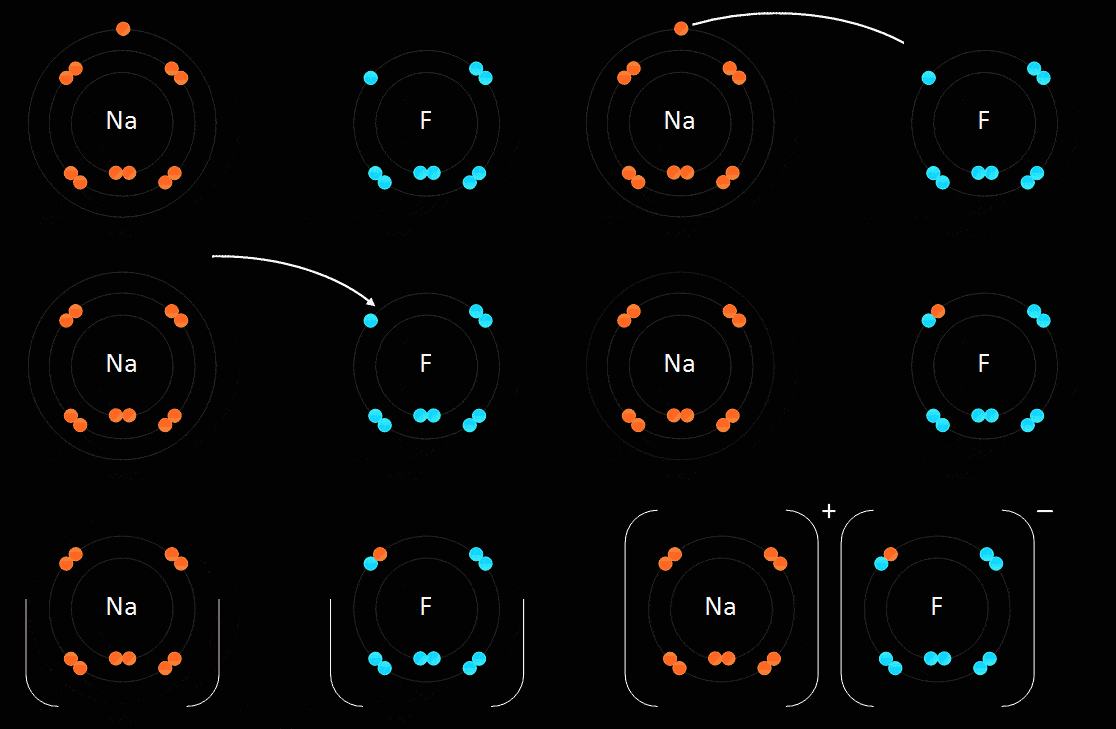
Why type of bond is forming between the atoms in the diagram?
a)
Ionic
b)
Covalent
