Wayground logo

Free Printable Worksheets

Font size

S
M
L
XL
Worksheets

Q4 Chemistry CFE Review

Total questions: 100

Worksheet time: 2hrs 1mins

Name
Class
Date
1.
What is a "homogeneous mixture of two or more substances in a single phase"?
a)
Solution
b)
Solvent
c)
Solute
d)
Compound
2.
What does it mean to be "Soluble" ?
a)
Capable of being a solid.
b)
To have soul.
c)
Capable of being dissolved.
d)
To sink.
3.
What is the unit for molarity?
a)
mass/liters
b)
moles
c)
liters
d)
moles/liter
4.
Which of the following are considered to be a homogeneous mixture?
a)
Colloid
b)
Solution
c)
Suspension
d)
All Mixtures
5.
A measure of the amount of solute in a given amount of solvent or solution is...
a)
saturated
b)
solubility
c)
concentration
d)
miscible
6.
A saturated solution is one that....
a)
contains the maximum amount of dissolved solute.
b)
contains less solute than a saturated solution.
c)
contains more solute than a saturated solution.
d)
is the amount of a substance required to form a saturated solution.
7.
An unsaturated solution is one that....
a)
contains the maximum amount of dissolved solute.
b)
contains less solute than a saturated solution.
c)
contains more solute than a saturated solution.
d)
is the amount of a substance required to form a saturated solution.
8.
An electrolyte is...
a)
The rapid, random movement of particles in colloidal dispersion.
b)
A substance that dissolves in water and conducts electric current.
c)
A substance that dissolves in water and does not conduct electric current.
d)
The solution process when water is the solvent.
9.
The dissolving medium in a solution is called ... 
a)
colloid
b)
solution
c)
solute
d)
solvent
10.
The substance dissolved in a solution is called ... 
a)
colloid
b)
solution
c)
solute
d)
solvent
11.
What is the molarity of a 2 liter solution containing 5 moles of NaCl?
a)
2.5
b)
0.4
c)
2.5 moles/liter
d)
10 moles/liter
12.
How many moles of NaCl are present in 6000. ml a 1.5 M NaCl solution?
a)
9 moles NaCl
b)
9000
c)
9
d)
4000  moles NaCl
13.

What does "like dissolves like" mean?

a)

polar solvents dissolve in polar solutes

b)

polar solutes dissolve in polar solvents

c)

non-polar solvents dissolve in polar solutes

d)

non-polar solutes dissolve in polar solvents

14.

Molality is defined as ________ divided by _____________

a)

liters solution, mols solute

b)

mols solute, liters solvent

c)

kg solvent, mols solute

d)

mols solute, kg solvent

15.

Molarity concentration is abbreviated as _________

a)

MM.

b)

m.

c)

Mol.

d)

M.

16.

Molarity is defined as _________ divided by ___________

a)

mol, liters

b)

mol, kg

c)

kg, liters

d)

liters, kg

17.

How many mols of HCl are in 3 liters of 2.0M HCl solution?

a)

2.0

b)

1.5

c)

6.0

d)

0.66

18.
Kool-Aid - Powder, sugar, and water
Identify the solvent 
a)
water
b)
powder
c)
sugar
d)
powder and sugar
19.
This type of mixture contains two or more substances that are visibly distinguishable. 
a)
homogeneous
b)
heterogeneous
c)
solution
d)
colloid
20.

Which of the following is NOT TRUE about Heterogeneous Mixtures?

a)

They will settle out over time

b)

Individual particles are often distinguishable

c)

Solutions are a type of heterogenous mixture

d)

Emulsions, Suspensions, and Collides are types of Heterogeneous Solutions.

21.
Determine the molarity of 2.25 mole of sulfuric acid, H2SO4, dissolved in 725 mL of solution.
a)
322.2 M
b)
3.1 M
c)
0.32 M
d)
2.25 M
22.
What is the concentration, in percent by mass, of 0.62 g of solute in 45.0 g of solution?
a)
0.014 %
b)
1.4 %
c)
0.13%
23.
What is the concentration, in percent by volume, of 15.3 mL of solute in 2.65 L of solution?
a)
0.58%
b)
0.0058%
c)
5.8%
24.
What mass of solute is needed to make 75.0 g of a 3.4% solution?
a)
2.55 g
b)
22 g
c)
0.05 g
25.

If you had four solutions of sweet tea, which would be the sweetest based on its concentration?

a)

1.5 M

b)

0.5 M

c)

2.4 M

d)

0.08 M

26.
What is the percent by mass of fluorine in CaF2 (gram-formula mass = 78 g/mol)?
a)
24%
b)
49%
c)
51%
d)
65%
27.
What is the percent by mass of chlorine in NaCl?
a)
39%
b)
61%
c)
35%
d)
65%
28.
What is the percent by mass of magnesium in MgO?
a)
20%
b)
40%
c)
50%
d)
60%
29.
What is the percent composition by mass of oxygen in the compound MgSO4 (gram formula mass = 120 g/mol)?
a)
20%
b)
27%
c)
46%
d)
53%
30.

What is the percent by mass of Oxygen in water? H2O.

a)

33 %

b)

88.9%

c)

11.1%

d)

50%

31.
Temperature is a measure of the...
a)
total energy in a substance
b)
total kinetic energy in a substance
c)
average potential energy in a substance
d)
average kinetic energy of molecules in a substance
32.

A chemical reaction that releases heat to the surroundings is said to be __________ and has a __________ ΔH at constant pressure.

a)

endothermic; positive

b)

endothermic; negative

c)

exothermic; negative

d)

exothermic; positive

33.

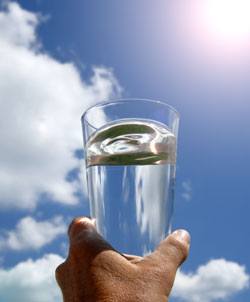
Over time, the temperature of a glass of cold water will...

a)

match the temperature of the surrounding environment.

b)

become colder still, as heat is transferred to the surrounding environment.

c)

become warmer than the surrounding environment.

d)

not change temperature.

34.
What would be the effect on the particles if more heat is supplied to the system?
a)
They would slow down
b)
They would stop moving
c)
They would speed up
d)
There would be no effect
35.

In an exothermic reaction, heat is ...

a)

taken in or absorbed

b)

given out or released

36.

In an endothermic reaction, heat is ...

a)

taken in or absorbed

b)

given out or released

37.

List four factors that affects the rate of a reaction

a)

temperature

b)

concentration

c)

surface area

d)

volume

e)

catalysts

38.
Grinding a seltzer tablet into powder increases the rate of reaction due to increased
a)
concentration
b)
surface area
c)
temperature
d)
reactants
39.
When a  piece of aluminum foil is taken out of the oven and cools from 100°C to 50°C.
What is the change in temperature?
a)
50°C
b)
0°C
c)
100°C
d)
150°C
40.
How much energy is required to heat up 12kg of copper from 10 °C to 120 °C. The specific heat capacity is 390 J/kg °C.
a)
46800 J
b)
561600 J
c)
514800 J
41.

Which of these pH values represent an acid?

a)

4

b)

8

c)

10

d)

12

42.

Which of these pH values represent an acid?

a)

4

b)

8

c)

10

d)

12

43.

If I add more water to this setup, what will happen to the pH?

a)

It will increase and get closer to 7

b)

It will decrease and get closert to 0

c)

It will stay the same and not change

44.

Milk is a very weak acid. What might its pH value be?

a)

6.5

b)

7.8

c)

4.2

d)

12.2

45.

When acids react with metals, they produce hydrogen gas and salt.

a)

True

b)

False

46.

Which of the following are properties of acids?

a)

They conduct electricity when dissolved in water

b)

They taste sour

c)

They react with metals to produce hydrogen gas

d)

All of the answer choices are correct

47.

Which of the following is an acid?

a)

vinegar

b)

bleach

c)

sugar in water

d)

starch in water

e)

toothpaste in water

48.

The pH value of an acid represents its __________ of positive ions in the solution

a)

amount

b)

concentration

c)

color

d)

charge

49.

Which of the following is a property of a base?

a)

bitter taste

b)

reacts with metals

c)

salty

d)

sour taste

50.

The higher the concentration of negative (hydroxide) ions in the solution, the stronger the base is.

a)

True

b)

False

51.

Which of the following pH values represents a base?

a)

2.1

b)

4.6

c)

6.8

d)

8.1

52.

The strongest bases have pH values close to

a)

0

b)

14

c)

7

d)

5

53.

Ocean water is only slightly basic. What might its pH value be?

a)

5

b)

8

c)

12

d)

2

54.
Acids react with
a)
water to produce bases and salts
b)
salts to produce bases and water
c)
neither bases, salts nor water
d)
bases to produce salts and water
55.

HF is...

a)

an acid

b)

a base

c)

a salt

d)

an ionic compound

56.

KOH is ...

a)

an acid

b)

a base

c)

a salt

d)

an ionic compound

57.

The pH of a solution is 2.0. What is the [OH-] concentration?

a)

1x10-12M

b)

12 M

c)

1x10⁻²M

d)

2 M

58.

What is the pH of a solution where the [H+] is 1.0 x 10⁻¹¹?

a)

11

b)

13

c)

14

d)

1

59.

What is the pOH of a 1 x 10⁻⁸ M solution of HNO3?

a)

8

b)

6

c)

7

d)

9

60.

What is the [H+] if the pH is 4.0?

a)

1.0 x 10⁻¹⁰ M

b)

1.0 x 10⁻⁴ M

c)

1.0 x 10⁻¹⁴ M

d)

1.0 x 10⁻⁷ M

61.
What is the pOH of a solution that has a pH of 2?
a)
10
b)
12
c)
14
d)
1
62.

What completely ionizes in solution?

a)

Weak acids

b)

Strong acids

c)

Strong Salts

d)

Neutral salts

63.
Ammonia has a pH of 12.  Ammonia is __________.
a)
an acid
b)
a base
c)
an element
d)
a metal
64.
What is the pH of water?
a)
0
b)
4
c)
7
d)
14
65.
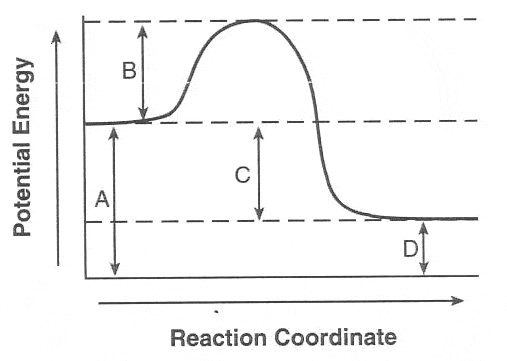
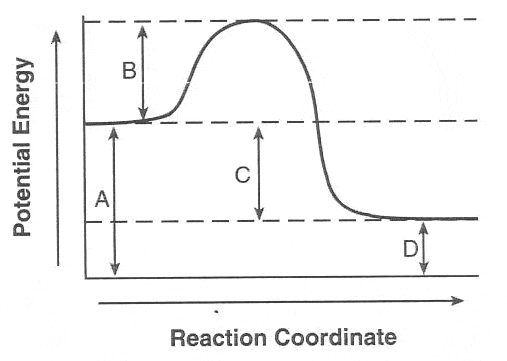
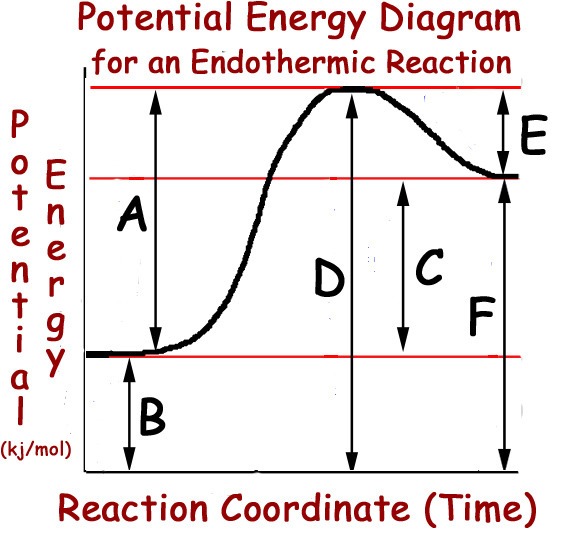
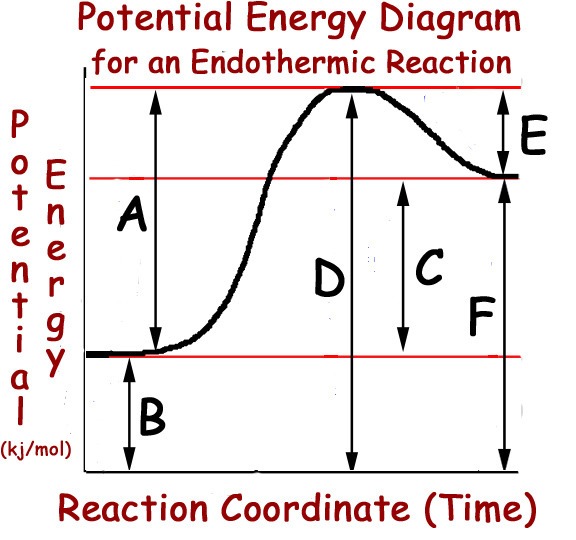
What letter represents the energy of the products?
a)
A
b)
B
c)
C
d)
D
66.
What type of reaction is this?
a)
Endothermic
b)
Exothermic
67.
What letter represents the activation energy?
a)
A
b)
B
c)
C
d)
D
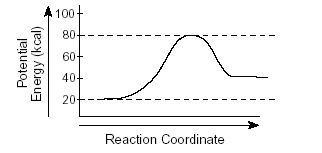
68.
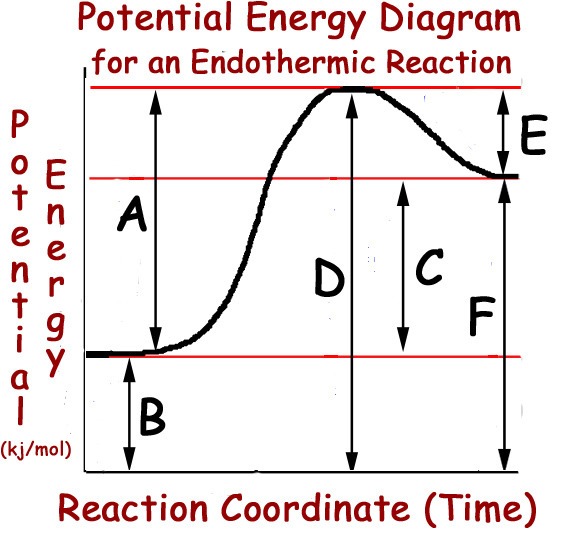
Is this reaction endothermic or exothermic?
a)
endothermic 
b)
exothermic
69.

What is the ΔH of this reaction?

a)

40 kJ

b)

20 kJ

c)

80 kJ

d)

-60 kJ

70.
What letter represents ΔH?
a)
A
b)
B
c)
C
d)
D
71.
What is the sign of ΔH for all endothermic reactions?
a)
Positive
b)
Negative
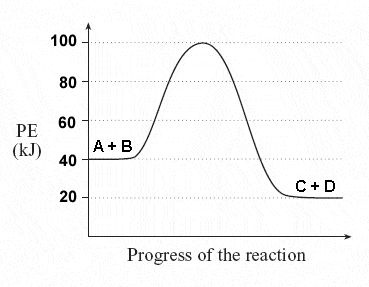
72.
What is the activation energy?
a)
40 kJ
b)
20 kJ
c)
100 kJ
d)
60 kJ
73.

What is the change of the heat of the reaction (ΔH)?

a)

-40 kJ

b)

-20 kJ

c)

100 kJ

d)

60 kJ

74.
What is the activation energy?
a)
100 kJ
b)
175 kJ
c)
50 kJ
d)
75 kJ
75.

What is the change of the heat of the reaction (ΔH)?

a)

100 kJ

b)

-175 kJ

c)

-50 kJ

d)

75 kJ

76.

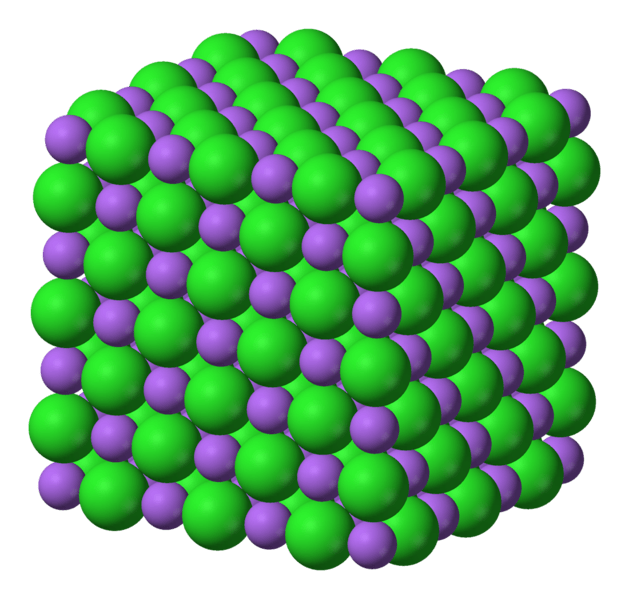
Which state of matter does this picture show?

a)

Solid

b)

Liquid

c)

Gas

77.

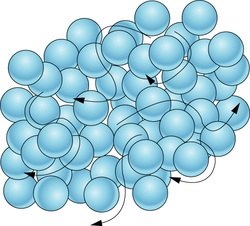
What state of matter does this picture show?

a)

Solid

b)

Liquid

c)

Gas

78.

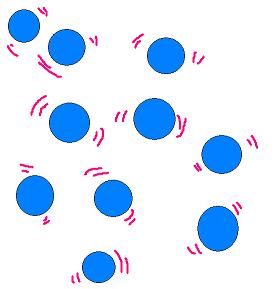
What state of matter does this picture show?

a)

Solid

b)

Liquid

c)

Gas

79.

Which state of matter does this picture show?

a)

Solid

b)

Liquid

c)

Gas

80.
Matter that has its own shape and takes up space.
a)
solid
b)
liquid
c)
gas
81.
How is a gas defined?
a)
no shape, no volume
b)
Definite shape, definite volume
c)
Found in stars
d)
Definite volume, no shape
82.
Define a liquid
a)
no shape, no volume
b)
Definite shape, definite volume
c)
Found in stars
d)
Definite volume, no shape
83.
From 30 degrees to 55 degrees, what state of matter is the substance?
a)
Solid
b)
Liquid
c)
Gas
d)
Plasma
84.
Sublimation is
a)
when solid turns into gas
b)
when gas turns into plasma
c)
when liquid turns into gas
d)
when gas turns into solid
85.
What state of matter is segment 5?
a)
Solid
b)
Liquid
c)
Gas
d)
Plasma
86.
What does Boyle's law relate to?
a)
Temperature and Volume
b)
Volume and Pressure
c)
Temperature and Pressure
87.
How do gas molecules move? 
a)
in an orderly fashion 
b)
constantly and randomly
c)
in straight line paths
d)
in a circular motion
88.
In Charles' Law the pressure remains constant.
a)
True
b)
False
89.
What type of relationship is Charles' Law?
a)
Inverse
b)
Direct
c)
Not enough information
d)
#goals
90.
True or False: Gases can be compressed. 
a)
True
b)
False
91.
What is the formula for Boyle's Law?
a)
P1V1=P2V2
b)
P1V1/P2V2
c)
P1V2=P2V1
d)
P1/V1=P2/V2
92.
When Pressure increases then the Volume must...
a)
Increase
b)
decrease
93.
What type of relationship to pressure and volume have?
a)
direct
b)
inverse
c)
no relationship
d)
I don't know
94.
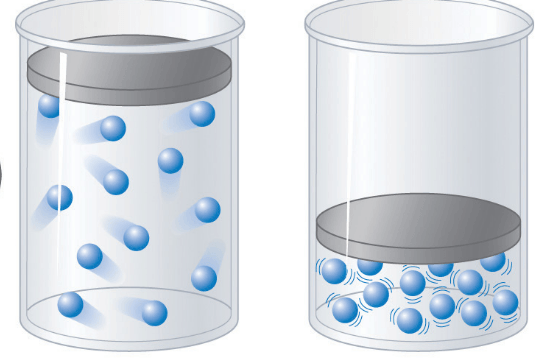
Which container will have a lower pressure?
a)
left
b)
right
c)
they both have the same pressure
d)
I don't know
95.
Boyle's law : When _______ is held constant, the pressure and volume of a gas are ________  proportional
a)
temperature,  equally
b)
mass, inversely
c)
temperature, inversely
d)
mass, equally
96.
What is the formula Charles' Law?
a)
V = T
b)
VT = VT
c)
T1 / V1 = T2 / V2
d)
V1 / T1 = V2 / T2
97.
A substance that increases speed of chemical reaction without being being changed is called:
a)
Catalyst
b)
Acid
c)
Base
d)
pressure
98.
Increase in temperature of the reactants can do one of the following
a)
Slow collision frequency
b)
Allow less effective collision between the particles
c)
Cause particles to lose speed
d)
Increase collision between the particles thus increasing the rate.
99.
Increasing the concentration increases the speed of reaction by
a)
lowering activation energy
b)
increasing collisions
c)
speeding up the reactants
d)
exposing more reactant
100.
Which factors increase the rate of a reaction.
a)
increasing temperature
b)
increasing concentration
c)
increasing surface area
d)
all of these