Worksheets
Unit 12: Thermochemistry Test Review
Total questions: 49
Worksheet time: 2hrs 38mins
If the enthalpy ter (ΔH) is negative the reaction is ____.
Endothermic
Exothermic
Neutral


The following graph indicates a...
All the Reactions
No Reaction
Exothermic Reaction
Endothermic Reaction

The following graph indicates a...
All the Reactions
No Reaction
Exothermic Reaction
Endothermic Reaction
ΔEuniverse=ΔEsurroundings + ΔEsystem = 0 refers to...
conservation of energy
conservation of mass
definite composition
multiple proportions
What is the term for the amount of energy gained or released in a chemical reaction?
enthalpy of vaporization
enthalpy of condensation
enthalpy of reaction
enthalpy of sublimation
During an exothermic reaction, heat content in the surrounding increases because -
all reactions release heat energy
the reaction releases heat energy
the reaction absorbs heat energy
heat energy is destroyed during reactions
What instrument do we use to measure the average kinetic energy of the particles in a substance?
speedometer
calorimeter
barometer
thermometer
Not using math, what is the correct enthalpy of reaction (ΔHrxn) for the endothermic decomposition of water?
-241.8 kJ/mol
-285.8 kJ/mol
+483.6 kJ/mol
-483.6 kJ/mol
Which of the following causes a change in state from gas to liquid?
a chemical reaction
temperature at freezing point
hydrogen bonding
decrease in kinetic energy
What process takes place when the average kinetic energy of a solid's particles increases?
vaporization
boiling
melting
condensation
If a reaction takes place in a beaker and the beaker feels warm, the reaction could be classified as...
hydrothermic
exothermic
endothermic
geothermic
Sublimation is when...
a solid changes to a liquid
a liquid changes to a gas
a solid changes to a gas
a gas changes to a solid
How much heat is required to raise the temperature of a sample of copper from 10.0°C to 55.0°C, if its specific heat is 0.384 J/g°C and its mass is 10.00g?
-172.8 J
1.728 J
172.8 J
17.28 J

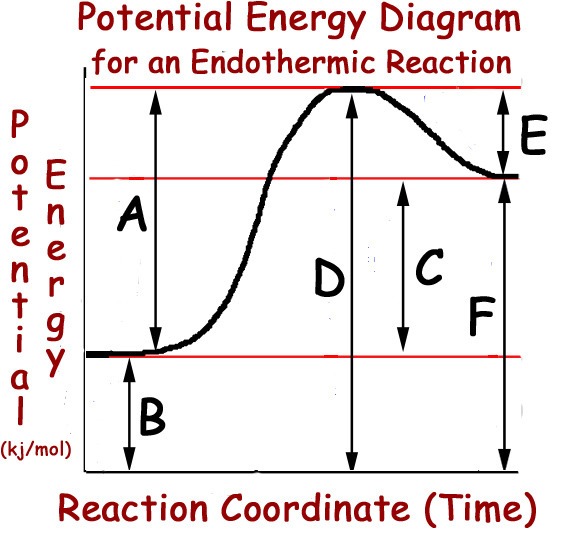
This is a potential energy diagram.
What can be concluded from the potential energy diagram?
The reaction was endothermic.
The reaction was exothermic.
The reaction was at equilibrium.
As the average kinetic energy of a substance increases, the temperature of the sample
decreases
increases
remains the same
Which of the following best describes exothermic chemical reactions?
They never release heat.
They always release heat.
The type of reaction in which heat is released to the surroundings is called -
Endothermic
Exothermic
Synthesis
Combustion
The type of reaction in which heat is absorbed from the surroundings, causing the temperature to feel cooler -
Endothermic
Exothermic
Synthesis
Combustion
According to the law of conservation of energy -
Energy is neither created nor destroyed
The amount of energy in the universe remains unchanged
If the energy of the system increases, the energy of the surroundings decreases by the same amount
All of the above
Which graph shows the amount of enthalpy in a system during an exothermic reaction?


Gold has a specific heat of 0.129 J/(g*C). How many joules of heat energy are required to raise the temperature of 15.0 grams of gold from 22.0*C to 85.0*C?
42.6 J
64.8 J
122 J
165 J
How does heat move?
from a warmer to a cooler object
from a cooler to a warmer object
toward a hot object
away from a cold object
Energy transmitted by electromagnetic waves
conduction
convection
radiation
__________ is the transfer of heat by the movement of a fluid.
Conduction
Convection
Radiation

When you touch hot sand, heat is transferred by _________ to your skin.
conduction
convection
radiation