Wayground logo

Free Printable Worksheets

Font size

S
M
L
XL
Worksheets

paper 1 chem revision 2

Total questions: 118

Worksheet time: 1hrs 29mins

Name
Class
Date
1.

What does this warning symbol mean?

a)

Toxic

b)

Corrosive

c)

Flammable

d)

Irritant

2.

What does this warning symbol mean?

a)

Toxic

b)

Corrosive

c)

Flammable

d)

Irritant

3.

What does this warning symbol mean?

a)

Toxic

b)

Corrosive

c)

Flammable

d)

Irritant

4.
What colour is universal indicator in a strong alkali?
a)
Green
b)
Orange
c)
Purple
d)
Red
5.
What colour is universal indicator in a neutral solution?
a)
Green
b)
Orange
c)
Purple
d)
Red
6.
What colour is universal indicator in strong acid?
a)
Green
b)
Orange
c)
Purple
d)
Red
7.
The pH scale is a range from:
a)
1-7
b)
0-14
c)
1-14
d)
1-20
8.
What is the only substance with a neutral pH of 7?
a)
Milk
b)
Orange Juice
c)
Water
d)
Blood
9.
A solution with a pH of 3.6 would be...
a)
Acid
b)
Base
c)
Neutral
d)
Acid and Base
10.
According to the pH range which substance is more acidic than lemon juice
a)
Hydrochloric acid
b)
cabbage
c)
milk
11.

What colour is pH neutral?

a)

Yellow

b)

Orange

c)

Red

d)

Green

12.

An alkali can neutralize an acid

a)

False

b)

True

13.

The pH of pure water

a)

5.6

b)

7.0

c)

8.1

d)

0.0

14.

Acid in our stomach:

a)

Hydrochloric acid

b)

Sulfuric acid

c)

Acetic acid

d)

Carbonic acid

15.

Acid in soft drink:

a)

Hydrochloric acid

b)

Sulfuric acid

c)

Acetic acid

d)

Carbonic acid

16.

Acid in car battery:

a)

Hydrochloric acid

b)

Sulfuric acid

c)

Acetic acid

d)

Carbonic acid

17.

Acid in vinegar:

a)

Hydrochloric acid

b)

Sulfuric acid

c)

Acetic acid

d)

Carbonic acid

18.

Which substance is alkali?

a)

Toothpaste

b)

Vinegar

c)

Lemon juice

d)

Soft drink

19.

The color of litmus in acid:

a)

Red

b)

Blue

c)

Purple

d)

Green

20.

The color of litmus in alkali:

a)

Red

b)

Blue

c)

Purple

d)

Green

21.

The color of litmus in neutral solution:

a)

Red

b)

Blue

c)

Purple

d)

Green

22.

Acids taste .....

a)

sour

b)

bitter

c)

sweet

d)

umami

23.

Rain water is slightly acidic. What is its pH?

a)

1.0

b)

5.6

c)

7.0

d)

8.2

24.

Indigestion can be treated by drinking ....

a)

water

b)

antacid

c)

vinegar

d)

sodium hydroxide

25.

Reaction between acid and alkali producing salt and water:

a)

Combustion

b)

Neutralization

c)

Precipitation

d)

Decomposition

26.

Something that can be used to identify acid/alkali:

a)

Indicator

b)

Oxidator

c)

Reductor

d)

Terminator

27.

The color of universal indicator in hydrochloric acid:

a)

Red

b)

Blue

c)

Purple

d)

Green

28.

pH of alkali:

a)

0

b)

7

c)

below 7

d)

above 7

29.

Which pH levels indicated a strong acid?

a)

1-3

b)

4-6

c)

8-11

d)

12-14

30.

Alkalis feel...

a)

Rough

b)

Soapy

c)

Granulated

d)

Smooth

31.

What does this warning symbol mean?

a)

Toxic

b)

Corrosive

c)

Flammable

d)

Irritant

32.

Complete the following word equation:

Metal + Acid -->

a)

Salt + water

b)

Salt + hydrogen

c)

Salt + Water + Carbon dioxide

33.

Complete the following word equation:

Metalcarbonate + acid -->

a)

Salt + Hydrogen

b)

Salt + Water + Carbon Dioxide

c)

Salt + Water

34.

How do you remove the water to leave solid copper sulfate crystals?

a)

Filter

b)

Evaporate

c)

Distill

35.

What does the word insoluble mean?

a)

Does dissolve

b)

Doesn't dissolve

c)

Is part of a solid

36.

What type of reaction produced an insoluble salt?

a)

Neutralisation reaction

b)

Precipitation reaction

c)

Titration reaction

d)

Insoluble reaction

37.

What is the test for Hydrogen gas?

a)

Squeaky pop

b)

Lime water turning cloudy

c)

Add pH paper

38.

What is the test for Carbon Dioxide?

a)

Add Litmus paper

b)

Lime water turning milky

c)

Squeaky pop

39.
Salts that are made with hydrochloric acid are called ______________.
a)
chlorides
b)
sulfates
c)
nitrates
d)
carbonates
40.
Salts that are made with sulfuric acid are called ______________.
a)
chlorides
b)
sulfates
c)
nitrates
d)
carbonates
41.
Salts that are made with nitric acid are called ______________.
a)
chlorides
b)
sulfates
c)
nitrates
d)
carbonates
42.
What salt is produced if you react sodium hydroxide with hydrochloric acid?
a)
sodium hydroxide
b)
sodium sulfate
c)
sodium nitrate
d)
sodium chloride
43.
A salt is formed when nitric acid combines with sodium hydroxide. What is the name of the salt?
a)
Sodium chloride
b)
Sodium nitrate
c)
Hydrogen Nitrate
d)
Nirate
44.

Which salt would be formed by reacting cobalt carbonate and hydrochloric acid?

a)

Cobalt sulfate

b)

Cobalt chloride

c)

Cobalt hydroxide

d)

Cobalt sulfide

45.

Why do you add excess of the insoluble reactant when making a soluble salt?

a)

To make sure all the acid is used up

b)

To separate the solid from the solution

c)

To make sure a reaction occurs

d)

To have the reaction happen faster

46.

How do you separate an excess insoluble reactant from a solution?

a)

Filtration

b)

Precipitation

c)

Crystalisation

d)

Evaporation

47.

Which two chemicals could you react to make only potassium chloride and water?

a)

Potassium and hydrochloric acid

b)

Potassium hydroxide and hydrochloric acid

c)

Potassium oxide and sulfuric acid

d)

Potassium and sulfuric acid

48.

When producing a soluble salt in a reaction between an acid and an alkali, how can you prepare dry solid crystals from the solution?

a)

Filtration

b)

Neutralisation

c)

Condensation

d)

Evaporation/crystallisation

49.

What is the symbol for Copper?

a)

C

b)

co

c)

Cu

d)

CU

50.

What is the symbol for carbonate?

a)

CO

b)

CO2

c)

CO3

51.

What is the name of the practical technique to neutralise an alkali?

a)

Neutralisation

b)

Titration

c)

Using a burette

d)

Telestration

52.
Which of these is a property of metals?
a)
It's malleable
b)
It can't conduct electricity
c)
They are used in food
d)
It's very brittle
53.
Which of the following is NOT a characteristic of most metals?
a)
Brittle
b)
Good conductor
c)
Ductile
d)
Malleable
54.

All of the following would classify an element as a metal except?

a)

Dull

b)

Luster

c)

Malleable

d)

Ductile

55.
If you have a material that can conduct electricity well it is probably a...
a)
Metalloid
b)
Matter
c)
Non-metal
d)
Metal
56.
Unlike non-metals, most metals tend to —
a)
conduct electricity and heat well.
b)
be gases at room temperature.
c)
break easily when hammered.
d)
have less luster and shine.
57.
Iron is a good conductor, malleable and magnetic. What type of element is Iron? 
a)
Metal
b)
Nonmetal
c)
Metalloid
58.
Which of the following has a full valence shell?
a)
Oxygen
b)
Neon
c)
Barium
d)
Carbon
59.
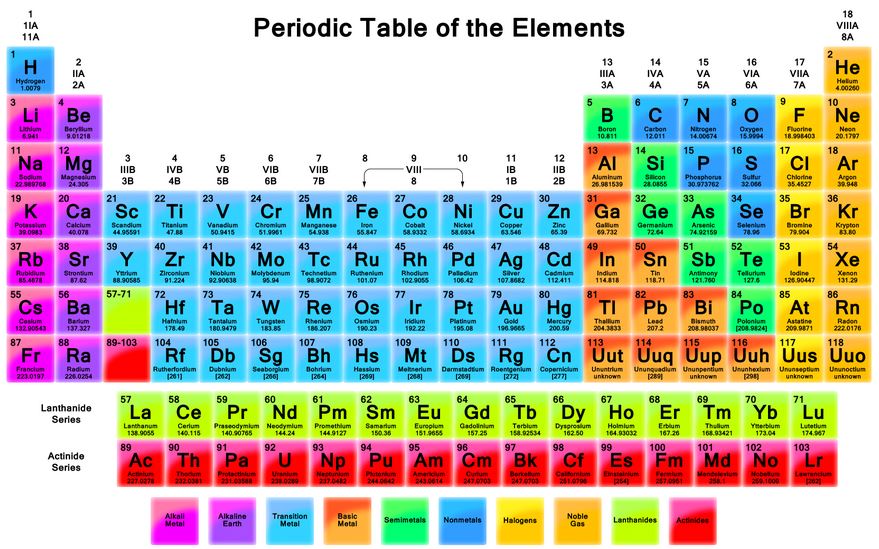
Elements on the LEFT side of the periodic table will most likely form:
a)
Positive ions
b)
Negative ions
c)
Neutral Ions
d)
None of these
60.
An ionic bond forms when atoms ___________ electrons.
a)
gain
b)
share
c)
increase
d)
transfer
61.
Chemical bonds form when atoms
a)
combined nuclei
b)
give up neutrons
c)
gain protons
d)
share or transfer electrons
62.
Bonds that form between two metals are called ______________ bonds.
a)
ionic 
b)
covalent
c)
metallic
d)
pervasive
63.
If an atom loses two electrons what charge will it have?
a)
+ 2
b)
 - 2
c)
+1
d)
-1
64.
Covalent compounds
a)
Share electrons
b)
transfer electrons
c)
contain a sea of electrons
d)
conduct electricity
65.
A bond that forms when electrons are transferred is called a/an
a)
ionic bond
b)
covalent bond
c)
hydrogen bond
66.
Atoms joined together by SHARING electrons are?
a)
Ionic bonds
b)
Covalent bonds
c)
Metallic Bonds
d)
James Bonds
67.
Which type of bond creates a "pool" of electrons between atoms?
a)
Ionic Bonds
b)
Covalent Bonds
c)
Metallic Bonds
d)
Saving Bonds
68.
Gain or lose electrons
a)
Ionic Bonds
b)
Covalent Bonds
c)
Both bonds
d)
Neither bond
69.
Share electrons
a)
Ionic Bonds
b)
Covalent Bonds
c)
Both bonds
d)
Neither bond
70.
Between metals and nometals
a)
Ionic Bonds
b)
Covalent Bonds
c)
Both bonds
d)
Neither bond
71.
Between  nonmetals
a)
Ionic Bonds
b)
Covalent Bonds
c)
Both bonds
d)
Neither bond
72.
H2O
a)
Ionic Bond
b)
Covalent Bond
c)
Both bonds
d)
Neither bond
73.
NaCl
a)
Ionic Bond
b)
Covalent Bond
c)
Both bonds
d)
Neither bond
74.
CO2
a)
Ionic Bond
b)
Covalent Bond
c)
Both bonds
d)
Neither bond
75.
LiF
a)
Ionic Bond
b)
Covalent Bond
c)
Both bonds
d)
Neither bond
76.
This picture shows a...
a)
Ionic Bond
b)
Covalent Bond
c)
Both bonds
d)
Neither bond
77.
This picture shows a...
a)
Ionic Bond
b)
Covalent Bond
c)
Both bonds
d)
Neither bond
78.
Atoms are most stable when their outer shell is complete.
a)
true
b)
false
79.
Which of the following is an example of an IONIC COMPOUND?
a)
NaCl
b)
H2O
c)
CO2
d)
NO
80.
Name that Ion
Li+
a)
copper (III)
b)
lithium
c)
ladmium
d)
iodine
81.
Which category of elements have the property of being malleable and ductile?
a)
gases
b)
metals
c)
metalloids
d)
nonmetals
82.
Electrons that are free to move in a metal are referred to as...
a)
localized electrons
b)
delocalized electrons
c)
electrostatic electrons
d)
cations
83.
Which term means "can be shaped?"
a)
malleable 
b)
ductile 
c)
hard 
d)
soft
84.
Alloys include a "sea" of free moving _______. 
a)
electrons
b)
atoms 
c)
molecules 
d)
protons 
85.
Ionic bonds are between _______ and ________. 
a)
nonmetals and nonmetals 
b)
metals and metals 
c)
metals and nonmetals
d)
none
86.
How does a positively charged ion form?
a)
An atom loses an electron
b)
An atom gains an electron
c)
An atom gains a proton
d)
An ionic compound dissolves
87.
In covalent bonding, electrons are
a)
shared
b)
transferred
c)
wiped out
88.
Covalent bonds tend to happen between two
a)
metals
b)
nonmetals
c)
metal and nonmetal
89.
Atoms want
a)
A full outer shell of electrons
b)
One electron short of a full shell
c)
kit kats
90.
What do metals conduct?
a)
heat
b)
electricity
c)
both
d)
neither
91.
The relative molecular mass of a compound is equal to the sum of its
a)
Atomic mass
b)
Atomic number
c)
Oxidation number
d)
Valence electrons
92.

Each element is defined by the number of

a)

Atoms

b)

Isotopes

c)

Neutrons

d)

Protons

e)

Nuclei.

93.

How to say 'Good at' in Nihongo?

a)

JOUZU

b)

JAUZU

c)

HETA

d)

HATE

94.

What type of charge does a proton have?

a)

negative

b)

postive

c)

no charge/neutral

95.

What type of charge does an electron have?

a)

positive

b)

no charge/neutral

c)

negative

96.

What is the center of the atom called?

a)

nucleus

b)

electron cloud

c)

energy level

d)

neutron

97.

What two sub-atomic particles belong in the nucleus of an atom?

a)

electrons and protons

b)

protons and neutrons

c)

electrons and neutrons

98.

How do you find the atomic number?

a)

by the number of electrons

b)

by the number of protons

c)

by the number of neutrons

99.

The number of neutrons in an atom =

a)

protons - neutrons

b)

mass number - protons

c)

protons - neutrons

d)

mass number - electrons

100.

What type of charge does a neutron have?

a)

negative

b)

positive

c)

no charge/neutral

101.

The number of electrons in an atom is found by the

a)

protons

b)

atomic number

c)

protons and atomic number

d)

none

102.

The mass number of an atom =

a)

protons + neutrons

b)

protons - neutrons

c)

electrons - neutrons

d)

neutrons + electrons

103.

All matter is made of what...

a)

energy

b)

atoms

c)

electrons

d)

compounds

104.

The central region of an atom where its neutrons and protons are is its

a)

nucleus

b)

electron cloud

c)

core

d)

center

105.

Particles in an atom that are neutral and have no charge are

a)

negatrons

b)

electrons

c)

neutrons

d)

protons

106.
A particle that moves around the nucleus is a(n)...
a)
Proton
b)
Neutron
c)
Electron
d)
Quark
107.

In the modern periodic table, elements are arranged by:

a)

atomic mass

b)

atomic number

c)

valence electrons

d)

number of isotopes

108.

The central region of an atom where its neutrons and protons are is its

a)

nucleus

b)

electron cloud

c)

core

d)

center

109.

An atom with atomic number 6 would have how many protons

a)

6

b)

12

c)

3

d)

cannot be determined

110.
What are the 3 particles that make-up the atom?
a)
protons, neutrons, and isotopes
b)
neutrons, isotopes, and electrons
c)
positives, negatives, and electrons
d)
protons, neutrons, and electrons
111.
In an exothermic reaction, heat is ...
a)
taken in
b)
given out
112.
In an endothermic reaction, heat is ,,,
a)
taken in
b)
given out
113.
What type of reaction occurs in a hand warmer
a)
exothermic
b)
endothermic
114.
What happens to the bonds when 2 substances react
a)
They break so new bonds can form
b)
Nothing the bonds are too strong
c)
They change colour
115.

Which one of them is not a fossil fuel?

a)

Coal

b)

Water

c)

Gas

d)

Oil

116.

When new chemical bonds form, energy ____________.

a)

is taken into the system.

b)

stays the same in the system.

c)

is released from the system.

117.

What type of reaction is represented by the graph above?

a)

endothermic

b)

exothermic

118.

What type of reaction is represented by the graph above?

a)

endothermic

b)

exothermic