wayground logo

Free Printable Worksheets

Font size

S
M
L
XL
Worksheets

Chemistry Final Review

Total questions: 117

Worksheet time: 4hrs 55mins
Name
Class
Date
1.
What are the states of matter?
a)
solid, liquid, and juice
b)
solid and liquid
c)
solid and gas
d)
solid, liquid, and gas
2.
At higher temperatures
a)
particles in an object have less energy
b)
particles in an object move faster
c)
a gas contracts
3.
Molecules are closest together in a 
a)
Solid
b)
Liquid
c)
Gas
d)
plasma
4.
A gas
a)
has a definite shape but no definite volume
b)
has a definite volume but no definite shape
c)
has fast-moving particles
5.
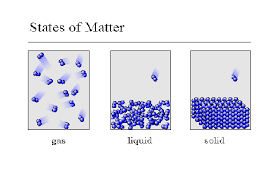
What state of matter does the picture best describe?
a)
Solid
b)
Liquid
c)
Gas
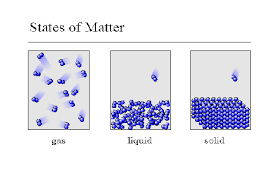
6.
Which State of Matter does the diagram best represent?
a)
Solid
b)
Liquid
c)
Gas
7.

The more energy that particles have, the ___ they move.

a)

slower

b)

faster

8.

When matter is decreasing in temperature the particles...

a)

Move slower and get closer together

b)

Move slower and get farther apart

c)

Do not change speed or distance from one another

9.
Look at this image.  Which object has the LOWEST density in water? How
a)
The Ping Pong Ball because it floats to the top 
b)
The bolt because it has sunk to the bottom
c)
The soda cap because it is not just full of air like the Ping Pong ball
10.
What two types of measurements make up DENSITY
a)
Mass and Volume
b)
Temperature and Mass
c)
Grams and Centimeters
d)
Volume and Weight
11.
Jack has a rock. The rock has a mass of 14g and a volume of 2cm3. What is the density of the rock?
a)
7 mL
b)
7 g/cm3
c)
28 g/cm3
d)
1/7 g/cm3
12.
Frank has an eraser. It has a mass of 4g, and a volume of 2cm3. What is its density?
a)
8 g/cm3
b)
2 g/cm3
c)
1/2 g/cm3
d)
24 g/cm3
13.
What units are used to measure mass?
a)
g
b)
cm3
c)
g/cm3
d)
cm3/g
14.
What is the formula for density?
a)
density = mass x volume
b)
density = mass / volume
c)
density = mass + volume
d)
density = mass - volume
15.
What units can be used to express density?
a)
g/mL
b)
grams
c)
millimeters
d)
milliliters
16.
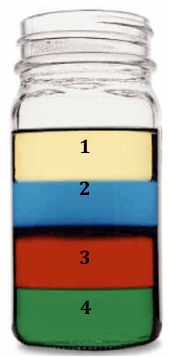
Put the liquids in order from most dense to least dense?
a)
4, 3, 2, 1
b)
1, 2, 3, 4
c)
3, 4, 2, 1, 
d)
4, 3, 1, 2
17.
What is the volume of Object X?
a)
10.0 cm3
b)
15.0 cm3
c)
20.0 cm3
d)
25.0 cm3
18.
Why do some substances float on water?
a)
they are warmer than water
b)
they are cooler than water
c)
they are more dense than water
d)
they are less dense than water
19.
Which units of measurement are used for volume?
a)
grams
b)
centimeters
c)
grams/milliliter
d)
milliliter
20.
A crayon has a mass of 10g and volume of 5 mL. What is the density?
a)
30 g/mL
b)
15 g/mL
c)
1 g/mL
d)
2 g/mL
21.
What is this tool to get volume?
a)
triple beam balance
b)
ruler
c)
thermometer
d)
graduate cylinder
22.
What is this tool to get mass?
a)
triple beam balance
b)
ruler
c)
thermometer
d)
graduate cylinder
23.
What is the density of a liquid that has a mass of 27g and a volume of 30ml?
a)
0.9 g/ml
b)
3 g/ml
c)
57 g/ml
d)
810 g/ml
24.
Which substance is the MOST dense?  ** Use the key
a)
A
b)
B
c)
C
25.
Which substance is the least dense? **Use the key 
a)
A
b)
B
c)
C
26.

When air is heated, its volume ____________.

a)

increases

b)

decreases

c)

remains the same

27.

Convection can take place in ____________.

a)

solids only.

b)

liquids only.

c)

liguids and gases only.

d)

solids, liquids and gases.

28.

The diagram shows some rice being boiled in a pan. What is the main methods by which thermal energy is transferred (i) through the metal pan and

(ii) through the water?

a)

(i) conduction (ii) conduction

b)

(i) convection (ii) convection

c)

(i) conduction (ii) convection

d)

(i) convection (ii) conduction

29.

Which of the following is an application of convection?

a)

The movement of heat through a metal pan to the food.

b)

The use of ice box to keep drinks cool.

c)

The sea breeze that blows from sea to land.

d)

The use of wool blanket to keep the body warm.

30.

Where do convection cycles happen?

a)

core

b)

mantle

c)

crust

31.

Convection cycles move in the mantle. How does this affect the crust?

a)

crust has no motion

b)

crust moves in random direction

c)

crust moves in same direction convection cycle moves

32.
In an ocean, warm water moves __________ and cold water moves ____________.
a)
Down, Up
b)
Up, Down
33.
During the day, water from the ocean is transferred to the atmosphere. Which statement best describes the energy change that takes place during the transfer?
a)
the ocean is cooled when energy is transferred from the atmosphere to the ocean
b)
ocean waves speed up when energy is transported from the ocean to the atmosphere
c)
the atmosphere is warmed when energy is transferred from the ocean to the atmosphere
34.
What kind of heat transfer happens when the sun is heating your body?
a)
Conduction
b)
Radiation
c)
Convection
d)
Density
35.
Ironing a shirt is an example of...
a)
condensation
b)
conduction
c)
convection
d)
radiation
36.
Warm air is __________ dense than cold air and rises creating convection currents.
a)
more
b)
less
37.
A chair is several feet from a fireplace. The side of the chair facing the fireplace gets warm due to
a)
conduction
b)
convection
c)
radiation
38.
"Lava lamps" contain colored liquids. These liquids form globs that rise to the top due to
a)
conduction
b)
convection
c)
radiation
39.
List the correct order of conduction.
1. They collide more vigorously with neighbouring particles
2. 
Particles at the heated end gain kinetic energy and vibrate vigorously.
3. Particles at cooler end vibrate vigorously.
a)
1, 2, 3
b)
3, 2, 1
c)
2, 1, 3
d)
1, 3, 2
40.

In the equation, 146C --> 147N + 0-1B, the _______ decay of radioactive carbon-14 results in the creation of a new nitrogen-14 atom.

a)

Gamma

b)

Beta

c)

Alpha

41.
How is the alpha particle written in a nuclear equation?
a)
42He
b)
24He
42.
In the nuclear equation below, calculate the mass number of the alpha particle. 
23892U-->23490Th + 42He + 200
a)
238
b)
0
c)
234
d)
4
43.
Uranium-238  decays into  Thorium-234  by emitting .........
a)
an alpha particle
b)
a beta particle
c)
gamma rays
d)
visible light
44.
Solve this equation for alpha decay.
85209At = ___ + 24He
a)
83205Bi
b)
86209Rn
c)
81207Tl
d)
85208At
45.

Gamma rays have

a)

no mass

b)

a huge mass

c)

a small mass

d)

an average mass

46.
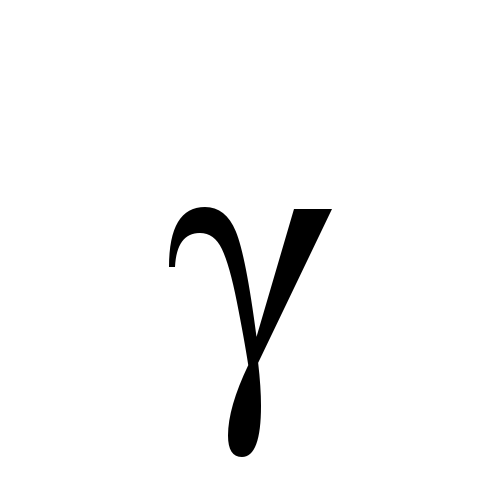
Has the symbol
a)
Alpha
b)
Beta 
c)
Gamma
47.
In a correctly written symbol what would be located in the "A" position?
a)
number of neutrons
b)
atomic number
c)
number of electrons 
d)
mass number
48.

In a correctly written symbol what would be located in the "Z" position?

a)

number of neutrons

b)

atomic number

c)

number of electrons

d)

mass number

49.
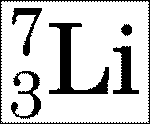
How many protons are in this atom?
a)
3
b)
4
c)
6
d)
10
50.

24094Pu —› ____ + 42He

a)

23692U

b)

24796Cm

c)

24493Np

d)

24295Am

51.
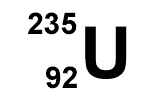
How many neutrons are in this isotope of Uranium?
a)
235
b)
92
c)
327
d)
143
52.

If the nucleus has too many neutrons, a neutron will turn into a proton and emit a fast-moving electron. This process is known as ___________.

a)

alpha radiation

b)

beta radiation

c)

gamma radiation

d)

neutron radiation

53.

What type of radiation is the most penetrating?

a)

Alpha

b)

Beta

c)

Gamma

54.

In alpha decay, a ________ particle breaks off of an atom.

a)

hydrogen

b)

helium

c)

carbon

d)

lithium

55.

What happens to an atom's mass when it undergoes beta decay?

a)

increases by 2

b)

increases by 4

c)

decreases by 2

d)

it does not change

56.

When an atom undergoes gamma ray radiation, its atomic number...

a)

increases by 1

b)

decreases by 1

c)

decreases by 2

d)

does not change

57.

Cobalt-60 (shown in diagram) undergoes gamma decay. What will it's atomic number be after it decays?

a)

60

b)

28

58.

Cobalt-60 (shown in diagram) undergoes gamma decay. What will it's mass number be after it decays?

a)

60

b)

28

59.
The type of radioactive particle that can be stopped by a sheet of paper is the ____.
a)
alpha particle
b)
beta particle
c)
gamma ray
d)
uranium
60.
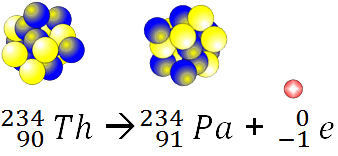
The three types of nuclear radiation in increasing order of penetrating power are ____.  
a)
  alpha, beta, gamma 
b)
X ray, beta, gamma
c)
alpha, gamma, beta 
d)
X ray, gamma, beta 
61.
Which type of nuclear radiation is being emitted here?
a)
Alpha
b)
beta
c)
gamma 
d)
none
62.
If we start off with element 24X50 after an alpha decay we get another element Y that looks like
a)
22Y50
b)
22Y46
c)
20Y48
d)
26Y54
63.

What type of nuclear decay is shown here

13756Ba →→ 13756Ba + γ rays

a)

alpha

b)

beta

c)

gamma

64.

Finish this equation

20983Bi--> _______ + 20581Tl

a)

42He

b)

0-1e

c)

y

65.

finish the equation


18173Ta --> ____ + 18174W

a)

42He

b)

0-1e

c)

y

66.
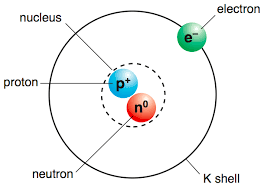
What subatomic particles would you find in the nucleus of an atom?
a)
Protons only
b)
Protons and Neutrons
c)
Neutrons and Electrons
d)
Protons and Electrons 
67.
What subatomic particle is electrically neutral (no charge)?
a)
Proton
b)
Ion
c)
Neutron
d)
Electron
68.
What subatomic particle(s) would be found orbiting the nucleus?
a)
Neutrons only
b)
Electrons only
c)
Protons and Neutrons
d)
Protons and Electrons
69.
Which subatomic particles contribute the most to the mass of an atom?
a)
Protons, Neutrons, Electrons
b)
Protons only
c)
Protons and Electrons
d)
Protons and Neutrons
70.
The first energy level can hold up to how many electrons?
a)
8
b)
4
c)
2
d)
5
71.
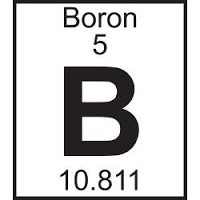
Which number here is my atomic number?
a)
5
b)
10.811
72.
How many protons does this atom have?
a)
2.5
b)
6
c)
5
d)
10.811
73.
In order for me to find the number of neutrons, I must round the atomic mass and then do what?
a)
atomic number-atomic mass
b)
atomic number x atomic mass
c)
atomic mass + atomic number
d)
atomic mass - atomic number
74.
an atom with atomic number 6 would have how many protons 
a)
6
b)
12
c)
3
d)
cannot be determined 
75.
Isotopes are atoms of the same element with different #’s of __________ & therefore different __________.
a)
n0 ;  atomic #’s
b)
p+ ; atomic #’s
c)
e- ; atomic masses
d)
n0 ; atomic masses
76.
How many neutrons does the isotope below have?     89 36Kr
a)
53
b)
36
c)
89
d)
125
77.
How many neutrons does an atom of the isotope Neon-22 have?
a)
12
b)
10
c)
22
d)
20
78.

What is a positive ion called?

a)

anion

b)

cation

c)

isotope

d)

covalent

79.

What is a negative ion called?

a)

anion

b)

cation

c)

covalent

d)

isotope

80.

A Bromine ion gains 1 electron, which of the following is the correct symbol for a Bromine ion?

a)

Br-1

b)

Br+1

c)

Br+7

d)

Br-7

81.
What is the charge of an atom that has lost one electron?
a)
-1
b)
-2
c)
+1
d)
+2
82.
If an element has 3 valence electrons, what charge will likely form on its ion ?  Hint:  It will lose those electrons.  What happens to the charge when it loses 3 electrons?
a)
+3
b)
+5
c)
-3
d)
-5
83.
How many total electrons does Mg+2 (a magnesium ion) have?
a)
10
b)
12
c)
14
d)
22
84.
How many total electrons does O-2 (an oxide ion) have?
a)
8
b)
10
c)
6
d)
18
85.
How many total electrons does Na+1 (a sodium ion) have?
a)
10
b)
11
c)
12
d)
22
86.

How many electrons are in an atom that has an atomic number of 34, an atomic mass of 74 and a charge of -2?

a)

2

b)

34

c)

36

d)

40

87.

Write the hyphen notation for the isotope that has 39 protons and 50 neutrons.

a)

Yttrium-11

b)

Tin-39

c)

Tin-89

d)

Yttrium-89

88.
Which of the following will have a lower ionization energy than Scandium (Sc)?
a)
Helium (He)
b)
Titanium (Ti)
c)
Calcium (Ca)
d)
Magnesium (Mg)
89.
Atoms that have a high electronegativity, _______________.
a)
give up their electrons more easily.
b)
hold on to their electrons more tightly.
c)
have more electron shells.
90.
Electronegativity is...
a)
how good an atom is at attracting electrons
b)
the ability of an atom to lose electrons
c)
the energy required to remove an electron from a specific atom
d)
how easy it is to make friends. 
91.
Ionization energy is...
a)
the energy required to add an electron to a specific atom
b)
how much energy it takes to remove an electron from an atom
c)
the energy required to shield the outer electrons from the nucleus
d)
a measure of the ability of an atom to attract electrons
92.
Atomic radius generally increases as we move __________.  
a)
down a group and from right to left across a period 
b)
up a group and from left to right across a period 
c)
down a group and from left to right across a period 
d)
up a group and from right to left across a period 
93.
Electronegativity __________ from left to right within a period and __________ from top to bottom within a group.
a)
decreases, increases 
b)
increases, increases
c)
increases, decreases 
d)
stays the same, increases
94.
Which element has the smaller atomic radius: potassium (K) or bromine (Br)?
a)
potassium (K)
b)
bromine (Br)
95.
Which element has the greatest electronegativity: Nitrogen (N) or Arsenic (As)?
a)
Nitrogen (N)
b)
Arsenic (As)
96.
Which has the greater Electronegativity: 
N or C?
a)
C
b)
N
97.
Which of the following will have a higher electronegativity than arsenic (As)?
a)
Carbon (C)
b)
Neon (Ne)
c)
Antimony (Sb)
d)
Germanium (Ge)
98.
What term is used to describe "A measure of the size of an atom"
a)
chemical reactivity
b)
atomic radius
c)
energy levels
d)
orbit
99.
Which of the following will have a larger radius than Zinc?
a)
Gallium
b)
Aluminum
c)
Magnesium
d)
Strontium
100.

According to the Octet Rule, atoms of elements react with each other in order to attain ____ electrons in their outermost energy level or shell.

a)

2

b)

4

c)

6

d)

8

e)

10

101.

What are valence electrons?

a)

The total number of electrons in an atom

b)

The number of electrons in the outermost shell

c)

The number of electrons in the second shell

d)

The number of protons in the outermost shell

102.

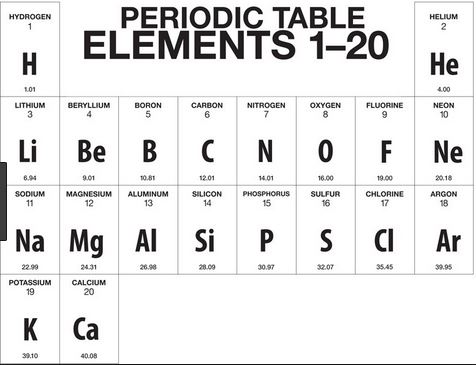
USE THE PERIODIC TABLE

How many valence electrons does Phosphorus have?

a)

31

b)

5

c)

15

d)

4

103.
How many valence electrons are in an atom of Ar?
a)
2
b)
8
c)
4
d)
1
104.
How many Valance electrons does Iodine Have?
a)
6
b)
16
c)
7
d)
17
105.

USE THE PERIODIC TABLE

How many valence electrons does sodium have?

a)

1

b)

2

c)

3

d)

4

106.

How many valence electrons does Helium Have?

a)

1 Valence electron

b)

2 Valence electron

c)

3 Valence electron

d)

4 Valence electron

e)

5 Valence electron

107.

How many valence electrons does Nitrogen Have?

a)

1 Valence electron

b)

2 Valence electron

c)

3 Valence electron

d)

4 Valence electron

e)

5 Valence electron

108.
What is the symbol for Thermal Energy?
a)
Q
b)
t
c)
m
d)
C
109.
What unit do you use to measure Thermal Energy?
a)
J/Kg ºC
b)
Kg
c)
ºC
d)
J
110.
What is the symbol for Specific Heat
a)
Q
b)
t
c)
m
d)
C
111.
What is the equation to measure change in Thermal Energy?
a)
Q=mc∆t
b)
Q=mc
c)
Q= ∆mct
d)
m=QC
112.
A material was cooled from 100ºC to 40ºC.  What is the temperature change?
a)
60ºC
b)
40ºC
c)
-60ºC
d)
-40ºC
113.

What does  ΔT\Delta T  represent?

a)

 tf tit_{f\ }-t_i  

b)

 ti tft_{i\ }-t_f  

c)

t - celsius

d)

celsius - t

114.
If 200 grams of water is to be heated from 24.0° C to  100.0° C to make a cup of tea, what is the mass and what is the change in temperature?
a)
m=100g,  ∆t= 224 C
b)
m=200g,  ∆t=124 C
c)
m=100g,  ∆t=24 C
d)
m=200g,  ∆t=76 C
115.
20 g of water. specific heat of water is 4.18 J/g°C.  temperature changes from 25° C to 20° Chow much heat energy (Q) moves from the water to the surroundings?
a)
418 Joules
b)
209 J
c)
83 J
d)
4.18 J
116.
The specific heat(c) of copper is 0.39 J/g °C. What is the temperature change(∆t) when 100 Joules of heat(Q) is added to 20 grams of copper?
a)
12.82 °C
b)
24.12°C
c)
351 °C
117.
If the specific heat of water is 4,186 J/kg∙°C, how much heat is required to increase the temperature of 1.2 kg of water from 23 °C to 39 °C? 
a)
-80,371.2 J
b)
44,938.6 J
c)
80,371.2 J
d)
112,575.9 K