
 Worksheets
Final Exam Review Part 2H
Total questions: 112
Worksheet time: 3hrs 13mins

A mixture of two or elements at least one of which is a metal is called
an ion
an alloy
steel
a crystal
A solid substance is an excellent conductor of electricity in both solid and molten states and is malleable and ductile. The chemical bonds in this substance are most likely?
Bonds formed by transferring electrons from one atom to another are
ionic
metallic
non polar covalent
covalent
Bonds formed by sharing electrons between atoms are
ionic
metallic
covalent
dipole-dipole
A compound that is a poor conductor and has low melting and boiling points is most likely
ionic
metallic
covalent

Describes the number of molecules or moles in a compound and is used to balance a chemical reaction.
KClO3 --> KCl + O2
If an element is diatomic it should have a subscript of___
1, always
2, only when it is an element
it shouldn't have a subscript, it should have a coefficent
2, when bonded in a compound
The symbol for a substance dissolved in water is ______
(s)
(l)
(aq)
(g)
Predict the products of this synthesis reaction: H2 + Cl2 →
HCl
H2Cl2
H2Cl
HCl2
What type of reaction is this?
2 C6H14 + 19 O2 → 12 CO2 + 14 H2O
Single Replacement
Double Replacement
Combustion
Decomposition
Predict the products for the decomposition of aluminum oxide, Al2O3 →
Al + O2
O + Al2
Al2 + O3
Al + O
What type of reaction is shown below?
Zn + 2HCl --> ZnCl2 + H2
Synthesis
Decomposition
Single Replacement
Double Replacement
Which of the following is an example of synthesis?
Na + Br2 → NaBr
KClO3 → KCl + O2
HgO + Cl2 →HgCl + O2
Cl2 + NaBr → NaCl + Br2
What type of reaction is this?
NO2 → N2 + O2
Synthesis
Decomposition
Single replacement
Combustion
Double replacement
Which of the following chemical equations is an example of a double replacement reaction?
2Al2O3 ⟶ 4Al + 3O2
2C5H10 + 15O2 ⟶ 10CO2 + 10H2O
2MgCl2 + Na2CO3 ⟶ 2 NaCl + MgCO3
K2O + H2O ⟶ 2 KOH
Unlike Ionic compounds, Covalent compounds require what when naming them?
A roman numeral
A charge
A prefix
When is the prefix mono not used?
It is never used when naming covalent compounds
It is never used on the second element
It is never used when on the first element
What is the name for NI3?
Mononitrogen TretraIodide
Nitrogen Triiodide
Nitrogen (III) Triiodide
Nitrogen Iodide
What is the name for P2O5?
Diphosphorous Pentaoxide
Phosphorous Oxide
Phosphorous (III) Oxide
Diphosphide Oxide
The name of FeCl₂ is
iron chloride
iron (II) chloride
iron (I) chloride
iron dichloride
LiBr is called
lithium bromine
lithium (I) bromine
lithium bromide
lithuim (I) bromide
Calculate the molar mass for Al(OH)3
78.0 g/mol
72 g/mol
28 g/mol
25 g/mol
Convert 86.235 g of diphosphorus pentaoxide to moles.
12240 moles
1.8747 moles
.608 moles
.60755 moles
How many molecules are there in 5.5 moles potassium chloride?
4.08 x 10⁻²⁴
3.31 x 1024
33.11
0.98
What is the percent by mass of fluorine in CaF2 (molar mass = 78 g/mol)?
What is the percent by mass of calcium in CaF2 (molar mass = 78 g/mol)?
Fe2O3(s) + 3H2(g) → 2Fe(s) + 3H2O(l)
How many moles of iron can be made from 6 moles H2?
Fe (s) + S (l) --> FeS (s) In the reaction above, 6.78 g of FeS was measured to have been produced, but 7.84 g was calculated to be produced. What is the % yield of FeS (s)?

particles in an object move faster and have less KE
particles in an object move faster and have more KE
particles in an object move slower and have more KE

What letter on the diagram represents a gas?
A
B
C
D
What letter on the diagram represents the triple point?
A
B
C
D

What line segment represents only the solid state? (Diagram F)
A-B
B-C
C-D
D-E
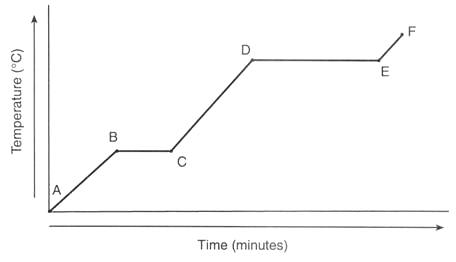
Between which points is the temperature of the substance remaining constant? (Diagram F)
A-B only.
A-B, C-D, E-F
B-C only.
B-C, D-E

A substance's heating curve is shown in the graph. What is its boiling point? (Diagram B)
100 C
60 C
80 C
20 C

Is the substance gaining or losing energy? (Diagram D)
Gaining
Losing

What will occur when the substance changes from 1 atm to 30 at a constant temperature of -15oC? (Diagram A)
condensation
deposition
melting
sublimation
**An ice cube feels cold when we hold it. Which of the following best explains why?
Heat moves from our hands into the ice cube.
Cold moves from our hands into the ice cube.
Heat moves from the ice cube into our hands.
Cold moves from the ice cube into our hands.

What is the normal boiling point of this substance? (Diagram C)
150 °C
100 °C
-50 °C
0 °C


Where on the graph are phase changes taking place?
1
2
3
4
5
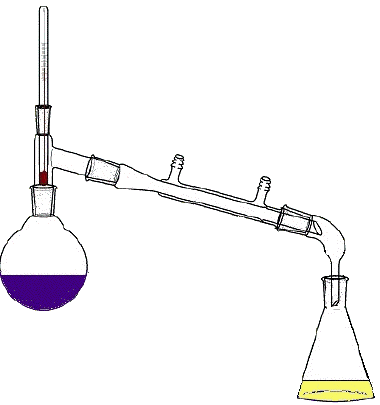

This diagram represents...
An element
A molecule
A compound
A mixture of elements and compounds


In a solution the substance that dissolves in the solvent.
Solute
Suspension
Colloid
Solvent
In a solution the substance which the solute dissolves
solvent
suspension
colloid
solution
A mixture with more solute dissolved in the solvent than is usually soluble is called:
concentrated
supersaturated
saturated
unsaturated
Which of the following is NOT a unit used to express concentration?
Molality
Molarity
Mass percent
Density


Solubility refers to the ____ of solute that can dissolve in a certain volume or mass of solvent, at a certain temperature.
Mean
Range
Amount
Mode
Which of the following factors affects the solubility of solutes?
temperature
polarity of solute and solvent
stirring
both a and b
What is the correct order for obtaining salt from a mixture of sand and salt?
Dissolving in water - filtration – evaporation
Evaporation - filtration - dissolving in water
Filtration - dissolving in water - evaporation
Dissolving in water – evaporation - filtration
Which mixture can be separated using a filtration method?
oil and water
sand and iron powder
sand and water
water and ethanol
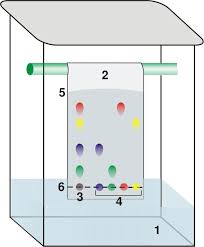
Dyes in water soluble markers may be separated by means of..
crystallization
sublimation
chromatography
sedimentation
When KCl (potassium chloride) is dissolved in water, how many particles are in solution for each unit?
1
2
3
4
6
Which techniques could increase or speed up the rate of dissolving?
stirring and heating the mixture
When CaBr2 is dissolved in water, how many particles will be in solution for each unit?
1
2
3
4
5
At the same concentration, which salt will have the largest effect on the freezing point?
C2H4O2
H2S
LiBr
CaF2
The van't Hoff factor measures the number of particles formed in solution. What is the van't Hoff factor for the compound Na2SO4?
1
3
5
7
Electrolytes have a greater effect on colligative properties than nonelectrolytes do because electrolytes
are volatile
have higher boiling points
produce fewer moles of solute particles per mole of solvent
produce more moles of solute particles per mole of solvent


Which group has a -3 charge?
group 13
group 3
group 15
group 14


Elements in group 2 will form ions with what charge?
What's the first thing you should do when you see a temperature in Celsius?
Ex: 48°C
add 273
subtract 273
multiply 273
divide 273
When gas particles collide with the side of the container, it creates
volume
pressure
temperature
quantity

Flask A has hydrogen gas and Flask B has oxygen gas. Both are kept at the same temperature and same pressure. What conclusion can you make?
Flask A has more gas particles.
Flask B has more gas particles.
Flask A and B have equal particles.
There's not enough information.
What temperature scale must we use in the Gas Laws?
Rankine
Fahrenheit
Kelvin
Celsius
How do we measure an increase in kinetic energy?
volume
temperature
Liters
none of the above
A sample of He gas (2.35 mol) occupies 57.9 L at 300.0 K and 1.00 atm. The volume of this sample is ___L at 423 K and 1.00 atm.
0.709 L
57.9 L
41.1 L
81.6 L
1.41 L
A sample of a gas (5.0 mol) at 1.0 atm is expanded at constant temperature from 10.0 L to 15.0 L. The final pressure is ___ atm.
1.5 atm
15 atm
0.67 atm
3.3 atm
7.5 atm
A gas sample is held at constant pressure. The gas occupies 3.62 L of volume when the temperature is 21.6°C. Determine the temperature at which the volume of the gas is 3.42 L.
312K
278K
20.4K
295K
552K

What is the pressure exerted by 5.00 moles of nitrogen gas contained in a 30.0 Liter container at 25.0 °C?
3670 atm
0.245 atm
4.08 atm
605 atm
A sample of a gas (5.0 mol) at 1.0 atm is expanded at constant temperature from 10.0 L to 15.0 L. The final pressure is ___ atm.
1.5 atm
15 atm
0.67 atm
3.3 atm
7.5 atm
A sample of He gas (2.35 mol) occupies 57.9 L at 300.0 K and 1.00 atm. The volume of this sample is ___L at 423 K and 1.00 atm.
0.709 L
57.9 L
41.1 L
81.6 L
1.41 L

