wayground logo

Free Printable Worksheets

Font size

S
M
L
XL
Worksheets

Wk 16: Semester Midterm Review

Total questions: 108

Worksheet time: 2hrs 24mins

Name
Class
Date
1.
Two Reactants and One Product
a)
Decomposition
b)
Synthesis
c)
Combustion
d)
Single Replacement
2.
One reactant into several products.
a)
Decomposition
b)
Synthesis
c)
Combustion
d)
Single Replacement
3.
Ions in two compounds switch. 
a)
Synthesis
b)
Combustion
c)
Single Replacement
d)
Double Replacement
4.
What does aq mean in a chemical reaction?
a)
aqua dancing
b)
aqua lungs
c)
aqualirious
d)
aqueous
5.
H2O + C yields H2 + CO2
1. Balance the equation,
2. what type reaction is this
a)
4:2:4:2
Decomposition
b)
1:1:1:2
Single Replacement
c)
2:1:2:1
Double Replacement
d)
2:1:2:1
Single Replacement
6.
Always starts with a Hydrocarbon that reacts with oxygen and produces carbon dioxide and water. 
a)
Decomposition
b)
Synthesis
c)
Combustion
d)
Single Replacement
7.

What are reactants?

a)

The chemicals that start the reaction.

b)

The chemicals that the reaction produced.

c)

The chemicals that are on the right side of the arrow.

8.

What are products?

a)

The chemicals that start the reaction.

b)

The chemicals that the reaction produced.

c)

The chemicals that are on the left side of the arrow.

9.

Identify the type of reaction:

ZnCl2 + Mg --> Zn + MgCl2

a)

Precipitate

b)

Single Replacement

c)

Double Replacement

d)

Decomposition

10.

Identify the reaction type:

NaCl + KOH --> KCl + NaOH

a)

Double replacement

b)

Combustion

c)

Synthesis

d)

Decomposition

11.
What is a coefficient?
a)
The small number on the right of the chemical symbol.
b)
The large number to the left of a formula.
12.
What is the little number after an element in a chemical equation called.
Example: H2
a)
Coefficient 
b)
Subscript
c)
Atom
d)
Equation
13.
Which side of a chemical equation is the reactant side?
a)
Left (before the arrow)
b)
Right (after the arrow)
14.
Which side of a chemical equation is the product side?
a)
Left (before the arrow)
b)
Right (after the arrow)
15.
Balance this equation
_Zn+_HCl-->_ZnCl+_H2
a)
1,1,2,1
b)
1,1,1,2
c)
1,2,1,1
d)
2,1,1,1
16.
Balance this equation.
_Mg + _Cl--> _MgCl2
a)
1, 2,1
b)
already balanced
c)
2,1,1
d)
1,1,2
17.
What does the Law of Conservation of Mass state?
a)
Matter cannot be gained or lost in a chemical reaction.
b)
Matter can only be lost in a chemical reaction.
c)
Matter can only be gained in a chemical reaction.
d)
Matter can be gained and lost in a chemical reaction. 
18.
Is making salt water to gargle with a physical or chemical change?
a)
physical
b)
chemical
19.
Is glass breaking a chemical or phyiscal change?
a)
chemical
b)
physical
20.
Marie had a beaker with a small amount of baking soda. She added a few drops of pickle juice to the baking soda and observed fizzing and bubbling. Based on her observation, which of these can Marie determine about the new substance formed by mixing the baking soda and pickle juice?
a)
A chemical reaction produced a solid.
b)
A chemical reaction produced a gas.
c)
No chemical reaction took place.
d)
Only a physical change happened.
21.
Which of the following characteristics is shared by all chemical reactions?
a)
Produce a precipitate
b)
Show a color change
c)
Release heat energy
d)
Form new substances
22.
A granular substance is added to a liquid. Which of the following would provide evidence to suggest a chemical change has taken place?
a)
The liquid gives off heat.
b)
The granules dissolve completely.
c)
The volume of the liquid increases.
d)
The granules seem to get smaller.
23.
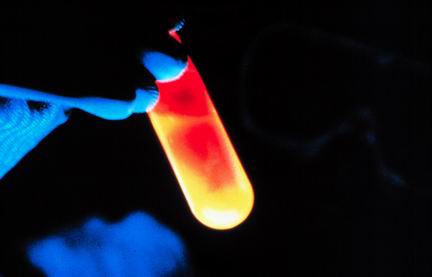
A student mixes two clear liquids together. After a few minutes, a white powdery solid can be seen settling on the bottom of the test tube. Which of the following is a conclusion that the student can draw based on these observations? The two clear liquids –
a)
were pure substances before they were mixed.
b)
are toxic and should be handled with extreme caution.
c)
have gone through a chemical change in which a new substance called a precipitate was produced.
d)
have been stored too long and are no longer good.
24.
A student added white crystals to a clear liquid. The crystals dissolved in the liquid. After a few seconds, the liquid became quite warm and then turned bright red in color. Indications that a chemical change was taking place could be observed when –
a)
the white crystals were added to the clear liquid.
b)
the crystals dissolved in the liquid leaving only the liquid visible.
c)
There are no indications of chemical change
d)
the temperature of the liquid increased and an unexpected color change occurred.
25.
Which of the following is NOT evidence that that a chemical reaction has occurred?
a)
produces light/heat
b)
production of a gas
c)
formation of a precipitate
d)
melting
26.
What causes a phase change?
a)
Motion
b)
Speed
c)
Energy
d)
Friction
27.
Which two phases changes add energy?
a)
Freezing, Melting
b)
Condensation, Evaporation
c)
Freezing, Condensation
d)
Melting, Evaporation
28.
Which two phases changes takes away energy?
a)
Freezing, Melting
b)
Condensation, Evaporation
c)
Freezing, Condensation
d)
Melting, Evaporation
29.

Convert 35 degrees Celsius to Fahrenheit

a)

90 degrees

b)

95 degrees

c)

105 degrees

30.

133℉ is what in Celsius?

a)

57℃

b)

113℃

c)

45℃

d)

0℃

31.

Phase change going from a Solid to a Gas...

a)

Deposition

b)

Sublimation

c)

Condensation

d)

Recombination

32.

Phase change going from a Gas to a Solid...

a)

Deposition

b)

Sublimation

c)

Condensation

d)

Vaporization

33.

Phase change going from Liquid to Solid...

a)

Melting

b)

Freezing

c)

Condensation

d)

Sublimation

34.

Phase change going from a Gas to a Liquid...

a)

Sublimation

b)

Deposition

c)

Ionization

d)

Condensation

35.

Phase change going from a Liquid to a Gas...

a)

Vaporization

b)

Deposition

c)

Condensation

d)

Melting

36.
________________ is anything that has mass and takes up space.
a)
volume
b)
matter
c)
mass
d)
weight
37.
How many significant figures does the following number have: 0.002040
a)
6
b)
4
c)
3
d)
2
38.
How many significant figures does the following number have: 100.00210
a)
7
b)
5
c)
10
d)
8
39.
Determine the number of Significant Figures in 13410000-m.
a)
4
b)
3
c)
2
d)
1
40.
Determine the number of Significant Figures in 10-L.
a)
4
b)
3
c)
2
d)
1
41.

How close a measurement is to the accepted value is called..

a)

Accuracy

b)

Precision

c)

Significant

d)

Estimate

42.
It is a measure of how close measurements come to each other when they are made in the same way
a)
Accuracy
b)
Precision
c)
Error
d)
Extrapolation
43.
7,000 g = ____ kg
a)
70
b)
700
c)
7
d)
0.07
44.
648 g = ____ mg
a)
6,480
b)
64,800
c)
648,000
d)
64.8
45.
240 cm = ___________ m
a)
2400
b)
24
c)
2.4
d)
0.24
46.
32.9 km = ___________ cm
a)
32,900
b)
329,000
c)
3,290,000
d)
32,900,000
47.

One kilometer equals how many meters?

a)

10,000

b)

1,000

c)

100

d)

10

48.

Which statement is true about compounds?

a)

a pure substance where two or more elements are chemically combined

b)

a homogenous mixture of 2 or more elements

c)

a pure substance containing only one type of atom

d)

a heterogeneous mixture of 2 or more elements chemically combined

49.

What is considered the simplest form of matter?

a)

Compounds

b)

Colloids

c)

Solutions

d)

Elements

50.

Sweet Tea, everything is mixed evenly and looks the same.

a)

Heterogeneous Mixture

b)

Homogeneous Mixture

51.
a)

Element

b)

Compound

c)

Homogeneous Mixture

d)

Heterogeneous Mixture

52.
Is salt (NaCI) a compound or a element
a)
Compound
b)
element
53.
Which of the following is an example of a heterogenous mixture?
a)
soap
b)
a salad with lettuce, olives, and tomatoes
c)
cup of coffee
d)
water
54.

Can be beaten into thin sheets

a)

Ductile

b)

Sonorous

c)

Malleable

d)

Flexible

55.

Can be drawn into wires

a)

Ductile

b)

Sonorous

c)

Malleable

d)

Flexible

56.
Takes two small nuclei and combines them into a larger nucleus
a)
fission
b)
fusion
57.
The splitting of a nucleus into smaller nuclei is
a)
fusion
b)
fission
c)
half-life
d)
gamma radiation
58.
How do nuclear power-plants work?
a)
Fusion
b)
Half-life
c)
Fission
d)
Fusion or fission
59.

Pure substances include:

a)

Elements

b)

Homogeneous Mixtures

c)

Compounds

d)

Heterogeneous Mixtures

60.

Mixtures

a)

chemically combined

b)

composed of two or more types of matter that can be present in varying amounts

c)

One or more elements chemically combined

d)

can be separated by physical changes

61.

Which subatomic particle tells the identity of an element?

a)

Electron

b)

Proton

c)

Neutron

d)

Nucleus

62.

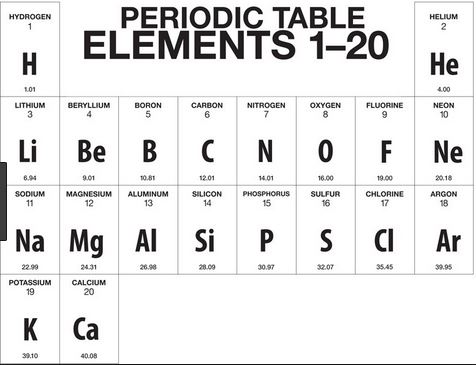
How many electrons are in this element?

a)

39

b)

19

c)

20

d)

21

63.

How many neutrons are in this element?

a)

39

b)

19

c)

20

d)

40

64.

How many electrons does Barium (Ba) have?

a)

56

b)

81

c)

137

d)

218

65.

How many neutrons does Sodium (Na) have?

a)

11

b)

23

c)

34

d)

12

66.
How many protons and electrons are in a copper (II) ion with a mass of 64?
a)
27 protons, 29 electrons
b)
27 protons, 31 electrons
c)
29 protons, 27 electrons
d)
29 protons, 31 electrons
67.
Valence electrons are the...
a)
Innermost electrons
b)
Middle electrons
c)
Outermost electrons
d)
Any electrons
68.
Elements in the same column of the periodic table always have the same # of _______ as one another.
a)
Protons
b)
Neutrons
c)
Electrons
d)
Valence Electrons
69.
How many valence electrons are in an atom of Ba?
a)
2
b)
8
c)
4
d)
1
70.

How many valence electrons does Neon Have?

a)

4 Valence electron

b)

5 Valence electron

c)

6 Valence electron

d)

7 Valence electron

e)

8 Valence electron

71.

A wave with a large wavelength will have a ______ frequency and _____ energy

a)

high, low

b)

high, high

c)

low, high

d)

low, low

72.

If short wavelength has more ENERGY than long wavelength, which color Lightsaber is the most dangerous, or powerful?

a)

Red

b)

Orange

c)

Blue

d)

Green

73.
High frequency waves have _________ wavelength.
a)
varying
b)
high
c)
the same
d)
low
74.
Select the correct order of waves on the Electromagnetic Spectrum
a)
Radio, Micro, Infra, Visible, Ultra, X-ray, Gamma
b)
Gamma, X-ray, Ultra, Vis, Infra, Micro, Radio
c)
Vis, Micro, Infra, Ultra, X-ray, Gamma, Radio
d)
Micro, Radio, Vis, Infra, Ultra, X-ray, Gamma
75.
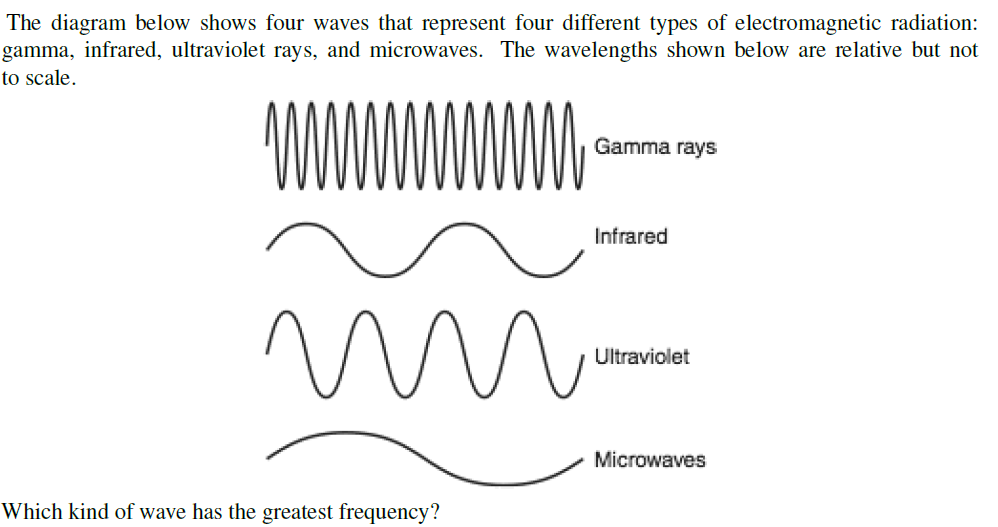
Which kind of wave has the greatest frequency?
a)
gamma rays
b)
infrared
c)
ultraviolet
d)
microwaves
76.
What is the electron configuration for F?
a)
1s2 2s2 3p5
b)
1s2 2s2 3d5
c)
1s2 2s2 2p5
d)
1s2 2p5
77.

What element has the electron configuration 1s2 2s2 2p6 3s2 3p5?

a)

Chlorine

b)

Argon

c)

Fluorine

d)

Sulfur

e)

Bromine

78.

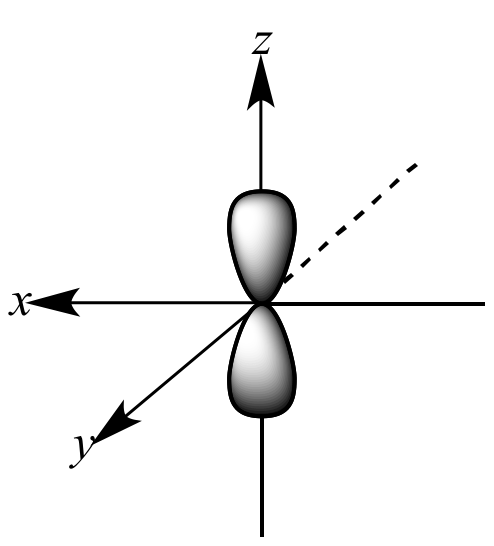
Which shape represents the shape of an "s" orbital?
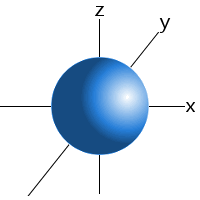
a)
b)
c)
d)
79.

Which orbital is furthest from the nucleus?

a)
b)
c)
d)
80.

The nucleus of an atom contains which subatomic particles?

a)

protons and electrons

b)

protons and neutrons

c)

electrons and neutrons

d)

protons, electrons, and neutrons

81.

Which of the following are subatomic particles? (Check all that apply)

a)

protons

b)

neutrons

c)

megatrons

d)

electrons

82.

Typically in an atom, which two subatomic particles are equal in number?

a)

protons and neutrons

b)

all subatomic particles are equal in number

c)

neutrons and electrons

d)

protons and electrons

83.

The frequency of violet light is 7.5x10¹⁴ Hz. What is its wavelength?

a)

4.0x10⁻⁷ m

b)

4.0x10⁷ m

c)

2.25x10²³m

d)

2.25x10²³ Hz

84.
Violet light has a wavelength of
4.10 x 10⁻¹²  m. What is the frequency?
a)
1.23 x 10^ -3 Hz
b)
7.31 x 10^ 19 Hz
c)
1.37 x 10^12 Hz
d)
3.0 x 10^ 8 Hz
85.

LiBr is called

a)

lithium bromine

b)

lithium (I) bromine

c)

lithium bromide

d)

lithuim (I) bromide

86.

The number that tells you if an ion has lost or gained electrons

a)

atomic number

b)

oxidation number

c)

mass number

d)

electron number

87.
How do the following two elements bond together?
K1+  S2- 
a)
KS
b)
K8S
c)
K6S3
d)
K2S
88.
How do the following two elements bond together?
Al3+  O2-         
a)
AlO
b)
Al2O3
c)
Al3O6
d)
Al3O2
89.
The chemical formula of iron (III)bromide is
a)
FeBr
b)
Fe(III)Br
c)
FeBr₃
d)
Fe₂Br₃
90.

What is the name of the following compound: Mn2O3

a)

manganese oxide

b)

manganese (II) oxide

c)

manganese (III) oxide

d)

magnesium oxide

91.
Diatomic molecules are __________ found in nature as their single element: I, O, N, H, Br, Cl, or H.
a)
often
b)
never
c)
sometimes
d)
always
92.

What are the seven diatomic elements?

a)

H2, Cl2, Br2, O2, N2, I2, F2

b)

H2, Cl2, I2, F2, Hg2, Br2, Fe2

c)

H2, Cu2, Ni2, B2, O2, I2, Fe2

93.

What are diatomic elements?

a)

Elements that form two-atom molecules when not combined in a compound.

b)

Two elements that combine with one atom from each element.

c)

Elements that are always in pairs no matter what.

94.

What number do the diatomic elements form on the periodic table?

a)

7

b)

1

c)

2

95.
Which of the following is the correct Lewis dot structure for the molecule fluorine (F2)?
a)
A
b)
B
c)
C
d)
D
96.
A covalent bond is
a)
a bond that shares electrons metallicaly
b)
A bond that shares electrons with non metals
c)
Metalloids bonding
d)
metals and nonmetals bonding
97.
What is the correct formula for this molecule?
a)
NH
b)
N3H
c)
NH3
d)
NH4
98.
Which of the following is the correct Lewis structure for the compound PBr3?
a)
structure A
b)
structure B
c)
structure C
d)
structure D
99.
This is the correct dot diagram for sodium (Na)
a)
true
b)
false
100.
This is a correct dot diagram for fluorine (F)
a)
true
b)
false
101.

Which is the correct molecular structure for carbon dioxide?

a)
b)
c)
d)
102.
Which of the following is the correct Lewis dot structure for the molecule fluorine (F2)?
a)
A
b)
B
c)
C
d)
D
103.
what is the formula for density?
a)
D=M/V
b)
D= P+N
c)
density is in grams per second
d)
density is volume divided by mass
104.

If an electrical current can run through a solution, it is said to contain

a)

electrons

b)

nonelectrolytes

c)

electricity

d)

electrolytes

105.

Which of the following is an electrolyte?

a)

sodium chloride

b)

sugar

c)

water

d)

helium

106.

Which of the following is an electrolyte?

a)

sodium chloride

b)

sugar

c)

water

d)

helium

107.

A solute whose water solution conducts electricity is called a(n)

a)

nonconductor

b)

electrolyte

c)

nonelectrolyte

d)

aqueous solution

108.
An electrolyte is...
a)
The rapid, random movement of particles in colloidal dispersion.
b)
A substance that dissolves in water and conducts electric current.
c)
A substance that dissolves in water and does not conduct electric current.
d)
The solution process when water is the solvent.