
 Worksheets
Honors Chem Chapter 6
Total questions: 112
Worksheet time: 6hrs 36mins

Which of the following has the shortest wavelength?
microwaves
UV rays
Infrared
the color blue
radio waves

Which of the following has the most energy?
Red
Blue
Green
Violet
IR (infrared)

Which of the following has the most energy?
X-rays
The color green
Microwaves
UV (ultraviolet)
IR (infrared)

Which of the following has the least amount of energy?
UV rays
The color yellow
infrared
Gamma rays

Which of the following has the lowest energy?
The color yellow
The color blue
The color purple
The color orange

Which of the following has the lowest frequency?
The color blue
The color green
The color yellow
The color violet

Which of the following is directly related to the energy of the photons of EMR?
speed
wavelength
frequency
Planck constant

Calculate the energy of the photons in a type of electromagnetic radiation if the frequency is 4.50 x 10¹⁸ Hz.
2.98 x 10¹⁵ joules
1.47 x 10-52 joules
6.79 x 1051 joules
2.98 x 10⁻¹⁵ joules
6.67 x 10⁻¹¹ joules
Liam, Avery, and Noah are discussing the properties of electromagnetic waves. They all agree that all electromagnetic waves have the same...
frequency
speed
wavelength
energy

Which of the following EMR carries the greatest amount of energy?
x-rays
gamma rays
infrared rays
visible light
microwaves
Sophia is observing ocean waves and notices that a wave with a large wavelength will have a ______ frequency and _____ energy.
high, low
high, high
low, high
low, low

During a physics class, David, Luna, and Elijah are studying waves. They notice that the blue section of a wave diagram is measuring _________________.
wavelength
crest
trough
amplitude

_____ have the longest wavelengths and lowest frequencies of all electromagnetic waves.
Microwaves
Radio waves
Gamma rays
Ultraviolet
What is a photon?
When radiation bursts through electric waves
The emission of electrons from a metal caused by light striking the metal
The rate at which a wave's energy flows through a given unit of area
Particles of light, also called packets of light energy
Light is emitted when an electron moves from the ________ state to the _________ state
excited, ground
ground, excited

Calculate the wavelength of light that has the following frequency:
5.2 x 10¹² s-1
5.8 x 10⁻⁵ m
5.8 x 10⁻⁷ m
5.19 x 10¹⁴ m
1.56 x 10²³ m
1.73 x 10⁴ m

Which wave has the highest frequency?
A
B
C
None (same frequency)
Not enough info

Charlotte, Henry, and Zoe are comparing the energy of different colored lights in their science project. Which color of light has the smallest energy in this group?
red
yellow
green
blue
purple
When atoms _____________ energy, their electrons move to higher energy levels. These electrons _____________ energy by emitting light when they return to lower energy levels.
lose, absorb
absorb, lose
lose, lose
absorb, absorb

A radio station broadcasts at a frequency of 89.4 MHz. What is the radio wavelength in meters?
(MHz = 106 Hz)
3.36 m
0.298 m
2.98 x 10⁻⁷ m
3.36 x 10⁶ m
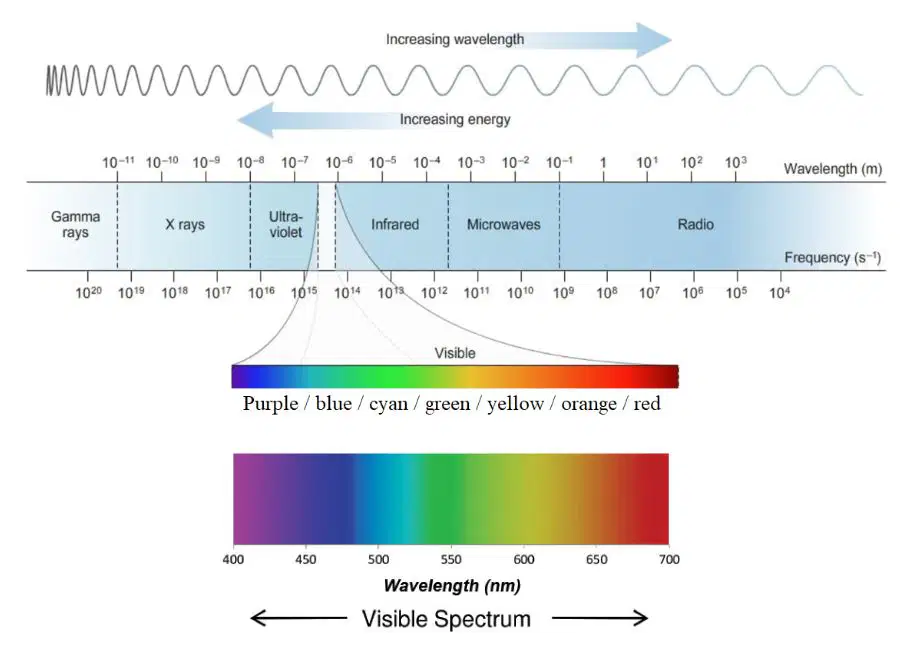
A beam of light has a wavelength of 615 nm. What is the color of this light?
purple
blue
green
yellow
red
A beam of light has a wavelength of 560 nm. What is the color of this light?
purple
blue
green
yellow
red
A beam of light has a wavelength of 465 nm. What is the color of this light?
purple
blue
green
yellow
red
A beam of light has a wavelength of 408 nm. What is the color of this light?
purple
blue
green
yellow
red

A beam of light has a wavelength of 615 nm. What is the frequency of this light?
4.88 x 10¹⁴ Hz
4.88 x 10⁻⁴ Hz
0.0488 Hz
2.05 x 10⁻¹⁵ Hz
4.88 x 10⁵ Hz
What is the energy of a photon emitted by a light source with a frequency of 6.00 x 10¹⁴ Hz?
3.97 x 10⁻¹⁹ joules
2.50 x 10⁻³⁴ joules
5.45 x 10¹⁴ joules
1.20 x 10⁻²⁵ joules
4.00 x 10⁻¹⁵ joules
Calculate the wavelength of light that has the following frequency:
6.0 x 10¹⁴ s-1
2.0 x 10⁻⁷ m
5.0 x 10⁻⁷ m
3.0 x 10¹⁴ m
2.0 x 10²³ m
4.0 x 10⁴ m
A broadcasting station emits a signal at a frequency of 102.5 MHz. What is the wavelength of this signal in meters?
(MHz = 106 Hz)
2.93 m
0.293 m
2.93 x 10⁻⁷ m
2.93 x 10⁶ m
A light wave travels with a wavelength of 700 nm. Determine the frequency of this light wave.
4.29 x 10¹⁴ Hz
5.71 x 10⁻¹⁵ Hz
700 x 106 Hz
2.85 x 10⁵ Hz
0.285 Hz
Write the electron configuration for Be
1s2 2s2
1s2 2s1
1s1 2s2
1s2 2s3
Write the electron configuration for B
1s2 2s2 2p1
1s2 2s2
1s1 2s2 2p2
1s2 2s3
Write the electron configuration for C
1s2 2s2 2p2
1s2 2s2
1s1 2s2 2p1
1s2 2s4
Write the complete electron configuration for N
(a)
Write the complete electron configuration for O
(a)
Write the complete electron configuration for F
(a)
Write the complete electron configuration for Ne
(a)
Write the complete electron configuration for Na
(a)
Write the complete electron configuration for Mg
(a)
Write the complete electron configuration for Al
(a)
Write the complete electron configuration for Si
(a)
Write the complete electron configuration for P
(a)
Write the complete electron configuration for S
(a)
Write the complete electron configuration for Cl
(a)
Write the complete electron configuration for Ar
(a)
Write the complete electron configuration for K
(a)
Write the complete electron configuration for Ca
(a)
Write the complete electron configuration for V
(a)
Write the complete electron configuration for Fe
(a)
Write the complete electron configuration for As
(a)

Which element does this orbital diagram represent?
Hint: Type the element symbol with proper upper and lower case letter(s). DO NOT type the full name of the element.
(a)
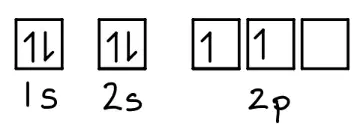
Which element does this orbital diagram represent?
Hint: Type the element symbol with proper upper and lower case letter(s). DO NOT type the full name of the element.
(a)

Which element does this orbital diagram represent?
Hint: Type the element symbol with proper upper and lower case letter(s). DO NOT type the full name of the element.
(a)
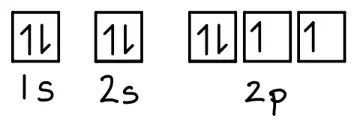
Which element does this orbital diagram represent?
Hint: Type the element symbol with proper upper and lower case letter(s). DO NOT type the full name of the element.
(a)

Which element does this orbital diagram represent?
Hint: Type the element symbol with proper upper and lower case letter(s). DO NOT type the full name of the element.
(a)

Which element does this orbital diagram represent?
Hint: Type the element symbol with proper upper and lower case letter(s). DO NOT type the full name of the element.
(a)
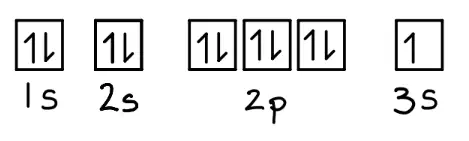
Which element does this orbital diagram represent?
Hint: Type the element symbol with proper upper and lower case letter(s). DO NOT type the full name of the element.
(a)
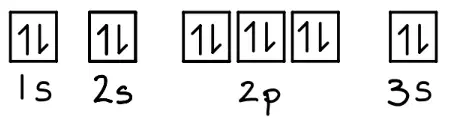
Which element does this orbital diagram represent?
Hint: Type the element symbol with proper upper and lower case letter(s). DO NOT type the full name of the element.
(a)

Which element does this orbital diagram represent?
Hint: Type the element symbol with proper upper and lower case letter(s). DO NOT type the full name of the element.
(a)

Which element does this orbital diagram represent?
Hint: Type the element symbol with proper upper and lower case letter(s). DO NOT type the full name of the element.
(a)

Which element does this orbital diagram represent?
Hint: Type the element symbol with proper upper and lower case letter(s). DO NOT type the full name of the element.
(a)

Which element does this orbital diagram represent?
Hint: Type the element symbol with proper upper and lower case letter(s). DO NOT type the full name of the element.
(a)

Which element does this orbital diagram represent?
Hint: Type the element symbol with proper upper and lower case letter(s). DO NOT type the full name of the element.
(a)

Which element does this orbital diagram represent?
Hint: Type the element symbol with proper upper and lower case letter(s). DO NOT type the full name of the element.
(a)
Write the abbreviated electron configuration for Si
(a)
Write the abbreviated electron configuration for Cl
(a)
Write the abbreviated electron configuration for Ca
(a)
Write the abbreviated electron configuration for Cr
(a)
Write the abbreviated electron configuration for Ni
(a)
Write the abbreviated electron configuration for Ge
(a)
Write the abbreviated electron configuration for Tc
(a)
Write the abbreviated electron configuration for Ag
(a)
Write the abbreviated electron configuration for Br
(a)
Write the abbreviated electron configuration for Cs
(a)
Write the abbreviated electron configuration for Eu
Eu = europium atomic # is 63
(a)
Write the abbreviated electron configuration for W
W = tungsten atomic # is 74
(a)
Write the abbreviated electron configuration for Bi
Bi = bismuth atomic # is 83
(a)
Categorize the following elements by how many valence electrons they have.
boron
aluminum
carbon
silicon
nitrogen
phosphorus
oxygen
sulfur
Categorize the following elements by how many valence electrons they have.
boron
gallium
germanium
silicon
arsenic
phosphorus
selenium
sulfur
Categorize the following elements by how many valence electrons they have.
boron
indium
tin
silicon
arsenic
antimony
magnesium
calcium
Categorize the following elements by how many valence electrons they have.
tellurium
fluorine
nitrogen
zinc
Categorize the following elements by how many valence electrons they have.
sodium
chlorine
neon
copper
potassium
iron
argon
bromine
Which element has the largest atomic radius?
C
N
O
F
Which element has the largest ionization energy?
C
N
O
F
Which element has the largest atomic radius?
Si
P
S
Cl
Which element has the largest ionization energy?
Si
P
S
Cl
Which element has the largest atomic radius?
Ge
As
Se
Br
Which element has the largest ionization energy?
Ge
As
Se
Br
Which element has the largest atomic radius?
Na
Mg
S
Cl
Which element has the largest ionization energy?
Na
Mg
S
Cl
Which element has the largest atomic radius?
K
Ca
Se
Br
Which element has the largest atomic radius?
I
Br
Cl
F
Which element has the largest ionization energy?
I
Br
Cl
F
Which element has the largest atomic radius?
Te
Se
S
O
Which element has the largest ionization energy?
Te
Se
S
O
Which element has the largest atomic radius?
Sb
As
P
N
Which element has the largest atomic radius?
Sn
Ge
Si
C
Arrange the following elements in order of increasing atomic radius.
(This means start with the smallest to the largest)
F
O
N
C
B
Arrange the following elements in order of increasing atomic radius.
(This means start with the smallest to the largest)
Zn
Cu
Ni
Co
Fe
Arrange the following elements in order of increasing atomic radius.
(This means start with the smallest to the largest)
Mo
Nb
Zr
Y
Sr
Arrange the following elements in order of increasing atomic radius.
(This means start with the smallest to the largest)
F
O
N
P
As
Arrange the following elements in order of increasing atomic radius.
(This means start with the smallest to the largest)
Ar
Cl
S
Se
Te

The data in the table shows the first 6 ionization energies for an unknown element. Of the following elements, which one could have the data presented in the table?
Na
Mg
Si
Al
Cl

The data in the table shows the first 6 ionization energies for an unknown element. Of the following elements, which one could have the data presented in the table?
Li
Be
B
C
O

The data in the table shows the first 6 ionization energies for an unknown element. Of the following elements, which one could have the data presented in the table?
Na
Mg
Al
P
S

The data in the table shows the first 6 ionization energies for an unknown element. Of the following elements, which one could have the data presented in the table?
S
Mg
Al
P
Si

The data in the table shows the first 6 ionization energies for an unknown element. Of the following elements, which one could have the data presented in the table?
N
F
O
B
C

The data table shows the first 6 ionization energies for Na, sodium. Why is there a very large difference between the 1st and 2nd ionization energy?
Sodium has 1 valence electron. The 2nd electron removed is a core electron.
Sodium has 2 valence electrons. The 3rd electron removed is a core electron.
Sodium has 1 total electron, therefore the remaining ionization energies are hypothetical.
Sodium has 1 core electron, the 2nd electron removed is a valence electron.

The data table shows the first 6 ionization energies for Al, aluminum. Why is there a very large difference between the 3rd and 4th ionization energy?
Aluminum has 3 valence electrons. The 4th electron removed is a core electron.
Aluminum has 4 valence electrons. The 5th electron removed is a core electron.
Aluminum has 3 electrons in the 3p subshell, and the rest are in the 6s subshell.
Aluminum has 3 core electrons, the 4th electron removed is a valence electron.

The data table shows the first 6 ionization energies for Si, silicon. Why is there a very large difference between the 4th and 5th ionization energy?
Silicon has 4 valence electrons. The 5th electron removed is a core electron.
Silicon has 5 valence electrons. The 6th electron removed is a core electron.
Silicon has 4 electrons in the 4p subshell, and the rest are in the 2s subshell.
Silicon has 4 core electrons, the 5th electron removed is a valence electron.
Why does fluorine have a higher ionization energy than iodine?
Fluorine's valence e- are closer to its nucleus than iodine's, making it harder to remove an electron from fluorine.
Fluorine's valence e- are further from its nucleus than iodine's, making it harder to remove an electron from fluorine.
Fluorine's valence e- are further from its nucleus than iodine's, making it easier to remove an electron from fluorine.
Fluorine's valence e- are closer to its nucleus than iodine's, making it easier to remove an electron from fluorine.
Why does sulfur have a higher ionization energy than tellurium?
Sulfur's valence e- are closer to its nucleus than tellurium's, making it harder to remove an electron from sulfur.
Sulfur's valence e- are further from its nucleus than tellurium's, making it harder to remove an electron from sulfur.
Sulfur's valence e- are further from its nucleus than tellurium's, making it easier to remove an electron from sulfur.
Sulfur's valence e- are closer to its nucleus than tellurium's, making it easier to remove an electron from sulfur.
Why does nitrogen have a higher ionization energy than arsenic?
Nitrogen's valence e- are closer to its nucleus than arsenic's, making it harder to remove an electron from nitrogen.
Nitrogen's valence e- are further from its nucleus than arsenic's, making it harder to remove an electron from nitrogen.
Nitrogen's valence e- are further from its nucleus than arsenic's, making it easier to remove an electron from nitrogen.
Nitrogen's valence e- are closer to its nucleus than arsenic's, making it easier to remove an electron from nitrogen.

