wayground logo

Free Printable Worksheets

Font size

S
M
L
XL
Worksheets

Chemistry Final Exam Review 2021

Total questions: 158

Worksheet time: 26hrs 20mins

Name
Class
Date
1.

The molar volume of a gas at STP occupies _____________.

a)

22.4 L

b)

0˚C

c)

1 kiloPascal

d)

12 grams

2.

Chemical equations must be balanced to satisfy ____.

a)

The law of definite proportions

b)

The law of multiple proportions

c)

The law of conservation of mass

d)

Avogadro's principle

3.

What are the coefficients that will balance the skeleton equation below?

AlCl3 + NaOH → Al(OH)3 + NaCl

a)

1,3,1,3

b)

3,1,3,1

c)

1,1,1,3

d)

1,3,3,1

4.

How many moles of aluminum are needed to react completely with 1.2 mol of FeO?

2Al(s) + 3FeO(s) → 3Fe(s) + Al2O3(s)

a)

1.2 mol

b)

0.8 mol

c)

1.6 mol

d)

2.4 mol

5.

What is the name of H2SO4?

a)

hyposulfuric acid

b)

hydrosulfuric acid

c)

sulfuric acid

d)

sulfurous acid

6.

When an equation is used to calculate the amount of product that could form during a reaction, then the value obtained is called the ____.

a)

Actual yield

b)

Percent yield

c)

Minimum yield

d)

Theoretical yield

7.

The equation 2C3H7OH + 9O2 → 6CO2 + 8H2O is an example of which type of reaction?

a)

Combustion reaction

b)

Single replacement reaction

c)

Double replacement reaction

d)

Decomposition reaction

8.

A process that absorbs heat is a(n) _________.

a)

Exothermic process

b)

Polythermic process

c)

Endothermic process

d)

Ectothermic process

9.

Which is an exothermic process?

a)

Ice melting

b)

Water boiling

c)

Water evaporating

d)

Water vapor condensing

10.
What state of matter is X?
a)
solid 
b)
liquid
c)
gas
d)
supercritical fluid
11.
What state of matter is Y?
a)
solid 
b)
liquid
c)
gas
d)
supercritical fluid
12.
What state of matter is Z?
a)
solid 
b)
liquid
c)
gas
d)
supercritical fluid
13.
What is point A?
a)
triple point
b)
critical point
c)
equilibrium point
d)
normal melting point
14.
What is point B?
a)
triple point
b)
critical point
c)
equilibrium point
d)
normal melting point
15.
What change occurs from E to C?
a)
sublimation
b)
freezing
c)
melting
d)
boiling
16.
What change occurs from C to D?
a)
condensation
b)
vaporization
c)
melting
d)
sublimation
17.
Water exists as a _____________ at 700 mmHg and 50 °C.
a)
solid
b)
liquid
c)
gas
d)
supercritical fluid
18.
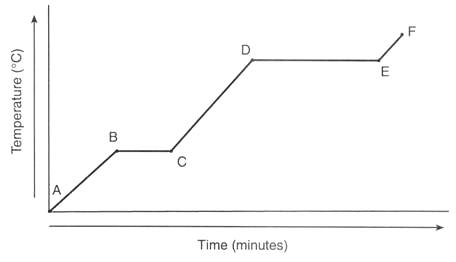
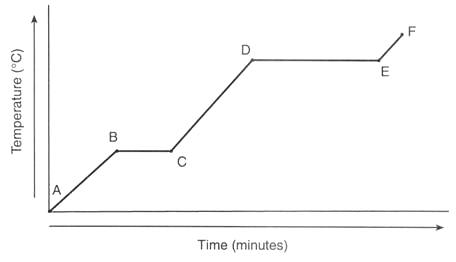
Describe the substance between letters A and B. 
a)
Solid
b)
Liquid
c)
Melting
d)
Evaporating
19.
Describe the substance between letters D and E. 
a)
Gas
b)
Liquid
c)
Melting
d)
Evaporating
20.
Between which points is the substance changing its state of matter?
a)
A-B only. 
b)
A-B, C-D, E-F
c)
B-C only. 
d)
B-C, D-E
21.
Between which points is the temperature of the substance remaining constant?
a)
A-B only. 
b)
A-B, C-D, E-F
c)
B-C only. 
d)
B-C, D-E
22.
freezing
a)
change of state from solid to liquid
b)
change of state from liquid to solid
23.
melting
a)
change of state from solid to liquid
b)
change of state from liquid to solid
24.
When does condensation happen?
a)
solid to liquid
b)
liquid to gas
c)
gas to liquid
d)
solid to gas
25.
When does evaporation happen?
a)
gas to liquid
b)
liquid to solid
c)
solid to liquid
d)
liquid to gas
26.
My particles move the slowest.
a)
Solid
b)
liquid
c)
Gas
d)
Plasma
27.
I have a definite shape and a definite volume.
a)
Gas
b)
Plasma
c)
Solid
d)
Liquid
28.
I have a definite volume, but no definite shape
a)
Gas
b)
Liquid
c)
Plasma
d)
Solid
29.
My particles are able to slide past one another, but are still close together
a)
Gas
b)
Plasma
c)
Liquid
d)
Solid
30.
What is the activation energy?
a)
The energy of the products
b)
The energy of the reactants
c)
The minimum energy needed by the reactants to form the products.
d)
The energy lost in the reaction
31.
According to collision theory, what must the reactants have in order to form products?
a)
The right size
b)
The right shape
c)
Enough energy
d)
Nothing
32.
Which factors increase the rate of a reaction.
a)
increasing temperature
b)
increasing concentration
c)
increasing surface area
d)
all of these
33.

How does a catalyst work in speeding up a reaction?

a)

By lowering the activation energy or reaction

b)

by giving them more energy

c)

by making them more available

34.

What term is given to a reaction which transfers heat energy to the surroundings?

a)

Endothermic

b)

Reversible

c)

Exothermic

d)

Exotermic

35.

When barium hydroxide and ammonium chloride react, the temperature of the mixture decreases. What kind of reaction is this?

a)

Endothermic

b)

Decomposition

c)

Exothermic

d)

Indothermic

36.

When calcium reacts with water, the temperature changes from 18°C to 39°C. Which statement is correct?

a)

The solution at the end is acidic

b)

The reaction is reversible

c)

The reaction is exothermic

d)

The reaction is endothermic

37.
What is the activation energy?
a)
The energy of the products
b)
The energy of the reactants
c)
The minimum energy needed by the reactants to form the products.
d)
The energy lost in the reaction
38.

One mole of sulfur (S) is equal to home many atoms?

a)

32 atoms

b)

16 atoms

c)

1.20 x 10²³ atoms

d)

6.022 x 10²³ atoms

39.

To convert from moles to particles, you should multiply by ....

a)
b)
c)
d)
40.

To convert from particles to moles, you should multiply by ....

a)
b)
c)
d)
41.

5.11 x 10²³ atoms of lithium (Li) is equal to how many moles?

a)

1.18 moles

b)

0.351 moles

c)

1.34 moles

d)

0.849 moles

42.

0.75 mole of copper (Cu) is equal to how many atoms?

a)

8.03 x 10²³ atoms

b)

6.02 x 10²³ atoms

c)

4.51 x 10²³ atoms

d)

3.11 x 10²³ atoms

43.

To convert from moles to grams, you should multiply by ....

a)
b)
c)
d)
44.

To convert from grams to moles, you should multiply by ....

a)
b)
c)
d)
45.

0.50 moles of carbon (C) is equal to how many grams?

a)

6.0 grams

b)

12.0 grams

c)

8.0 grams

d)

14.0 grams

46.

36.0 g of beryllium (Be) contains how many moles?

a)

0.25 mol

b)

4.0 mol

c)

45 mol

d)

320 mol

47.
2H2  +   O2  →  2H2O
How many moles of oxygen are consumed if 8 moles H2 are used?
a)
2
b)
4
c)
6
d)
8
48.
For the Balanced Reaction: 3 Mg + 1 Fe2O3 → 3 MgO + 2 Fe; What is the Ratio of moles of MgO to moles Fe?
a)
3mol Mg / 2 mol Fe
b)
2 mol Mg/ 3 mol Fe
c)
1 mol Fe/ 2 mol Fe
d)
3 mol MgO / 2 mol Fe
49.
2 KClO3 → 2 KCl + 3 O2
How many moles of oxygen are produced when 6.7 moles of KClO3 decompose completely?
a)
6.7 mol
b)
1.0 mol
c)
10.1 mol
d)
4.5 mol
50.
2Na + 2H2O → 2NaOH+ H2
How many grams of hydrogen are produced if 120 g of Na are available?
a)
5.2 g
b)
2.6 g
c)
690 g
d)
45 g
51.
Cl2 + 2 KBr → Br2 + 2 KCl
How many grams of potassium chloride can be produced from 356 g of chlorine and 356 g of potassium bromide?
a)
749 g
b)
223 g
c)
479 g
d)
814 g
52.
2 NaClO3 (s) --> 2NaCl (s) +3 O2 (g)  
12.00 moles of NaClO3 will produce how many grams of O2?
a)
256 g of O2
b)
576 g of O2
c)
288 g O2
53.

When reacting Na with Cl2, we calculated that the theoretical yield should be 13 grams. Our actual yield was 12.5 grams. What is the percent yield?

a)

90.4%

b)

104%

c)

96.15%

d)

1.04%

54.
The ______________ yield is the maximum amount of product possible in a reaction. This determines the amount of product that should be produced in a perfect setting
a)
Percent
b)
actual
c)
stoichiometry
d)
theoretical
55.

2Fe2O3 + C → Fe + 3CO2

You add 28 grams of carbon. You find the actual yield to be 181.2 grams of CO2. What is the percent yield of CO2? (Hint: calculate theoretical yield of CO2 first)

a)

58.83%

b)

308%

c)

6435%

d)

15.5

56.
Theoretical yield = 73g
Actual yield = 62g
Calculate the percent yield.
a)
1.16%
b)
116%
c)
85%
d)
76%
57.
What is the percent by mass of oxygen in MgO?
a)
20%
b)
40%
c)
50%
d)
60%
58.
What is the percent by mass of fluorine in CaF2 (gram-formula mass = 78 g/mol)?
a)
24%
b)
49%
c)
51%
d)
65%
59.
What is the percent by mass of calcium in CaF2 (gram-formula mass = 78 g/mol)?
a)
24%
b)
49%
c)
51%
d)
65%
60.
A compound consists of 72.2% magnesium(Mg) and 27.8% nitrogen(N) by mass. What is the empirical formula?
a)
Mg4N3
b)
MgN2
c)
Mg3N
d)
MgN
61.
You are given the following percentages: 40.05% S and 59.95% O. Find the empirical formula for these elements.
a)
SO
b)
SO2
c)
SO3
d)
SO4
62.
What is the molecular formula if the empirical formula is CH2O and the molecular molar mass is 180.18?
a)
CH2O
b)
C2H4O2
c)
C4H8O4
d)
C6H12O6
63.
Given the following: 42.07% Na, 18.89% P, and 39.04% O, determine the empirical formula.
a)
 NaPO2
b)
Na2PO3
c)
Na3PO4
d)
NaPO4
64.
What is the molecular formula for a compound with the empirical formula: K2SOand a molecular mass of 696g.
a)
K2SO
b)
K8SO16
c)
K8S4O
d)
K8S4O16 
65.
Glycerol has a molar mass of 92.09g/mol. Its percent composition is: 39.12% C, 8.75% H, and 51.12% O. What is the molecular formula for glycerol?
a)
C2H3O2
b)
CH2O
c)
C2H4O2
d)
C3H8O3
66.

Molarity is measured in _____.

a)

moles per g.

b)

mols per L.

c)

moles per mm.

d)

moles per mL.

67.

The _____ is the thing being dissolved.

a)

solute

b)

solvent

68.

What is a solvent?

a)

The substance that does the dissolving in a solution.

b)

The substance that is being dissolved in a solution.

c)

The mixing of different substances.

d)

The process in which neutral molecules lose or gain electrons.

69.

A solution that is considered unsaturated would _____.

a)

be dark in color.

b)

have a strong scent.

c)

have a large amount of solute.

d)

have a small amount of solute.

70.
How many moles of NaCl are present in a solution with a molarity of 8.59 M and a volume of 125 mL?
a)
1074 mol
b)
0.069 mol
c)
1.07 mol
d)
62.7 mol
71.

Which equation is used to find molarity?

a)

Moles solute/L solution

b)

Moles solute/kg solution

c)

Moles solute/kg solvent

d)

Grams solute/L solution

72.

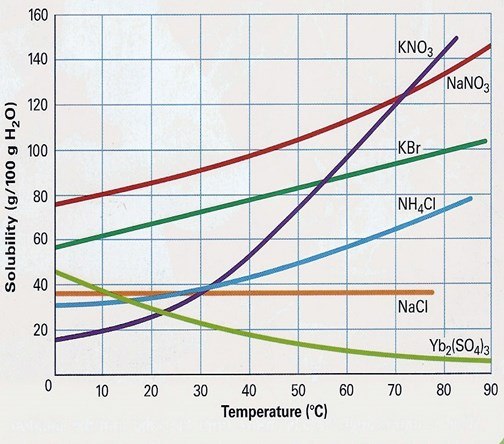
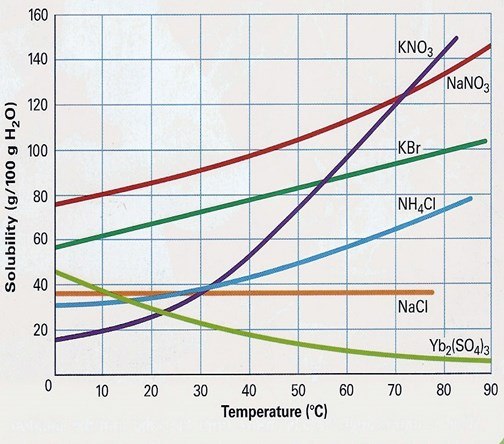
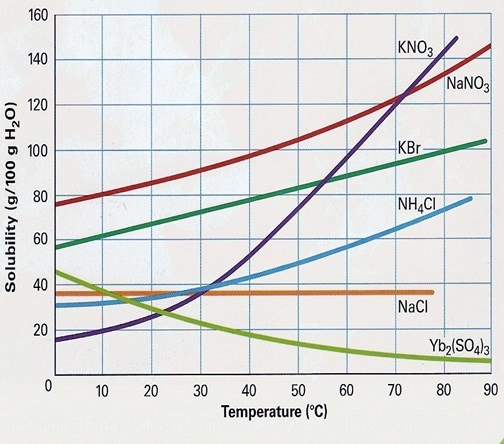
At 80'C, KBr's solubility is:

a)

100

b)

90

c)

80

d)

0

73.

Identify if the following solution would be saturated, unsaturated, or supersaturated: 103 g KBr at 70'C.

a)

Unsaturated

b)

Saturated

c)

Supersaturated

74.

Identify how many grams of KNO3 is required to make a saturated solution at 40'C.

a)

50 g

b)

45 g

c)

60 g

d)

33 g

75.

The name of FeCl₂ is

a)

iron chloride

b)

iron (II) chloride

c)

iron (I) chloride

d)

iron dichloride

76.

LiBr is called

a)

lithium bromine

b)

lithium (I) bromine

c)

lithium bromide

d)

lithuim (I) bromide

77.

Which of the following combinations would need roman numerals in the name?

a)

potassium + fluorine

b)

beryllium + oxygen

c)

boron + iodine

d)

lead + oxygen

78.

What is the name of the compound Na2(SO4)?

a)

Sodium sulfate

b)

Sodium sulfide

c)

Sodium sulfite

d)

Sodium sulfuroxide

79.
What is the correct formula for Sodium Oxide?
a)
NaO
b)
NaO2
c)
Na2O
d)
Na2O2
80.

What is the correct molecular formula for barium hydroxide?

a)

Ba(OH)2

b)

Ba2OH

c)

BaOH

d)

Ba2OH

81.
What is the formula for copper(I) sulfate?
a)
CuSO3
b)
CuSO4
c)
Cu2SO3
d)
Cu2SO4
82.

Which of these combinations is an ionic compound made of?

a)

Metal and Metal

b)

Nonmetal and Nonmetal

c)

Metal and Nonmetal

d)

Cation and Cation

83.

When naming ionic compounds with transition metals you need to include roman numerals to show the _____ of the metal..

a)

atomic number

b)

mass number

c)

charge

d)

ionization energy

84.
Which of the following is the correct name for the chemical formula Ca(NO2)2?
a)
cadmium nitride
b)
calcium nitrate
c)
calcium nitrite
d)
cadmium nitrite
85.
What is the name of N2O3
a)
Nitrogen trioxide
b)
Dinitrogen oxide
c)
Dinitrogen trioxide
d)
Nitrogen oxide
86.
The chemical formula of sulfur hexabromide is
a)
SBr₆
b)
S₆Br
c)
S(VI)Br
d)
S6Br
87.
The chemical formula of tetraphosphorus heptaoxide is
a)
F₄O₁₀
b)
P₄O7
c)
PO
d)
P₁₀O₄
88.
Molten compound does NOT conduct electricity.
a)
ionic compound
b)
covalent compound
89.
Molten compound conducts electricity.
a)
ionic compound
b)
covalent compound
90.
All solids at room temperature
a)
ionic compounds
b)
covalent compounds
91.
Have a high m.p. (1000°C-3000°C)
a)
ionic compounds
b)
covalent compounds
92.
Have a low m.p. (< 200°C)
a)
ionic compounds
b)
covalent compounds
93.
When dissolved in water, the solution is a good conductor of electricity.
a)
ionic compounds
b)
covalent compounds
94.
When dissolved in water, the solution does NOT conduct electricity.
a)
ionic compounds
b)
covalent compounds
95.

Compounds composed of a ______________ and _____________ like the compound CaCl2 , are ionic compounds.

a)

metal ... metal

b)

nonmetal ... nonmetal

c)

metal ... nonmetal

96.
Ionic Bonding involves...
a)
The transfer of protons
b)
The transfer of nuetrons 
c)
The transfer of electrons
d)
None Of the above
97.

Which of the following describes covalent bonds?

a)

Bonds form because of opposite charges

b)

electrons are shared to fill outer electron shells

c)

Electrons are transferred between atoms

d)

Covalent bonds are magical

98.
What is the formula for Hydrosulfuric Acid?
a)
H2(SO3)
b)
H2S
c)
H2(SO2)
d)
H2(SO4)
99.
Name HF
a)
hydrofluoric acid
b)
Hypofluoric acid
c)
hydrogen fluorine acid
d)
fluoric acid
100.
Name the acid: H3PO3
a)
hydrophosphoric acid
b)
phosphorous acid
c)
phosphoric acid
d)
phosphoric hydroxide
101.
What is the formula for hydrochloric acid?
a)
HCl
b)
HClO
c)
H3ClO3
d)
HClO3
102.
What is the formula for nitric acid?
a)
HNO2
b)
HNO3
c)
HNO4
d)
H2NO3
103.
HNO2
a)
hydronitrogen
b)
hydrogen nitrogen oxygen
c)
nitrous acid
d)
nitric acid
104.
carbonic acid
a)
H2CO3
b)
H2CrO4
c)
H2C2O4
d)
HCO3
105.
chlorous acid
a)
HClO3
b)
HClO2
c)
HClO
d)
HCl
106.
What electron configuration matches an oxygen atom?
a)
1s22s22p63s2, 3p64s23d104p5
b)
1s22s22p4
c)
1s22s22p6
d)
1s22s22p63s23p64s23d1
107.
What atom matches this electron configuration?
1s2s2p3s2
a)
Neon
b)
Magnesium
c)
Aluminum
d)
Potassium
108.
What is the shorthand electron configuration for Sulfur atom?
a)
[Ar] 3p4
b)
[He] 3s23p4
c)
[Ne] 3s23p4
d)
[Na] 3s23p3
109.
What is the noble gas configuration for phosphorus?
a)
[Ar] 3p5
b)
[He] 3s2 3p5
c)
[Ne] 3s2 3p3
d)
[Na] 3s2 3p5
110.
[Ne]3s23p5 is the noble gas configuration for which element?
a)
chlorine
b)
fluorine
c)
sulfur
d)
aluminum
111.
How many valence electrons does Chlorine have?
a)
5
b)
2
c)
7
d)
5
112.
How many valence electrons does phosphorus have?
a)
5
b)
2
c)
8
d)
15
113.

How many neutrons are in an atom of carbon-14?

a)

6

b)

8

c)

10

d)

14

114.

How many protons does this isotope of titanium have?

a)

22

b)

26

c)

48

d)

70

115.

How many electrons are in an atom that has an atomic number of 34, an atomic mass of 74 and a charge of -2?

a)

2

b)

34

c)

36

d)

40

116.

An atom that has gained or lost electrons in an attempt to become stable/bond with another atom.

a)

Normal/Neutral Atom

b)

Ion

c)

Isotope

117.

A negatively charged ion that has gained electrons to satisfy the octet rule (metals do this)

a)

Anion

b)

Cation

c)

Neutral Atom

d)

Isotope

118.

A positively charged ion that has lost electrons to satisfy the octet rule (non-metals do this)

a)

Anion

b)

Cation

c)

Neutral Atom

d)

Isotope

119.

Atoms of the same element that have different mass than expected because they have a different number of neutrons.

a)

Neutral Atom

b)

Ion

c)

Isotope

d)

Cation

120.

If an atom has 9 protons and 10 electrons it has a charge of ____.

a)

0

b)

-1

c)

+1

d)

-2

121.

If an atom has 4 protons and 2 electrons it has a charge of ____.

a)

0

b)

-2

c)

+2

d)

+1

122.
Which of the following is an Alkali Metal? 
a)
Magnesium
b)
Chromium
c)
Sodium
d)
Fluorine 
123.
Which of the following is an Alkaline Earth Metal? 
a)
Calcium
b)
Lithium
c)
Phosphorus
d)
Copper 
124.
Which of the following is a transition metal? 
a)
Iron
b)
Oxygen
c)
Neon
d)
Barium
125.
Which of the following is a Halogen? 
a)
Bromine
b)
Rubidium
c)
Argon
d)
Beryllium
126.
Which of the following is a Noble Gas? 
a)
Krypton
b)
Chlorine
c)
Radium
d)
Gallium
127.
How many valence electrons does an alkaline earth metal have? 
a)
1
b)
2
c)
7
d)
8
128.
How many valence electrons does a halogen have? 
a)
1
b)
2
c)
7
d)
8
129.

The vertical (up and down) columns in the Periodic Table are called

a)

groups

b)

towers

c)

periods

d)

atomic numbers

130.
Elements in a ..................have similar chemical properties.  
a)
period
b)
group
c)
row
131.
As you move down a group, atomic radius increases because - 
a)
you add more and more neutrons
b)
you add more and more protons
c)
you add more and more shells (energy levels)
d)
you add more atomic mass
132.
Francium (Fr) has the lowest ionization energy in Group 1 because - 
a)
it has the smallest number of valence electrons
b)
it has the greatest atomic mass
c)
it has the greatest number of protons, so it attracts its electrons the strongest
d)
its 1 valence electron is very far from the nucleus, so little energy is needed to remove it
133.
Which of the following will have a lower ionization energy than Scandium (Sc)?
a)
Helium (He)
b)
Titanium (Ti)
c)
Calcium (Ca)
d)
Magnesium (Mg)
134.
Electronegativity is...
a)
the ability of an atom to attract/ accept electrons
b)
the ability of an atom to lose electrons
c)
the energy required to remove an electron from a specific atom
d)
how easy it is to make friends. 
135.
Which has the greater Electronegativity: 
N or C?
a)
C
b)
N
136.
The symbols W, X, Y, and Z represent four elements shown on the outline of a periodic table.
Which element has the highest electronegativity?

a)
W
b)
X
c)
Y
d)
Z
137.
Which of the following will have a larger radius than Zinc?
a)
Gallium
b)
Aluminum
c)
Magnesium
d)
Strontium
138.
Ionization energy is...
a)
the energy required to add an electron to a specific atom
b)
how much energy it takes to remove an electron from an atom
c)
the energy required to shield the outer electrons from the nucleus
d)
a measure of the ability of an atom to attract electrons
139.
Which statement correctly and completely identifies a trend?
a)
Atomic radius decreases across a period and increases down a group.
b)
Electronegativity decreases across a period and decreases down a group.
c)
Ionization energy increases across a period and increases down a group.
d)
Ionic radius increases across a period and increases down a group.
140.
Electronegativity __________ from left to right within a period and __________ from top to bottom within a group.
a)
decreases, increases 
b)
increases, increases
c)
increases, decreases 
d)
stays the same, increases
141.
Atomic radius generally increases as we move __________.  
a)
down a group and from right to left across a period 
b)
up a group and from left to right across a period 
c)
down a group and from left to right across a period 
d)
up a group and from right to left across a period 
142.
Vertical columns of elements (families) on the periodic table with similar  properties
a)
groups
b)
periods
c)
quadrants
d)
rows
143.
What subatomic particles would you find in the nucleus of an atom?
a)
Protons only
b)
Protons and Neutrons
c)
Neutrons and Electrons
d)
Protons and Electrons 
144.
What subatomic particle is electrically neutral (no charge)?
a)
Proton
b)
Ion
c)
Neutron
d)
Electron
145.
What subatomic particle(s) would be found orbiting the nucleus?
a)
Neutrons only
b)
Electrons only
c)
Protons and Neutrons
d)
Protons and Electrons
146.
Which subatomic particles contribute the most to the mass of an atom?
a)
Protons, Neutrons, Electrons
b)
Protons only
c)
Protons and Electrons
d)
Protons and Neutrons
147.
The positive particles of an atom are 
a)
electrons 
b)
positrons 
c)
neutrons 
d)
protons 
148.
the central region of an atom where its neutrons and protons are is its 
a)
nucleus 
b)
electron cloud
c)
core 
d)
center 
149.
In order for me to find the number of neutrons, I must round the atomic mass and then do what?
a)
atomic number-atomic mass
b)
atomic number x atomic mass
c)
atomic mass + atomic number
d)
atomic mass - atomic number
150.
Is water melting a physical or chemical change?
a)
Physical
b)
Chemical
151.
Is salt dissolving in water a physical or chemical change?
a)
Physical
b)
Chemical
152.
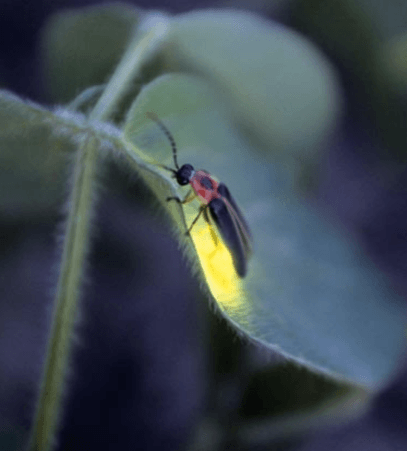
Is a firefly lighting up a physical or chemical change?
a)
Physical
b)
Chemical
153.
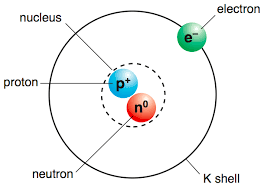
What element is represented in this Bohr Model?
a)
Lithium
b)
Boron
c)
Carbon
d)
Neon
154.
How many valence electrons?
a)
2
b)
3
c)
5
d)
10
155.

If energy is supplied, electron ___________ the energy and is _____________ from a lower energy level to a higher ones.

(a)  

156.

At excited state electron is _______________and it will fall back to lower energy level and released a specific amount of ________________ in form of light (photon).

(a)  

157.

La resistencia al flujo se conoce como ___________.

a)

régimen de flujo

b)

energía hidráulica

c)

energía mecánica

d)

presión

158.

If an electron moves from n=4 to n=2 it ____

a)

absorbs energy

b)

releases energy