
 Worksheets
Spring ICP Final
Total questions: 50
Worksheet time: 1hrs 10mins

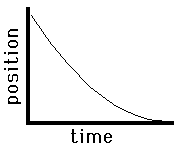

What is the object doing between 3 and 5 seconds?
moving at a constant speed
speeding up
not moving
slowing down

A dog runs with an initial speed of 7.5 m/s on a waxed floor. It slides to a stop in 15 seconds. What is the acceleration?
-7.5 m/s
-7.5 m/s2
-0.5 m/s2
0.5 mi//hr
Which law of motion is explained by the equation:
Force = Mass x Acceleration (F=ma)?
Newton's 1st Law of Motion
Newton's 2nd Law of Motion
Newton's 3rd Law of Motion
Which two forces are the only forces that can both attract and repel?
strong nuclear and weak nuclear
electric and magnetic
gravitation and magnetic
strong nuclear and electric
A hiker pushed on a large rock, but it did not move. He pushed 300 N to the left. How much force does he feel from the rock?
Less than 300 N
300 N
More then 300 N
The SI unit for electric current is the
amp
volt
ohm
mho
How much work is done when a crate is pushed with 50 N of force for a distance of 15m?
750 J
3 J
65 J
650 J
A student rows a boat across a still pond, doing 3600 J of work on the oars in 60 seconds. What is the student's power output? (Power=Work/Time)
6 N
60 W
60 J
.06 W
Because there is always some _____________, the efficiency of any machine is always less than 100%.
air
force
friction
gravity
In which situation is work not done?
lifting a 20 pound box off the floor
holding a 20 pound box above the floor
sliding a 20 pound box across the floor
sliding a 20 pound box up an inclined plane
What is the SI unit of pressure?
pascal
newton
meter
meter squared
Where is fluid pressure greatest in a swimming pool?
2 meter below surface
30 cm below surface
1 meter below surface
at the surface
Which of the following materials is NOT a fluid?
oxygen gas
cranberry juice
rubber
water
Atmospheric pressure is caused by
the weight of the atmosphere above a location
there is no cause, it just happens
the position of the sun in the sky
the temperature
As the speed of a fluid increases, the pressure within the fluid decreases.
Pascal’s principle
Bernoulli's principle
Archimedes principle
Murphy's Law
What principle states that the buoyant force on an object is equal to the weight of the fluid displaced by the object?
Pascal’s principle
Bernoulli's principle
Archimedes principle
Murphy's Law
Compared to the pressure exerted by a brick standing on its end, the pressure exerted by the same brick resting on its side is
higher
lower
the same
A device that uses pressurized fluid acting on pistons of different sizes to increase force is a(n)
pump
pulley system
hydraulic system
thermometer
What is kinetic energy plus potential energy called?
total energy
chemical energy
mechanical energy
electric energy
KE = 21mv2 If a 90 kilogram man is traveling at a speed of 2 m/s, what is his kinetic energy?
180 joules
270 newtons
270 joules
20 joules
PE = mgh where g=9.8 s2m A 10 kg jar of pickles is on a shelf 2.4 meters above the floor. What is the jar's potential energy?
1197 kg
235 joules
141 joules
42 joules

Fission is a nuclear reaction in which
nuclei of two atoms combine into one larger nucleus, giving off enormous amounts of energy
one atom is split into two or more lower-mass atoms or particles, giving off enormous amounts of energy
one atoms bonds with another atom, forming a new compound
a compound breaks apart into two or more atoms
a source of energy that can be replaced in a relatively short period of time
renewable energy resources
nonrenewable energy resources
elastic potential energy
energy conversion
a source of energy that exists in limited quantities and, once used, cannot be replaced except over the course of millions of years
renewable energy resources
nonrenewable energy resources
elastic potential energy
energy conversion
Heat is the transfer of thermal energy from one object to another because of a difference in
specific heat
phase
temperature
waste heat
Q = m×c×ΔT
How many kilojoules of heat must be transferred to a 420-g
aluminum pizza pan to raise its temperature from 22°C to 232°C?
The specific heat of aluminum in this temperature range is 0.96
J/g•°C.
60 kJ
85 kJ
90 kJ
120 kJ
Q = m×c×ΔT
As 315 g of hot milk cools in a mug, it transfers 31,000 J of heat to the environment. What is the temperature change of the milk? The specific heat of milk is 3.9 J/g•°C.
25 °C
50 °C
75 °C
100 °C
What property of an object is related to the average kinetic energy of the particles in that object?
specific heat
mass
conductivity
temperature
What is the SI unit of electric charge?
ampere
ohm
volt
coulomb
Which of the following would reduce the resistance of a metal wire?
increasing its thickness
increasing its temperature
increasing its length
all of the above
V=IR The current in a clothes iron measures 5.0 amps. The resistance of the iron is 24 ohms. What is the voltage?
120 V
4.8 V
19 V
600 V
V=IR The current in a lap measures 6.0 amps, and voltage of the is 12 V. What is the resistance?
1 Ω
2 Ω
3 Ω
6 Ω
The SI unit for electric potential is the
amp
volt
ohm
mho
The SI unit for resistance is the
amp
volt
ohm
mho

