Wayground logo

Free Printable Worksheets

Font size

S
M
L
XL
Worksheets

Diffusion, Osmosis, Molar Mass and Gas Laws

Total questions: 41

Worksheet time: 3hrs 25mins

Name
Class
Date
1.

How do the particles move in diffusion?

a)

From a region of low concentration to a region of high concentration

b)

From a region of high concentration to a region of low concentration

c)

From a region of low concentration to a region of low concentration

d)

From a region of high concentration to a region of high concentration

2.

Which diagram best shows the end result of diffusion?

a)

F

b)

G

c)

H

d)

J

3.

What does a 'region with high concentration' mean?

a)

An area with a SMALL number of particles

b)

An area with a LARGE number of particles

c)

An area with an UNEVEN number of particles

d)

An area with no particles

4.

Diffusion moves along the __________

a)

concentration gradient

b)

Avogadro's constant

c)

conservation of energy

5.
Osmosis is the diffusion of _____ across a selectively permeable membrane.
a)
food
b)
air
c)
water
d)
oxygen
6.
In a solution, salt is considered the _______.
a)
solvent
b)
solute
c)
solution
7.
In a scenario, salt is placed into a bowl of water.  What is the solvent?
a)
salt
b)
water
c)
saltwater
8.
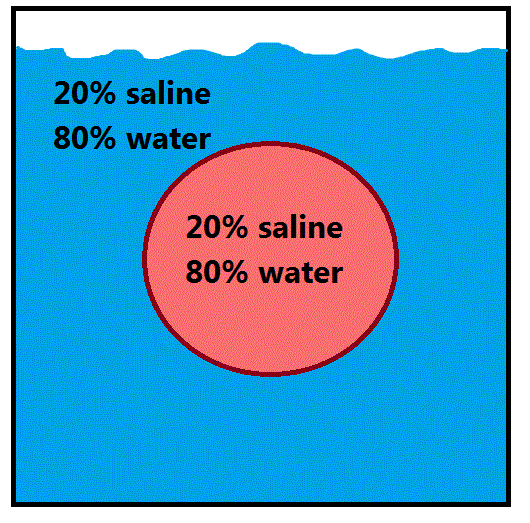
The cell below is in a _________ solution.
a)
Hypotonic
b)
Hypertonic
c)
Isotonic
9.
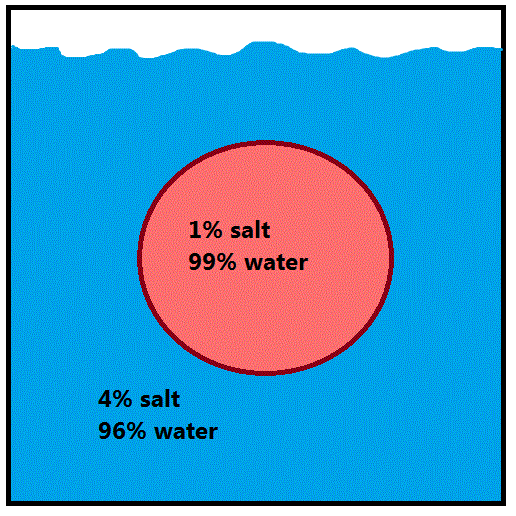
The cell below is in a _____________ solution.
a)
Hypertonic
b)
Hypotonic
c)
Isotonic
10.
What type of solution is this cell in?
a)
Isotonic
b)
Hypertonic
c)
Hypotonic
d)
diffused
11.
What type of solution is this cell in?
a)
Isotonic
b)
Hypertonic
c)
Hypotonic
d)
diffused
12.
The image indicates what type of solution the cell is in?
a)
Isotonic
b)
Hypertonic
c)
Hypotonic
13.

What is the molar mass of Cl2?

a)

17 g/mol

b)

35.5 g/mo;

c)

71.0 g/mol

d)

89 g/mol

14.

Calculate the molar mass of KOH.

a)

28 g/mol

b)

56 g/mol

c)

84 g/mol

d)

112 g/mol

15.

Calculate the molar mass for Al(OH)3

a)

78.0 g/mol

b)

72 g/mol

c)

28 g/mol

d)

25 g/mol

16.

Calculate the molar mass of Ba(C2H3O2)2

a)

255.3 g/mol

b)

237.3 g/mol

c)

228.3 g/mol

d)

196.3 g/mol

17.

Osmosis

a)

diffusion of water molecules through a semi-permeable mebrane from an area of low concentration to an area of high concentration
b)

the diffusion of particles from an area of high concentration to an area of low concentration

c)

diffusion of water molecules through a semi-permeable membrane from an area of high concentration to an area of low concentration

d)

the diffusion of particles from an area of low concentration to an area of high concentration

18.

Where will the water go?

a)

Into the cell

b)

Out of the cell

c)

Equally in & out - it's isotonic

d)

There is no water

19.

A blood cell is placed into the jar, as seen. Where will the water go?

a)

Into the cell

b)

Out of the cell

c)

Equally in & out - it's isotonic

d)

The water is a lie

20.

HYPO means...

a)

Low

b)

High

c)

Equal

d)

Fat

21.

ISO means...

a)

Low

b)

A lot

c)

Equal

d)

Mammal

22.

Why can't you drink salt water?

a)

It's hypertonic to your cells

b)

It's hypotonic to your cells

c)

It's isotonic to your cells

d)

It's paratonic to your cells

23.
Ideally, your cells should be in a(n) _______ solution
a)
Hypertonic
b)
Hypotonic
c)
Isotonic
d)
Cola
24.

Which cell is in a hypertonic environment?

a)

A

b)

B

c)

C

d)

None of them are hypertonic

25.

Which cell is in an isotonic environment?

a)

A

b)

B

c)

C

d)

None of them are isotonic

26.
The cells seem to be shriveled and dehydrated what type of solution are they most likely in?
a)
Hypertonic
b)
Isotonic
c)
Hypotonic
d)
Inertonic
27.
What type of solution is this cell in?
a)
Isotonic
b)
Hypertonic
c)
Hypotonic
d)
diffused
28.
What type of solution is this cell in?
a)
Isotonic
b)
Hypertonic
c)
Hypotonic
d)
diffused
29.
The cells seem to be swelling and about to burst what type of solution are they most likely in?
a)
Hypertonic
b)
Isotonic
c)
Hypotonic
30.
Gas laws involve what three variables?
a)
Solid Liquid Gas 
b)
Speed Velocity Acceleration 
c)
Elements Compounds Mixtures 
d)
Pressure Temperature Volume 
31.
If you increase the pressure, what will happen to the temperature, if volume is constant?
a)
Increase
b)
Decrease
c)
Stay the same
d)
It will Blow Up
32.
What will happen to the volume of a gas if the pressure increases, with constant temperature ?
a)
Increase
b)
Decrease
c)
Nothing
d)
Explosion!
33.
According to the Combined Gas Law, pressure and volume are inversely related which means that
a)
When pressure increases, volume increases
b)
When pressure decreases, volume decreases
c)
When pressure increases, volume decreases
d)
When pressure doubles, volume triples
34.
When a cold tire is inflated to a certain pressure and then is warmed up due to friction with the road, the pressure increases. This happens because the
a)
air molecules hit the walls of the tire less frequently
b)
rubber in the tires reacts with oxygen in the atmosphere
c)
air molecules speed up and collide with the tire walls more often
d)
air molecules diffuse rapidly through the walls of the tire.
35.
Directly proportional means that as one value increases ....................
a)
the other stays the same 
b)
the other increases as well
c)
the other decereases
d)
the other goes to zero
36.
Inversely proportional means as one value increases the other............. 
a)
increases 
b)
decreases 
c)
stays the same 
d)
goes to zero
37.

As the pressure of a gas goes up, the

a)

volume of the gas will get larger

b)

volume of the gas will get smaller

c)

the atoms will slow down

d)

the pressure of the gas will get lower

38.

As the temperature of a gas goes up, the

a)

volume of the gas will get larger

b)

volume of the gas will get smaller

c)

the atoms will slow down

d)

the pressure of the gas will get lower

39.
You have a gas that has a pressure of 2 ATM and a volume of 10L.  What would be the new volume if the pressure was changed to 1 ATM?
a)
5 L
b)
20 L
c)
It would stay at 10L
d)
1 L
40.

Assuming the temperature is constant, how could you increase the pressure inside a container by a factor of 3?

a)

increase volume by 1/3

b)

decrease volume by 1/3

c)

increase volume by 3

d)

decrease volume by3

41.

A gas sample has a volume of 25.0 milliliters at a pressure of 1.00 atmosphere. If the volume increases to 50.0 milliliters and the temperature remains constant, the new pressure will be

a)

1.00 atm

b)

2.00 atm

c)

0.250 atm

d)

0.500 atm