
 Worksheets
TEST 8 CH 13 EM waves and Light optics U15
Total questions: 58
Worksheet time: 1hrs 23mins


What is the ray of light that strikes the surface ?
Incident ray
reflected ray
normal ray
normal
A flat mirror is an example of a ___.
plane mirror
concave mirror
convex mirror
spherical mirror
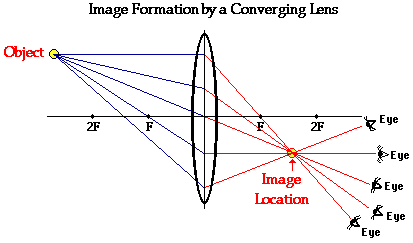

What do a prism, a magnifying glass, a microscope, and eyeglasses ALL have in common.
They are opaque
They refract light
They reflect light
That are translucent
Which image CORRECTLY shows how light behaves when it travels from air through glass?


Eyeglasses bend light to help the image form properly on the retina. The bending of light as it passes from one medium to another is called
diffraction
interference
reflection
refraction

Which part is #5?
pupil
iris
cornea
lens
This structure is the back of the eye and it sends images to the optic nerve.
Cornea
Lens
Retina
Pupil

Identify this structure
iris
lens
pupil
cornea


Type of mirror that can produce an inverted image...
Plane
Convex
Concave

Type of mirror that provides a wide angle view...
Plane
Convex
Concave

The size of an object and its image are the same in this type of mirror...
Plane
Convex
Concave

According to the law of reflection the angle of incidence is ____________ the angle of reflection.
less than
greater than
equal to
Image behind the mirror is
virtual
real
upside down
upright
image above the principal axis (PA) is
virtual
real
upright
upside down
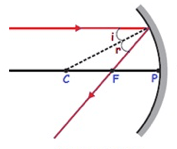
This ray diagram is for which mirror?
concave
convex
plane
window
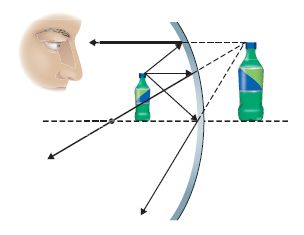
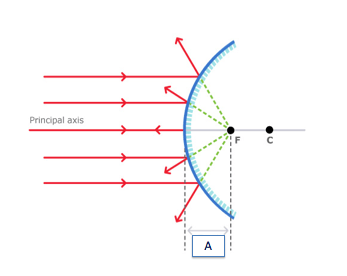
This image is showing a convex mirror because the image is (choose 2 answers)
rays meeting behind the mirror
rays meeting behind the mirror
image is real
image is virtual

The size of the image formed in the figure is .............. the size of the object.
larger than
same as
smaller than
A ____?____ can be described as a disturbance that travels through a medium.
ray
particle
wave
As wavelength increases, frequency decreases, with frequency decreasing, energy increases.
True
False
Insufficient data
It is the entire range of wavelengths or frequencies of electromagnetic radiation
electromagnetic waves
electromagnetic spectrum
electromagnetic collection
EM Waves with the longest wavelength
radio
infrared
gamma
x-ray
What does radar stand for?
radio detection and ranging
radial disemmination and ranging
recorded detection and ranging
Xrays and Gamma Rays have the highest frequencies, therefore, highest energies.
True
False
FM stands for
Frequency Metering
Frequency Modulation
Frequency Monitoring
Frequency Making
Select the correct order of waves on the EMS from low to high energy
Radio, Micro, Infra, Visible, Ultra, X-ray, Gamma
Gamma, X-ray, Ultra, Vis, Infra, Micro, Radio
Vis, Micro, Infra, Ultra, X-ray, Gamma, Radio
Micro, Radio, Vis, Infra, Ultra, X-ray, Gamma

The _______________ determines the color of visible light.
wavelength (and frequency)
speed
amplitude
particles of the medium

Put the visible light colors in order from SHORTEST wavelength (highest frequency) to longest wavelength (lowest frequency)
Violet, Indigo, Blue, Green, Orange, Yellow, Red
Red, Yellow, Green, Orange, Violet, Blue, Indigo
Red, Orange, Yellow, Green, Blue, Indigo, Violet

All electromagnetic waves are...
transverse waves and have the same frequency
transverse waves and have the same speed
mechanical waves and have the same wavelength
longitudinal waves and have the same energy

A beam of light has a wavelength of 600 nm in air. What is the frequency of the light (c = 3x10⁸ m/s)?
5 x 10¹⁴ Hz
2 x 10¹⁴ Hz
3 x 10¹⁴ Hz
6 x 10¹⁴ Hz
Find the frequency of an electromagnetic wave with a wavelength 2.75 × 10⁻⁸ m.
1.10 Hz
1.09 × 10¹⁶ Hz
9.17 × 10¹⁵ Hz
9.17 × 10¹⁶ Hz
Which of the following electromagnetic waves travels the fastest?
gamma rays
radio waves
ultraviolet waves
they all travel the same speed
Mr. H catches the news on 780 AM, which broadcasts at 780. kHz. Determine the wavelength of these radio waves.
3.85 x 10⁵ m
385 m
3.85 x 10⁴ m
3.85 x 10⁶ m
Light waves travel the fastest in
solid
liquid
gas
vacuum of empty space
Light waves travel the slowest in
solid
liquid
gas
vacuum of empty space


C = λν
If an AM radio station broadcasts at
9.95 x 10⁵ Hz, what is the wavelength of this radiation?

Calculate the wavelength of light that has a frequency of 5.2 x 10¹² 1/s.
5.8 x 10 -5 m
5.8 x 10 -7 m
5.19 x 10 14 m
1.56 x 10 23 m

IRAS, the Infrared Astronomy Satellite launched by NASA in 1983, had a detector that measured infrared or heat radiation from different regions of space. What is the frequency of infrared light that has a wavelength of
1.10 X 10⁻⁶ m?
3.67 x 10⁻¹⁵ Hz
3.67 x 10⁻³ Hz
2.73 x 10² Hz
2.73 x 10¹⁴ Hz
Which of the following has the highest energy?
Infrared radiation
Microwave radiation
Radio waves
Visible light

