
 Worksheets
DBMS unit2 ER model and Relational algebra
Total questions: 25
Worksheet time: 17mins
Relational Algebra is a __________ query language that takes two relations as input and produces another relation as an output of the query.
Relational
Structural
Procedural
Fundamental
Which of the following is a fundamental operation in relational algebra?
Set intersection
Natural join
Assignment
None of the mentioned
Which of the following is used to denote the selection operation in relational algebra?
Pi
Sigma
Lambda
Omega
For select operation the ________ appear in the subscript and the ___________ argument appears in the paranthesis after the sigma.
Predicates, relation
Relation, Predicates
Operation, Predicates
Relation, Operation
The ___________ operation, denoted by −, allows us to find tuples that are in one relation but are not in another.
Union
Set-difference
Difference
Intersection
Which is a join condition contains an equality operator:
Equijoins
Cartesian
Natural
Left

Based on the figure above, identify the number of tuples that will be returned by the following relational algebra query : σ Type = 'Saving' (Account)
2
3
6
0

Identify the CORRECT output for table (Student Difference Lecturer) or (Student - Lecturer) in table above


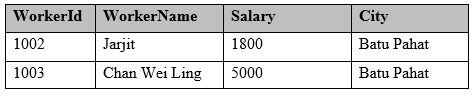
Base on the table given, identify output that will be produced when, σ Salary > 3000 ˅ City = ‘Batu Pahat’ (WORKER).



Which of the following are relational algebra operators?


An entity is a
object of relation
present working model
thing in real world
model of relation
A relationship is
an item in an application
a meaningful dependency between entities
a collection of related entities
a related data
Property that describes the characteristics of entity is
entities
relationship
attributes
identifiers
By relation cardinality we mean
number of items in a relationship
number of relationships in which an entity can appear
number of items in an entity
number of entity sets which may be related to a given entity
Rows of a relation is called
a relation row
an entity
a data structure
tuples
The columns of a relation
must be in specified order
may be in any order
with key field in first column
with largest width column last
Attributes are
properties of relationship
attributed to entities
properties of members of an entity set
In ER diagram relationships is represented by
circles
rectangles
ellipse
diamond shaped box

This is similar to


what type of generalization and specialization best describes this figure
disjoint, partial
disjoint, total
overlapping, total
overlapping, partial

Which is the correct and the best conversion of the ER diagram below to the relational model
Employee(eid , name)
Department(dname , location,budget ,date )
Employee(eid , name,date)
Department(dname , location,budget)
Employee(eid , name)
Department(dname , location,budget ,date,eid)
Employee(eid , name,date,dname)
Department(dname , location,budget)

In figure below what is the best way to model the Supplier and Project entity types and Supplies relationship type to relational schema
Supplier(Sname)
Project(Proj_name)
Supplier(Sname, Proj_name)
Project(Proj_name)
Supplier(Sname)
Project(Proj_name, Sname)
Supplier(Sname)
Project(Proj_name)
Supplies(Sname, Proj_name)
Which type of entity cannot exist in the database unless another type of entity also exists in the database, but does not require that the identifier of that other entity be included as part of its own identifier?
Weak entity
Strong entity
ID-dependent entity
ID- independent entity

