

wayground logo

Free Printable Worksheets

Font size

S
M
L
XL
Worksheets

Anatomy Semester Exam review

Total questions: 87

Worksheet time: 1hrs 13mins
Name
Class
Date
1.
What antigens are present in a person with type B- blood?
a)
B, only
b)
B and Rh
c)
A and Rh
d)
A, only
2.
What types of antigens are present in a person with O+ blood?
a)
A and B
b)
Rh, only
c)
A, B and Rh
d)
None
3.
What type(s) of antibodies are in a person with A+ blood?
a)
Anti-A and Anti-Rh
b)
Anti-Rh, only
c)
Anti-B
d)
None
4.
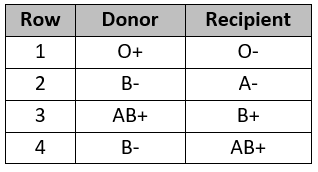
In which row of the chart will agglutination NOT occur in?
a)
Row 1
b)
Row 2
c)
Row 3
d)
Row 4
5.
In which row of the chart will agglutination NOT occur in?
a)
Row 1
b)
Row 2
c)
Row 3
d)
Row 4
6.
An individual's blood type is determined by
a)
environment
b)
genetics
c)
both environment and genetics
d)
your children's blood type
7.

What makes up around 55% of the blood?

a)

Plasma

b)

Red Blood Cells

c)

White Blood Cells

d)

Platelets

8.

What carries oxygen around the body?

a)

Plasma

b)

Red Blood Cells

c)

Platelets

d)

White Blood Cells

9.

What carries oxygen around the body?

a)

Plasma

b)

Red Blood Cells

c)

Platelets

d)

White Blood Cells

10.

What is the function (job) of the platelets?

a)

To form clots (i.e. scabs) when you have cuts and grazes.

b)

To transport oxygen to the muscles

c)

To carry dissolved sugars.

d)

To produce antibodies

11.

What is the function (job) of the plasma?

a)

To release antibodies to fight infections.

b)

To transport oxygen around the body.

c)

To carry dissolved nutrients and sugars.

d)

To transport oxygen around the body.

12.

What is the function (job) of the red blood cells?

a)

To transport oxygen around the body and to the muscles.

b)

To release antibodies to fight infections.

c)

To carry dissolved nutrients and sugars.

d)

To clot and form scabs if there is a wound on the body.

13.

Which is the smallest of the 3 blood vessels?

a)

Veins

b)

Arteries

c)

Capillaries

14.

Which blood vessels take blood AWAY from the heart?

a)

Veins

b)

Arteries

c)

Capillaries

15.

Which blood vessels take blood TO the heart?

a)

Veins

b)

Arteries

c)

Capillaries

16.

Which cells receive oxygen from red blood cells?

a)

all cells

b)

only skin cells

c)

only muscle cells

d)

only bone cells

17.

The protein that carries iron in the rbc is called _____.

a)

Hematocrit

b)

Hemoglobin

c)

Fibrinogen

d)

Albumin

18.

Which WBC kills parasites?

a)

neutrophils

b)

eosinophils

c)

monocytes

d)

basophils

19.

The.............carries visual messages to the brain.

a)

optic nerve

b)

taste buds

c)

receptors from the skin

d)

auditory nerve

e)

olfatory nerve

20.

The.............carries messages from the nose to the brain.

a)

optic nerve

b)

taste buds

c)

receptors from the skin

d)

auditory nerve

e)

olfatory nerve

21.
What is the central nervous system (CNS) made of?
a)
brain and spinal cord
b)
brain and cranial nerves
c)
spinal cord and spinal nerves
d)
cranial nerves and spinal nerves
22.
What is the purpose of the myelin sheath on the axon?
a)
To maintain temperature
b)
To improve conductivity
c)
To protect the axon
d)
To release neurotransmitters
23.
Sensory neurons carry nerve impulses from the sense organs and internal organs (like your stomach) to the
a)
peripheral nervous system (PNS)
b)
central nervous system (CNS)
c)
muscles
d)
sense organs
24.
What is NOT part of the peripheral nervous system (PNS)?
a)
axons
b)
sensory receptors
c)
spinal cord
d)
motor neurons
25.
part of a neuron that receives information from other neurons
a)
axon
b)
dendrites
c)
myelin sheath
d)
synapse
26.

The bones of the middle ear are collectively known as the ____

a)

superior temporal gyrus

b)

cochlea

c)

ossicles

d)

malleus, incus, and sternum

e)

tympanic membrane

27.
Moves the tongue
a)
Trigeminal
b)
Facial
c)
Hypoglossal
d)
Accessory
28.
Salivary glands
a)
facial
b)
optic
c)
olfactory
d)
accessory
29.
What part of the brain is Letter A pointing to?
a)
Temporal Lobe
b)
Parietal Lobe
c)
Occipital Lobe
d)
Frontal Lobe
30.
What part of the brain is Letter A pointing to?
a)
Temporal Lobe
b)
Parietal Lobe
c)
Occipital Lobe
d)
Frontal Lobe
31.
What part of the brain is Letter D pointing to?
a)
Frontal Lobe
b)
Temporal Lobe
c)
Occipital Lobe
d)
Cerebellum
32.
What part of the brain is Letter G pointing to?
a)
Frontal Lobe
b)
Parietal Lobe
c)
Occipital Lobe
d)
Temporal Lobe
33.
What part of the brain is Letter C pointing to?
a)
Frontal Lobe
b)
Parietal Lobe
c)
Occipital Lobe
d)
Temporal Lobe
34.
The brain and spinal cord together are considered the
a)
telencephalon
b)
peripheral nervous system
c)
central nervous system
d)
diencephalon
e)
Text for option 5 (optional)
35.

Action potentials are conducted more rapidly:

a)

along myelinated axons

b)

along unmyelinated axons

c)

in dendrites of a large diameter

d)

in dendrites of a small diameter

36.
Efferent division of PNS
a)
carries sensory information to the CNS
b)
carries motor information to muscles and glands
c)
processes and integrates sensory information
d)
processes and integrates motor and sensory information
37.
Along a neuron, the correct pathway for impulse conduction is:
a)
dendrite, axon, cell body, receptor
b)
dendrite, cell body, axon
c)
cell body, axon, dendrite
d)
receptor, axon, cell body
38.
At a synapse, a nerve impulse is transmitted by
a)
depolarization
b)
the myelin sheath
c)
a neurotransmitter
d)
Schwann Cell
39.
A reflex is
a)
an involuntary response to a stimulus
b)
a concious decision to maintain homeostasis
c)
a sensation to be interpreted
d)
a stimulus to be felt
40.
Define this major function 
Shape and Support 
a)
Red and white blood cells are produced in the bone marrow found in many bones.
b)
It is our body's framework. It provides shape for our body, holds our vital organs in place and allows us to have a good posture.
c)
Our muscles are attached to our bones in a way which allows movement.
d)
It protects our delicate organs e.g. - the SKULL protects the BRAIN, and the RIB CAGE protects the HEART and LUNGS etc…
41.
The five functions of the skeletal system are
a)
Protection, Shape &
Support, Movement, Blood production, Stor
b)
Protection, Shape, Rotation, 
Support, Movement, 
c)
Protection, Shape, Rotation, Movement, Organ support
d)
Movement, Blood production, Support, Vertebrae, Rotation
42.
Define this major function 
Blood Production
a)
Red and white blood cells are produced in the bone marrow found in many bones.
b)
carry oxygen to the muscles to enable them to work. They are red in colour because they carry haemoglobin.
c)
fight infection in the body.
d)
minerals like calcium are stored in the bones to add strength
43.
Define this major function 
Storage 
a)
minerals like calcium are stored in the bones to add strength
b)
It protects our delicate organs e.g. - the SKULL protects the BRAIN, and the RIB CAGE protects the HEART and LUNGS etc…
c)
It is our body's framework. It provides shape for our body, holds our vital organs in place and allows us to have a good posture.
d)
Red and white blood cells are produced in the bone marrow found in many bones.
44.

Which system of the human body provides protection to most of the major organs?

a)

skeletal system

b)

circulatory system

c)

respiratory system

d)

muscular system

45.

The joint with a rounded end of bone fitting snug within another bone.

a)

ball and socket joint

b)

hinge joint

c)

pivot joint

d)

gliding joint

46.
Hip and shoulder have examples of this type of joint
a)
ball and socket
b)
condyloid
c)
hinge
d)
gliding
47.
The elbows, knees and phalanges are examples of this type of joint
a)
ball and socket
b)
condyloid
c)
gliding
d)
hinge
48.
How many bones does an adult human have?
a)
300
b)
306
c)
206
d)
602
49.
Which of these is a long bone?
a)
Femur
b)
Patella
c)
Scapula
d)
Carpal
50.
Which of these is an irregular bone(s)?
a)
Pelvis
b)
Humerus
c)
Phalanges
d)
Tarsals
51.
_______ system
a)
Muscular
b)
Skeletal
c)
Bone
d)
Circulatory
52.
How many chambers does the heart have?
a)
1
b)
2
c)
3
d)
4
53.
The arrow indicates the
a)
Right atrium
b)
Left ventricle
c)
Right ventricle
d)
Left atrium
54.
The arrow indicates the
a)
Right ventricle
b)
Pulmonary artery
c)
Left ventricle
d)
Right atrium
55.
The major blood vessel that carries oxygenated blood out of the heart is the
a)
left atrium
b)
right atrium
c)
aorta
d)
vena cava
56.

Which side of the heart pumps blood without oxygen to the lungs?

a)

Left

b)

Right

57.

Which organ of your body controls your thoughts and emotions?

a)

Brain

b)

Heart

58.

Blood from the R. Ventricle flows through the

a)

Pulmonary Vein

b)

Pulmonary Artery

c)

Aorta

d)

Superior Vena Cava

59.

The AV valves are:

a)

Mitral

b)

Pulmonary

c)

Tricuspid

d)

Aortic

60.

Which of the following is carried by a red blood cell throughout the body?

a)

Glucose

b)

Carbon Dioxide

c)

Oxygen

d)

Both Carbon Dioxide AND Oxygen

61.
How many types of Muscles are there in the body?
a)
2
b)
4
c)
3
d)
1
62.

This body systems involves white and red blood cells and transporting things through the body

a)

Circulatory System

b)

Respiratory System

c)

Digestive System

d)

Endocrine System

63.

This body systems involves nutrient absorption, breaking down of food and enzymes.

a)

Circulatory System

b)

Respiratory System

c)

Digestive System

d)

Endocrine System

64.

The ________ is a sac-like muscular organ that stores urine until it is released from the body.

a)

ureters

b)

kidneys

c)

bladder

d)

urethra

65.

Which row below indicates a mismatch between the processes and the functions of the kidney?

a)

Process: excretion of metabolic wastes

Function: rids the body of urea and uric acid

b)

Process: maintaining the water-salt balance

Function: helps regulate blood volume

c)

Process: maintaining the acid-base balance

Function: rids the body of nitrogenous wastes

d)

Process: regulating salt balance in the blood

Function: reabsorption of various ions including Na+

66.

Which sequence represents the correct order that a molecule of urea will pass through in the urinary system?

a)

Bowman’s capsule, nephronic tubules, collecting duct, ureter, bladder, urethra

b)

glomerulus, Bowman’s capsule, nephronic tubules, collecting duct, ureter, bladder, urethra

c)

glomerulus, Bowman’s capsule, nephronic tubules, collecting duct, urethra, bladder, ureter

d)

Bowman’s capsule, glomerulus, nephronic tubules, ureter, collecting duct, bladder, urethra

67.

During which process is waste, excess salts and toxins actively transported from the renal capillaries into the nephron to form urine.

a)

Filtration

b)

Reabsorption

c)

Secretion

d)

Active transport

68.

In a healthy person, the main job of the kidney is to produce urine that contains

a)

indigestible foods and bacteria.

b)

glucose and amino acids.

c)

toxic waste products of metabolism.

d)

water and plasma proteins.

69.

The first step of urine formation is ...

a)

Reabsorption

b)

Augmentation

c)

Filtration

d)

Urination

70.

Structure shows nephron with blood vessels inthe kidney. What is R and S?

(a)  

71.
What is the anatomical landmark that surrounds the knot of capillaries in a nephron?
a)
Collecting Duct
b)
Renal tubule
c)
Glomerulus
d)
Bowman's capsule
72.
If someone decides to ‘hold it in’ and not urinate, they are controlling which urethral sphincter?
a)
Medial Urethral Sphincter
b)
Lateral Urethral Sphincter
c)
External Urethral Sphincter
d)
Internal Urethral Sphincter
73.

The baby grows and develops here

a)

prostate

b)

uterus

74.

Produces sperm:

a)

Females

b)

Males

75.

_____ nourishes sperm.

a)

Testicles

b)

Epididymis

c)

Semen

d)

Urethra

76.

What is the sac like structure that houses the testicles.

a)

Epididymis

b)

Vas deferens

c)

Scrotum

d)

Seminal Vesicle

77.
The part of the female reproductive system where fertilization takes place
a)
Uterus
b)
Womb
c)
Vaginal opening
d)
Fallopian Tubes
78.
The part of the female reproductive system where fertilization takes place
a)
Uterus
b)
Womb
c)
Vaginal opening
d)
Fallopian Tubes
79.
external organ which sperm leave the body
a)
penis
b)
ovaries
c)
menstrual cycle
d)
fertilization
80.
reproductive organs that produce eggs and hormones
a)
cervix
b)
vagina
c)
ovaries
81.
What do we call a fertilized egg?
a)
Sperm
b)
Testosterone
c)
Zygote
d)
Egg
82.
What is the process called when a sperm and egg produce a zygote?
a)
Reproduction
b)
Excretion
c)
Fertilization
d)
Sneezing
83.

The human male reproductive system is adapted for the production of

a)

sperm and the delivery of these cells for internal fertilization

b)

gametes that transport food to the egg

c)

zygotes and the development of these cells into a fetus

d)

hormones that stimulate placenta formation in the male

84.

Which structure is correctly paired with its function?

a)

ovary — provides milk for newborns

b)

testis — development of sperm

c)

placenta — storage of released eggs

d)

uterus — produces estrogen

85.

Which reproductive structure is correctly paired with

its function?

a)

uterus—usual site of fertilization

b)

testis—usual location for egg development

c)

ovary—delivers nutrients to the embryo

d)

sperm—transports genetic material

86.

What process produces sperm?

a)

Spermatogensis

b)

Oogenesis

87.

What process produces ova (eggs)?

a)

Spermatogenesis

b)

Oogenesis
