
 Worksheets
Final Exam- Chemistry
Total questions: 30
Worksheet time: 25mins
In a double replacement, ____________________
The reactants are usually a metal and a nonmetal
One of the reactants is often water
The reactants are generally 2 ionic compounds in aqueous solutions
Energy in the form of light or heat is often produced
Chemical equations must be balanced to satisfy ____.
The law of definite proportions
The law of multiple proportions
The law of conservation of mass
Avogadro's principle
What are the coefficients that will balance the skeleton equation below?
AlCl3 + NaOH → Al(OH)3 + NaCl
1,3,1,3
3,1,3,1
1,1,1,3
1,3,3,1
An ionic bond is between
metal and metal
metal and nonmetal
nonmetal and nonmetal
The periodic table is organized by the
atomic numbers
alphabetical order
densities
melting points
What is the oxidation number for Carbon?
+4 and -4
-3
+1

Is this the correct lewis dot for Chlorine?
yes
no
Which Lewis dot matched the configuration:
1s2 2s2 2p2 2p6 3s1


States of Matter: Melting, Freezing, Evaporating, and Sublimating are all...
physical changes.
chemical changes.
Match the name and formula:
iron (II) oxide, Fe2O3
potassium chloride, K2Cl2
carbon monoxide, CO2
Which name represents the formula Fe2O3 ?
Iron (III) oxide
Iron (II) oxide
Subatomic particles with a negative charge
Electrons
Neutrons
Protons
Quarks
Subatomic particles found on the outermost shell & responsible for the atom's reactivity
neutrons
valence electrons
isotopes
ions

How many valence electrons does this picture show?
2
3
4
5
6

What will this atom do to become stable?
Gain 3 e-
Gain 5 e-
Lose 3 e-
Lose 5 e-
Already stable

What is the atomic mass of the atom pictured?
9
10
18
19
28

This element tends to _________________ and form a(n) ________________
lose 4 e-; anion
gain 4 e-; anion
lose 2 e-; cation
gain 2 e-; cation
lose 4 e-; cation
CH4 + 2O2 -> CO2 + 2H2O
Does this equation follow the law of conservation of mass? In other words, are there the same number of carbon, hydrogen, and oxygen atoms in the reactants and the products?
What coefficients are needed to balance the reaction?
What coefficient goes in front of CaO?
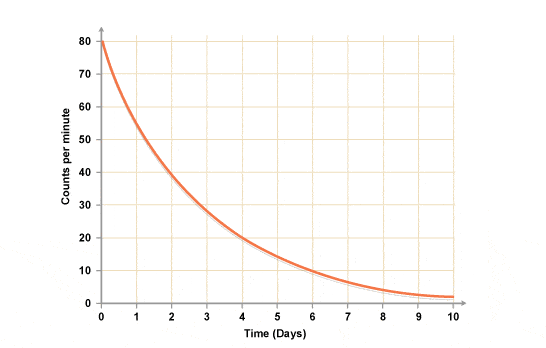


Atoms of the same element that have different numbers of neutrons.
Isotope
Covalent Bond
Enzymes
Ionic Bonds

A covalent bond is formed as a result of
transferring electrons
sharing electrons
transferring protons
sharing protons

What is the number of protons that the element in this image contain?
14
7
15
18

Which element is in period 1, group 8?
Helium
Hydrogen
Neon
Lanthanum
Rank the elements Mn, Ne, O, Si, and Sr from lowest to highest electronegativity.
(low) Ne < Sr < Mn < Si < O (high)
(low) Sr < Mn < Si < O < Ne (high)
(low) O < Si < Mn < Sr < Ne (high)
(low) Ne < O < Si < Mn < Sr (high)

