wayground logo

Free Printable Worksheets

Font size

S
M
L
XL
Worksheets

Chemistry Final- F2021

Total questions: 142

Worksheet time: 2hrs 26mins

Name
Class
Date
1.

What is volume?

a)

The distance around a 3D object

b)

The amount of space that matter takes up

c)

The amount of space on the surface of a 3D object

2.

_______________is the amount of matter in an object.

a)

mass

b)

volume

c)

weight

3.

Unit of length

a)

Liter

b)

Meter

c)

Gram

4.
Basic unit of Mass
a)
Meter
b)
Liter
c)
Gram
5.
What is the factor that an experimenter changes on purpose?
a)
Dependent Variable
b)
Independent Variable
c)
Constant
d)
Control
6.
What is a factor that is measured for change in an experiment?
a)
control
b)
constant
c)
independent variable
d)
dependent variable
7.
The part of the experiment that does not contain the independent variable. Used for comparison.
a)
Control Group
b)
Experimental Group
c)
Results
d)
Data
8.
What are all the things that are kept the same in an experiment?
a)
controls
b)
data
c)
constants
d)
independent variables
9.
What is the effect of salt water on the average of the height of the 3 tallest blades of grass?
What is the independent variable in the above question?
a)
salt water
b)
height
c)
average
d)
effect
10.
There are two types of data. Which type of data involves numbers that are obtained by counting or measuring?
a)
quantitative
b)
qualitative
11.
A series of steps used by scientists to solve a problem or answer a question. 
a)
scientific method
b)
recipe
c)
metric system
12.
If I study for my scientific methods quiz, then I will have a better test score. What is the DEPENDENT VARIABLE?
a)
Test score
b)
Studying
c)
Independent variable
13.
Mia sets up an experiment to see how the mass of a ball affects the distance it rolls off a ramp.  Identify the INDEPENDENT VARIABLE:
a)
distance traveled by the ball
b)
mass of the ball
14.

What is a hypothesis?

a)

A hypothesis is the right answer to an experiment.

b)

A hypothesis is the wrong answer to an experiment.

c)

A hypothesis is an educated guess about what you think will happen.

15.
What step does every scientific experiment begin with?
a)
hypothesis
b)
question/problem
c)
procedures
d)
conclusion
16.
Which of the following would be considered QUANTITATIVE data?
a)
Color
b)
Smell
c)
6.84 cm
d)
texture
17.

How close a measurement is to the accepted value is called..

a)

Accuracy

b)

Precision

c)

Significant

d)

Estimate

18.
When a measurement is repeatable and consistent it is said to have...
a)
High precision
b)
Low precision
c)
High accuracy
d)
Low accuracy
19.

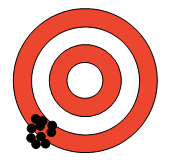
What does this bullseye demonstrate?

a)

High Accuracy & High Precision

b)

High Accuracy & Low Precision

c)

Low Accuracy & High Precision

d)

Low Accuracy & Low Precision

20.

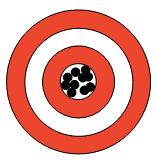
What does this bullseye demonstrate?

a)

High Accuracy & High Precision

b)

High Accuracy & Low Precision

c)

Low Accuracy & High Precision

d)

Low Accuracy & Low Precision

21.

Students measured length during a science experiment and got 12 cm. But the actual measurement was 14.25 cm. What was the percent error?

a)

15.79%

b)

18.75%

c)

2.25%

d)

18%

22.
The deer population is estimated to be 17,600 in northern Illinois, but an actual count was 21,300. What is the percent error?
a)
21%
b)
17.37%
c)
17.4%
d)
21.02%
23.
The attendance for the basketball game was estimated to be 15,000 people but 12,500 people attended. What was the percent error?
a)
16.67%
b)
20%
c)
2500%
d)
80%
24.

Comparing the two numbers written in scientific notation, which number is larger 6.0 X 10 -3 or 6.0 X 10 -2

a)

6.0 X 10 -3

b)

6.0 X 10 -2

c)

both have the same value

25.

A zero percent error in a lab is accomplished by...

a)

having a really good measuring device

b)

making sure all the steps in a procedure are being followed

c)

getting the exact result as the expected result in a lab

d)

rounding numbers to zero

26.

Students worked in teams to measure the length of an object. Their results are listed below. The actual length of the object was 7.0 cm. Select the best choice that represents their data in terms of accuracy and precision

GROUP RESULTS

5.00 cm

5.01 cm

5.02cm

4.99 cm

5.00 cm

4.99 cm

a)

both accurate and precise

b)

only accurate

c)

only precise

d)

not accurate and not precise

27.
What measurement are we finding when we use a graduated cylinder?
a)
mass
b)
volume
c)
length
d)
weight 
28.
What tool can you use to find out how the mass of a pencil compares to the mass of a pen?
a)
balance
b)
meter stick
c)
thermometer
d)
measuring tape
29.
What is the name of Group 1?
a)
Alkali Metals
b)
Alkali Earth Metals
c)
Transition Metals
d)
Halogens
30.
What is the name of Group 2?
a)
Alkali Metals
b)
Alkali Earth Metals
c)
Transition Metals
d)
Halogens
31.
What is the name of Groups 3-12?
a)
Alkali Metals
b)
Alkali Earth Metals
c)
Transition Metals
d)
Halogens
32.
What is the name of Groups 17?
a)
Alkali Metals
b)
Alkali Earth Metals
c)
Transition Metals
d)
Halogens
33.
What is the name of Groups 18?
a)
Alkali Metals
b)
Alkali Earth Metals
c)
Halogens
d)
Noble Gases
34.
Where are the metals on the Periodic Table?
a)
To the left
b)
In the upper right hand corner
c)
On the zigzag line
d)
At the bottom
35.
Where are the metals on the Periodic Table?
a)
To the left
b)
In the upper right hand corner
c)
On the zigzag line
d)
At the bottom
36.
Where are the nonmetals on the Periodic Table?
a)
To the left
b)
In the upper right hand corner
c)
On the zigzag line
d)
At the bottom
37.
Where are the metalloids on the Periodic Table?
a)
To the left
b)
In the upper right hand corner
c)
On the zigzag line
d)
At the bottom
38.
What is the name for the bottom two rows of the table that have been removed?
a)
Alkali Metals
b)
Alkali Earth Metals
c)
Transition Metals
d)
Lanthanides and Actinides
39.
Which atom has the largest atomic radius?
a)
potassium
b)
rubidium 
c)
francium
d)
cesium
40.

Which of the following would be most similar to Phosphorus? (select all that apply)

a)

Nitrogen

b)

Sulfur

c)

Silicon

d)

Germanium

e)

Antimony

41.

Which of these elements are a Non-Metal?

a)

Copper

b)

Gold

c)

Oxygen

42.

Some metals are m (a)   , which means the can be hammered into different shapes.

43.

Non-metals are insulators, this means electricity ______ flow through them.

a)

can

b)

cannot

44.
Brittle
a)
Metal
b)
Nonmetal
45.
How do metals differ from nonmetals?
a)
metals are shiny, nonmetals are dull
b)
metals are good insulators, nonmetals are good conductors
c)
metals are powdery
d)
nonmetals are shiny
46.
What are the three major categories of the periodic table?
a)
Alpha, Beta & Gamma
b)
Metals, Non-Metals and Metalloids
c)
Metals, Semi-metals and Metalloids
d)
Non-Metals, Semi-Metals and Metalloids
47.
Which of the following is a good conductor of heat?
a)
Metal
b)
Nonmetal
c)
Metalloid
48.

A positively charged particle found in the nucleus is called a

a)

neutron.

b)

proton.

c)

electron.

d)

positron.

49.

Electrons can best be described as having a

a)

large size, positive charge.

b)

very small size, positive charge.

c)

large size, negative charge.

d)

very small size, negative charge.

50.

Electrons are subatomic particles that exist

a)

inside the nucleus.

b)

in simultaneous dimensions.

c)

in parallel universes.

d)

outside the nucleus.

51.

Which of these has a positive charge?

a)

proton

b)

neutron

c)

electron

d)

protons and neutrons

52.

Which of these has the least mass at almost 0 amu?

a)

proton

b)

neutron

c)

electron

d)

protons and neutrons

53.

Which answer below is correct?

a)

A is negative; B is positive; C is neutral

b)

A is neutral; B is positive; C is negative

c)

A is positive; B is neutral; C is negative

d)

A is negative; B is neutral; C is positive

54.

Which statement is true?

a)

A proton is the same size as an electron but smaller than a neutron.

b)

An electron is the same size as a proton and bigger than a neutron.

c)

A neutron is the same size as a proton and much bigger than an electron.

d)

A neutron is the same size as a proton but much smaller than an electron.

55.

Which of the following is a chemical property?

a)

Crystal formation

b)

Ductility

c)

Colour

d)

Reaction to heat

56.

Which of the following is a physical property?

a)

Ability to burn

b)

Reaction with acids

c)

Flash point

d)

Solubility

57.

Classify the following example of matter:

Oxygen gas ( O2O_2 

a)

Element

b)

Compound

c)

Homogeneous mixture

d)

Heterogeneous mixture

58.
Which of the following can only be observed when it is changing composition?
a)
chemical property
b)
physical property
59.

1.Particles cannot change position in a ________

a)

solid

b)

liquid

c)

gas

60.
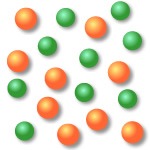
This picture represents which of the following?
a)
element
b)
compound
c)
mixture
61.
A mixture in which different materials can be identified easily
a)
element
b)
heterogeneous mixture
c)
homogeneous mixture
d)
solution
62.

This state of matter has a constant volume, but fits the space of the container holding it.

a)

Solid

b)

Liquid

c)

Gas

d)

Plasma

63.

Atoms or molecules in this state of matter have the lowest energy.

a)

Solid

b)

Liquid

c)

Gas

d)

Plasma

64.

Heating a solid to a high temperature will usually result in this phase change.

a)

Condensation

b)

Melting

c)

Sublimation

d)

Evaporation

65.
Type of intermolecular force present in HF.
a)
dipole dipole
b)
dispersion
c)
H-bond
d)
ionic
66.
Intermolecular forces are the forces
a)
within molecules
b)
between molecules
67.

Ethanol and water have different boiling point. What would be the suitable separation technique for a mixture of both substances?

a)

Distillation

b)

Chromatography paper

c)

Sieving

68.

Dirt

a)

Heterogeneous

b)

Homogeneous

69.

The pigment responsible for the colour of spinach leaves are several substances. How can you separate them?

a)

sieving

b)

decanting

c)

paper chromatography

70.
Air
a)
Heterogeneous
b)
Homogeneous
71.

Are made from a combination of 2 or more elements in a constant ratio...

a)

Atom

b)

Mixture

c)

Compounds

d)

Elements

72.
Another name for a homogeneous mixture is 
a)
an element.
b)
a solution.
c)
a compound.
73.

Type of mixture that DOESN'T HAVE the same composition in every part.

a)

Homogeneous

b)

Heterogeneous

74.
Kool-Aid - Powder, sugar, and water
Identify the solvent 
a)
water
b)
powder
c)
sugar
d)
powder and sugar
75.
Combination of two or more pure substances that are not chemically combined
a)
compound          
b)
atom
c)
mixture 
d)
element
76.
Conduct electricity when melted or dissolved in water.
a)
ionic compounds
b)
molecular compounds
77.
Formed when a non-metal shares electrons with another non-metal.
a)
ionic compound
b)
molecular compound
78.
Formed when positively charged metal ions attract negatively charged non-metal ions.
a)
ionic compounds
b)
molecular compounds
79.
An atom, or a group of atoms that has an electrical charge, either positive or negative.
a)
electron
b)
ion
c)
nucleus
d)
orbital
80.
Which of the following forms an ionic compound?
a)
a metal and another metal
b)
a non-metal and another non-metal
c)
a metal and a non-metal
d)
a covalent bond
81.
NaCl is a(n) 
a)
ionic compound
b)
molecular compound
82.
MgO is a(n)
a)
ionic compound
b)
molecular compound
83.
CH4 is a(n)
a)
ionic compound
b)
molecular compound
84.
Which of the following is an ionic compound?
a)
CCl4
b)
CO
c)
MgO
d)
CH4
85.
Which of the following is a molecular compound?
a)
CaO
b)
NaCl
c)
CaCl2
d)
CH4
86.
MgCl2
a)
Ionic
b)
Covalent
c)
Polyatomic Ion
d)
Metallic 
87.
Which following is a nonmetal?
a)
Se
b)
Mn
c)
Na
d)
Be
88.
What is the best name for the positively charged ion?
a)
cation
b)
anion
c)
metal
d)
nonmetal
89.
Molecular compounds contain
a)
1 metal and 1 nonmetal
b)
only metals
c)
only nonmetals
d)
more than 2 elements (either metal or nonmetal)
90.
If magnesium binds with oxygen, what compound forms? (use your periodic table)
a)
MgO
b)
Mg₂O
c)
Mg₂O₂
d)
MgO₂
91.
Which of the following forms an ionic compound?
a)
a metal and another metal
b)
a non-metal and another non-metal
c)
a metal and a non-metal
d)
a covalent bond
92.
PH3 is a(n)
a)
ionic compound
b)
molecular compound
93.

When metals bond with non-metals they form what type of bonds

a)

molecular

b)

ionic

c)

cooperative

d)

lewis

94.
Name this compound: 
KF
a)
Potassium fluoride
b)
Potassium fluorite
c)
Fluorine potasside 
d)
Potassium fluorate
95.
The chemical formula of carbon tetrachloride is
a)
CCl
b)
C₄Cl
c)
CCl₄
d)
C(IV)Cl
96.
carbon monoxide
a)
CO
b)
CO2
c)
C2O
d)
COH
97.

What is the name of PBr3

a)

phosphorus tribromide

b)

phosphorus bromide

c)

phosphorus (III) bromide

d)

phosphorus bromine

98.

What is the name of KOH

a)

potassium oxygen hydrogen

b)

potassium monoxygen monohydride

c)

potassium hydroxide

d)

potassium hydride

99.

LiBr is called

a)

lithium bromine

b)

lithium (I) bromine

c)

lithium bromide

d)

lithuim (I) bromide

100.

What is the name for SiCl4?

a)

silicon tetrachloride

b)

silicon quadchloride

c)

monosilicon tetrachloride

d)

silicon chloride

101.

A binary compound is composed of two ..........................

a)

elements

b)

compounds

c)

mixtures

102.
Chemical reactions occur when _________ are broken and new bonds are formed.
a)
mixtures
b)
osteoclasts
c)
physical bonds
d)
chemical bonds
103.

Why must chemical equations be balanced?

a)

So that the equation doesn't explode

b)

The reaction won't happen until it is balanced

c)

Based on the Law of Conservation of Matter, matter cannot be created or destroyed.

d)

Based on the Law of Conservation of Energy, energy cannot be created or destroyed.e

104.

The products of a reaction have the same ________as the reactants.

a)

molecule

b)

atoms

c)

subscripts

d)

coefficients

105.
How many atoms of aluminum are on each side of the following equation: 4Al + 3O--> 2AlO3
a)
2
b)
6
c)
1
d)
4
106.
The substances listed on the right side of a chemical equation are the
a)
Yields
b)
Reactants
c)
Products
d)
Precipitates
107.
How many HCl molecules do you need to balance this equation? 
Mg +  __HCl --->  MgCl2 + H2
a)
1
b)
2
c)
3
d)
4
108.
Which number should go in the blank?
_ H2 + O2 -> 2 H2O
a)
1
b)
2
c)
3
d)
0
109.

Which type of chemical reaction has two or more reactants to make one product?

a)

combustion

b)

single displacement

c)

double displacement

d)

synthesis

e)

decomposition

110.

Identify the following chemical reaction.

Pb + FeSO4 ----> PbSO4 + Fe

a)

Synthesis (or combination)

b)

Decomposition

c)

Single displacement

d)

Double displacement

111.

Combustion reactions will always involve

a)

Oxygen and a solid

b)

Liquid nitrogen and heat

c)

Oxygen and heat/energy

d)

CO and H2O

112.

What type of reaction involves the breaking down of a substance into simpler substances?

a)

Single Displacement Reaction

b)

Double Displacement Reaction

c)

Synthesis Reaction

d)

Decomposition Reaction

113.
Which of the following symbols is not a correct indication of the phase of a substance in a reaction? 
a)
(s)=solid
b)
(g)=grams
c)
(l)=liquid
d)
(aq)= aqueous
114.
What is the molar mass of Mg3N2?
a)
191.6 g/mol
b)
76.64 g/mol
c)
38.32 g/mol
d)
100.95 g/mol
115.
What is the mass of one mole of Al2(SO4)3?
a)
75.04 g
b)
342.14 g 
c)
75.04 mol
d)
342.14 mol
116.
How many moles of carbon atoms are there in 5g of carbon?
a)
60 mol
b)
17 mol
c)
0.42 mol
d)
7 mol
117.
How many molecules are present in 69.0 moles of SrO?
a)
4.16x1025molecules
b)
8.72x10²¹molecules
c)
7,149.78 molecules
d)
6,893.32 molecules
118.
How many molecules are present in 25 g of NaBr?
a)
102.96 molecules
b)
0.24 molecules
c)
1.45x10²³ molecules
d)
2.34 x 10²⁰molecules
119.

Which type of reaction is:

4 (NH4)3PO4 + 3 Pb(NO3)4 → 12 NH4NO3 + Pb3(PO4)4

a)
Synthesis
b)
Decomposition
c)
Single Displacement
d)
Double Displacement
120.

What happens to the equilibrium if we add methane (CH4)?

a)

It shifts left, towards the reactants

b)

It shifts right, towards the products

c)

It does not shift

121.

What happens to the equilibrium if we remove carbon monoxide (CO)?

a)

It shifts left, towards the reactants

b)

It shifts right, towards the products

c)

It does not shift

122.

What happens when sulfur trioxide (SO3) is added?

a)

The reaction shifts left, towards the reactants

b)

The reaction shifts right, towards the products

c)

The reaction does not shift

123.
Why does a catalyst increase the rate of reaction?
a)
it produces extra energy for the reactants
b)
it increases the speed of the reactant particles
c)
it increases the frequency of particle collisions
d)
it reduces the activation energy of the reaction 
124.
Which of the following increase the reaction rate?
a)
less surface area
b)
lower temperature
c)
an inhibitor
d)
increased concentration
125.
Why don't all collisions between particles cause a reaction?
a)
the particles also need to collide with a catalyst
b)
not all the particles collide with enough energy
c)
not all the particles collide at a high enough temperature
d)
the particles need to collide with each other twice
126.
Which factors increase the rate of a reaction.
a)
increasing temperature
b)
increasing concentration
c)
increasing surface area
d)
all of these
127.

A substance is found to have the following characteristics:


Very bitter taste

Feels slippery to the touch

Produces OH- ions when dissolved in water


In what category would the substance be classified?

a)

acid

b)

base

c)

enzyme

d)

fatty acid

128.

HNO2

a)

a base

b)

a salt

c)

an acid

d)

an ionic compound

129.
Releases hydrogen in an aqueous solution.
a)
base
b)
strong base
c)
acid
d)
weak base
130.

Bases have a pH of

a)

7

b)

Less than 7

c)

More than 7

131.

Which of the following pH values represents a base?

a)

2.1

b)

4.6

c)

6.8

d)

8.1

132.

Ocean water is only slightly basic. What might its pH value be?

a)

5

b)

8

c)

12

d)

2

133.

If two objects have different temperatures when they come in contact, heat will flow from the warmer object to the cooler one UNTIL ____________

a)

one reaches a temperature of zero

b)

they both have an equal temperature

c)

one runs out of energy

134.

For a skillet, used for cooking, do you want a high or low specific heat

a)

High, so that it will need more energy to heat up

b)

Low, so that it will change temperature quickly

135.
A reaction is performed in a beaker with a temperature probe recording the temperature changes of the reaction.  If the temperature began at 15.0 degrees Celsius and ended at 27.5 degrees Celsius. Is the reaction endothermic or exothermic?
a)
Exothermic
b)
Endothermic
136.
The amount of energy required to raise the temperature 1ºC for every kilogram is called____?
a)
Thermal Energy
b)
Specific Heat
c)
Temperature
d)
Kinetic Energy
137.

A metal cube at temperature of 70°C is immersed in water at temperature of 20°C. The metal _______ heat while the water __________ heat.

a)

gains, loses

b)

loses, gains

138.
The SI unit of heat and energy is the __________.
a)
calorie
b)
heat
c)
joule
d)
watt
139.

What does "q" mean?

a)

A measure of heat energy

b)

A change in heat energy

c)

A measure of kinetic energy

d)

A change in temperature

140.

What does  ΔT\Delta T  represent?

a)

 tf tit_{f\ }-t_i  

b)

 ti tft_{i\ }-t_f  

c)

t - celsius

d)

celsius - t

141.

When is your answer negative?

a)

When the sample is cooled or loses heat energy.

b)

When the sample heats up or gains heat energy.

c)

When the sample absorbs heat energy.

142.
If 200 grams of water is to be heated from 24.0° C to  100.0° C to make a cup of tea, what is the mass and what is the change in temperature?
a)
m=100g,  ∆t= 224 C
b)
m=200g,  ∆t=124 C
c)
m=100g,  ∆t=24 C
d)
m=200g,  ∆t=76 C