wayground logo

Free Printable Worksheets

NEW

Font size

S
M
L
XL
Worksheets

2nd Semester Test Review

Total questions: 40

Worksheet time: 49mins

Name
Class
Date
1.
Where the better adapted organisms survive to pass traits along to offspring.
a)
Evolution
b)
Natural Selection
c)
Extinction
d)
Artifical Selection
2.
Why are advantageous traits more likely to be passed onto offspring?
a)
Because they are more likely to survive and reproduce.
b)
Because they come from dominant alleles.
c)
Because they come from recessive alleles.
d)
Because the trait is an acquired phenotype.
3.
Mutations are a change in what?
a)
DNA
b)
tRNA
c)
genotype
d)
phenotype
4.

What word describes a trait that helps an organism survive in its environment?

a)

natural selection

b)

mutation

c)

camouflage

d)

adaptation

5.
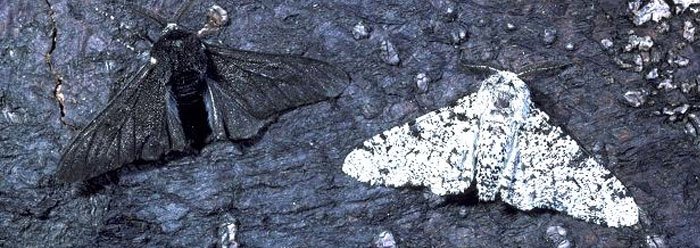
The trees these moths used to live on were white, but have been covered in soot from coal factories. Which moth will be more successful in this environment?
a)
Dark moth
b)
Light moth
c)
Both will be equally successful
d)
Neither will be successful
6.
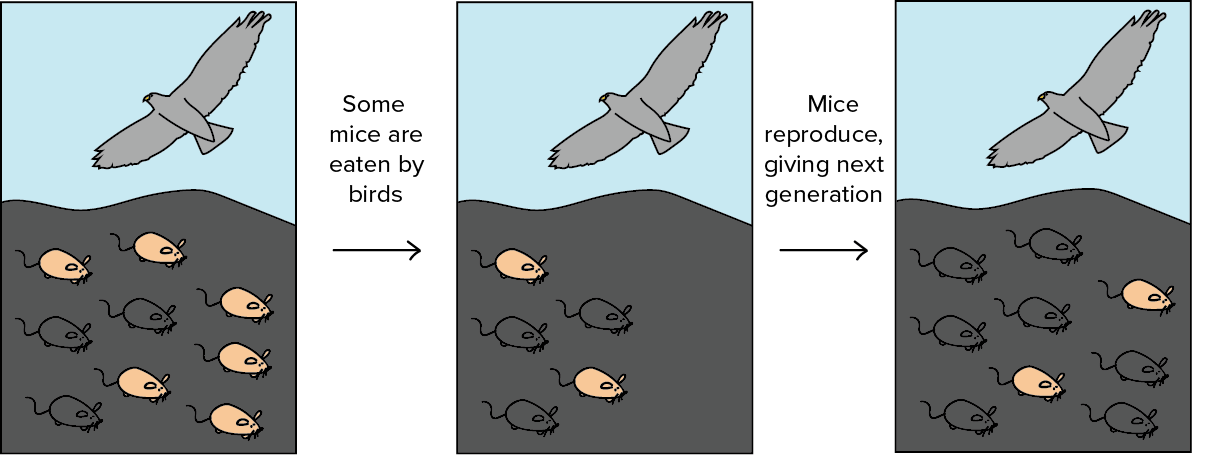
Why is the mouse population changing over time?
a)
The light mice can reproduce more successfully than the dark mice
b)
The hawks eat more dark mice than light mice because the dark mice taste better
c)
The hawks eat more light mice than dark mice because they can see the light mice more easily
d)
The hawks eat more dark mice than light mice because they can see the dark mice more easily
7.
All rabbits living in a particular area would be an example of a(n)
a)
population
b)
species
c)
fossil
d)
individual organism
8.
Change over time
a)
Natural Selection
b)
Selective Breeding
c)
Homeostasis
d)
Evolution
9.
A mutation is a random change in genetic material.
a)
true
b)
false
10.
Two organisms that are closely related would have
a)
very similar DNA sequence
b)
exactly the same DNA sequences
c)
no proteins in common
d)
completely different DNA sequence
11.
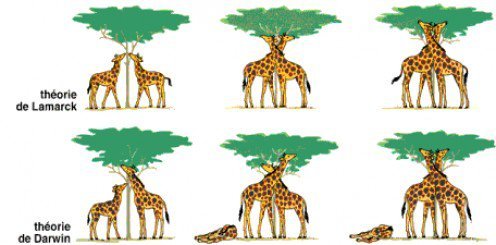
What would happen if the Giraffes never evolve?
a)
they would survive
b)
They would thrive
c)
They would become extinct
d)
They will find another source of food
12.
The scientific name for an organism is made from the:
a)
class and family name
b)
genus and species name
c)
domain and kingdom name
d)
kingdom and phylum name
13.
The 8 levels of classification, most broad to most specific.
a)
Domain, Genus, Family, Order, Class, Phylum, Kingdom, Species
b)
Domain, Species, Kingdom, Genus, Phylum, Family, Class, Order
c)
Domain, Kingdom, Phylum, Class, Order, Family, Genus, Species
d)
Order, Kingdom, Species, Domain, Phylum, Family, Class, Genus
14.
Which of the following organisms are MOST closely related?
a)
organisms that share a domain
b)
organisms that share a family 
c)
organisms that share a genus 
d)
organisms that share an order  
15.
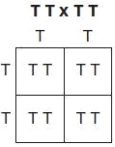
T - tall and t = short
In the punnett square below, what belongs in the missing square
a)
tt
b)
Tt
c)
Bb
d)
TT
16.
What ratio of the offspring from the cross shown will be homozygous recessive for the  trait of tallness? 
a)
0 in 4
b)
1 in 4
c)
2 in 4
d)
4 in 4
17.
What is the phenotype of the offspring? (A-Brown hair; a-blond hair) 
a)
50 % Brown Hair and 50% Blond Hair 
b)
25 % Brown Hair and 75% Blond Hair 
c)
75 % Brown Hair and 25% Blond Hair 
d)
0% Brown Hair and 100% Blond Hair 
18.
In DNA, Adenine bonds with ______________.
a)
Guanine
b)
Thymine
c)
Cytosine
d)
Adenine
19.
Which sequence of DNA bases would pair with this partial strand
ATG TGA CAG
a)
ATG TGA CAG
b)
TAC ACT GTC
c)
GTA AGT GAC
d)
CAT TCA CTG
20.
What are the 4 nitrogen bases?
a)
adenine, thymine, cytoplasm, and guanine
b)
adenine, thymine cytosine, and guanine
c)
adenine, thymine, cytosine, and gylcerol
d)
adenine, thymine, cytosine, and glucose
21.
Which organelle is DNA usually found in?
a)
cell membrane
b)
vacuole
c)
ribosome
d)
nucleus
22.
The image illustrates which process?
a)
Mitosis
b)
Meiosis
23.
Which of the following statements best explains the overall purpose of MEIOSIS?
a)
Asexual reproduction of somatic cells
b)
To produce gametes
24.
If a parent cell has 88 chromosomes, following MITOSIS, the daughter cells will have ___ chromosomes.
a)
42
b)
88
c)
Impossible to know
25.
Only mistakes during ____ can be passed to future generations.
a)
Mitosis
b)
Meiosis
c)
Both Mitosis and Meiosis
26.
Process that produces two daughter cells.
a)
Mitosis
b)
Meiosis
c)
Both Mitosis and Meiosis
27.
Process that produces four daughter cells.
a)
Mitosis
b)
Meiosis
c)
Both Mitosis and Meiosis
28.
Process that produces sex cells (gametes).
a)
Mitosis
b)
Meiosis
c)
Both Mitosis and Meiosis
29.

Human somatic cells contain _____ chromosomes, human haploid sex cells contain ____ chromosomes.

a)

46 --- 23

b)

23 --- 46

c)

46 --- 46

d)

23 ---- 23

30.

During MEIOSIS, the process that is responsible for increasing genetic variation is called ____________. It happens during which phase?

a)

Crossing Over, metaphase

b)

Fertilization, prophase 2

c)

Crossing Over, Prophase 1

d)

Crossing Over, Prophase 2

31.

If an animal has a diploid number of 30 chromosomes, how many chromosomes will there be in an unfertilized egg or a sperm?

a)

15

b)

30

c)

60

d)

0

32.

A strand of mRNA containing the repeating sequence AAGAAGAAGAAG could code for which of the following amino acid sequences?

a)

lys – arg – glu – lys

b)

ser – ser – glu – glu

c)

lys – arg – lys – arg

d)

lys – lys – lys – lys

33.

In the mRNA sequence 5’ UACGCUAAGAUC 3’ , which amino acids are coded?

a)

Tyr –Ala – Lys - Iso

b)

Try - Ala

c)

Lys – Tyr – Iso - Ala

d)

Ala – Lys - Iso

34.

A is pointing to

a)

codon

b)

anticodon

c)

tRNA

d)

amino acid

35.

C is pointing to

a)

codon

b)

anticodon

c)

tRNA

d)

amino acid

36.

A is pointing to

a)

chromosome

b)

centromere

c)

chromatid

d)

centriole

37.

B is pointing to

a)

chromosome

b)

centromere

c)

chromatid

d)

centriole

38.

One difference between a cancer cell and a normal cell is that

a)

cancer cells divide uncontrollably.

b)

normal cells divide uncontrollably.

c)

cancer cells cannot make copies of DNA

d)

normal cells cannot make copies of DNA.

39.

What does a cell make during the synthesis stage of the cell cycle?

a)

more organelles

b)

a copy of DNA

c)

daughter cells

d)

greater surface area

40.

This is a karyotype of a

a)

female

b)

male