
 Worksheets
Ecology Part 2
Total questions: 50
Worksheet time: 1hrs 2mins


Fungi are ________
Autotrophs.
Heterotroopers.
Decomposers.
Primary Consumers.

Which is not a biome found in North America?
Mojave Desert
Grasslands of the Great Plains
Everglades/Coastal Plain
Tropical Rainforest

Which is not an example of a decomposer?
mushroom
leaves
mold
worm


The interaction between all living and nonliving things in an area


In the wild, some alligators gets their teeth cleaned by birds. The birds gets their food from the alligators' teeth.
What type of symbiosis is this?
Mutualism
Commensalism
Parasitism
Neutralism

In this photo, what is an abiotic factor?
deer
grass
rain
flowers
trees

Tundra, Tropical Savanna, Desert, and Rainforest are all examples of
biospheres.
apex predators.
biomes.
habitats.
What would be a good example of a primary consumer?
carnivore
detrivore
decomposer
herbivore
A lion that eats a zebra that eats grass is a
primary consumer
secondary consumer
tertiary consumer
quaternary consumer

Consider this pond ecosystem diagram. Which statement describes an interaction that helps maintain the dynamic equilibrium of this ecosystem?
The frogs make energy available to this ecosystem through the process of photosynthesis.
The algae directly provide food for both the rotifers and the catfish.
The green-backed heron provides energy for the mosquito larvae.
The catfish population helps control the populations of water boatman and waterfleas.

10%
20%
80%
90%
Temperature, light, air, water, and soil are all _____ parts of the environment
alive
biotic
abiotic
living

A relationship where one organism benefits and one organism is harmed is called __________.
mutualism
commensalism
parasitism
conversationalism

A relationship where both organisms benefit is called __________.
mutualism
commensalism
parasitism
symbolism
Scientists found, that over a period of 200 years, a mountain pond was transformed into a meadow. During that time, several communities of organisms were replaced by different communities. Which of these best explains why new communities were able to replace older communities?
The original species became extinct.
Species in the older community died from old age.
The abiotic characteristics of the habitat changed.
Diseases that killed the older organisms disappeared.

The process by which plants use sunlight to make sugar from water and carbon dioxide is called
pollination
photosynthesis
scavenging
fertilization

Which of the following are examples of different types of symbiotic relationships?
A bee pollinates a flower (mutualism).
A tapeworm takes nutrients from a dog (parasitism).
An orchid lives in a tree but does not harm the tree (commensalism).
One species of flower lives next to another species of flower without either overpowering the other (non-competitiveism).


In the image, there are two versions of the same species of moth. Which adaptation protected the dark-colored moths from predators?
breeding
migration
camouflage
hibernation
Which organisms convert Nitrogen from the atmosphere into a usable resource for plants and animals?
Plants
Animals
Bacteria
Converters
Which of the following is abiotic?
A tree in a forest.
Wood from the tree on the forest floor.
A termite on the tree.
The soil the tree is growing in.
Which of the following is a predator and prey relationship?
Cow and grass.
Vulture and a dead lion.
Tick and a deer.
Spider and a fly.
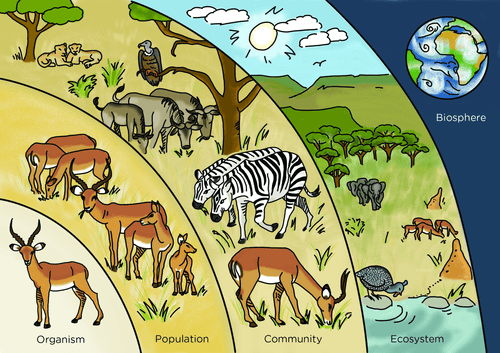
The living world is organized in levels. Biotic and abiotic factors also can be arranged into levels of biological organization. Put the words below in order from the least complex to the most complex
Community, Organism, Biome, Population, Biosphere, Ecosystem
Organism, Population, Community, Ecosystem, Biome, Biosphere
Organism, Biome, Population, Community Biosphere, Ecosystem

Animals such as fiddler crabs advertise the size of their enlarged claw to intimidate their rivals. This territorial display is an example of what type of relationship?
predation
commensalism
competition
mutualism

Oxpeckers are birds that sit on zebras and rhinos and eat ticks and other parasites that live on their skin. The oxpeckers get food and in return the zebras and rhinos get pest control. When there is danger, the oxpeckers fly upward and scream a warning to help the zebras and rhinos. Which of the following correctly identifies the symbiotic relationship between the oxpeckers and the zebras?
parasitism
commensalism
mutualism
competition

What is the carrying capacity for this sheep population?
1.8 million
1.25 million
1.6 million
1.o million

In a forest ecosystem, which of the following is the best example of a limiting factor for a rabbit population?
Squirrel population
Sunlight accessibility
Grass available
Mosquito population
What is ecology?
the study of life
the study of the interactions (connections) among living things, and between living things and their environment
the study of fossils, embryos, homologous structures and how they are evidence of our evolution from a common ancestor
the study of atoms, molecules, organelles and cells

The frog eats the cricket. Choose three terms to describe the frog.
primary consumer, carnivore, autotroph
secondary consumer, herbivore, heterotroph
primary consumer, omnivore, heterotroph
secondary consumer, carnivore, heterotroph

Name the tertiary level consumer(s) in the food web shown.
hawk
shrew
frog
snake

The portion of the planet in which living things are found
ecosystem
biosphere
biome
atmosphere

Salamanders live in cool, damp places like underneath rocks. This is a description of a salamander's:
habitat
niche
community
decorating preferences

Applied Reading: Sea turtles are marine reptiles. They rely on an external heat source, which makes them ectotherms. They are commonly found in waters off the Mid-Atlantic and Northeast United States during the summer and early fall. Typically, they begin to migrate south to warmer water by late October. However, some sea turtles strand along our shores when water temperatures drop rapidly or unexpectedly. This is called “cold stunning.” Cold stunning is similar to hypothermia in humans. Initial symptoms include a decreased heart rate, decreased circulation, and lethargy, followed by shock, pneumonia and possibly death.
Based from this passage, why do sea turtles migrate?
Sea turtles migrate because their food source is more abundant in the south during the fall.
Sea turtles migrate because predators become more abundant in the Mid-Atlantic and Northeast of the U.S. during the summer and early fall.
Sea turtles migrate because humans are fishing more often in the areas where they are commonly found during summer and fall.
Sea turtles migrate because they depend on external sources of heat to help maintain their body temperature.

You see a cat crouched behind a flowerpot, carefully and quietly looking at something on the other side. You think it is hunting a mouse. Your idea is known as:
an experiment.
an observation.
an inference.
a variable.

You watch a worm slowly disappear into the ground. Which statement is an example of an observation?
The worm was looking for food.
The worm was moving away from the light.
The worm burrowed into the ground.
The worm had a lot of energy.

The diagram on the left is most likely representing...
anthropology.
anthropologists.
anthropomorphism.
anthropocentrism.

An non-anthropomorphic statement of observation might be...
The worms moved from the gravel into the sand.
The worm wanted to have some shade, so it decided to use the leaf.
The worm likes Henry better than it likes me.
My worm got scared of me when I transfered it to the dish.

