
 Worksheets
APPLICATION OF DERIVATIVES
Total questions: 110
Worksheet time: 4hrs 40mins
The curve y = x1/5 has at (0, 0)
(a) a vertical tangent (parallel to y-axis)
(b) a horizontal tangent (parallel to x-axis)
(c) an oblique tangent
d) no tangent
The equation of normal to the curve 3x2 – y2 = 8
which is parallel to the line x + 3y = 8 is
(a) 3x – y = 8
(b) 3x + y + 8 = 0
(c) x + 3y ± 8 = 0
(d) x + 3y = 0
. If the curve ay + x2 = 7 and x3 = y, cut orthogonally
at (1, 1), then the value of a is :
1
6
0
-6
The tangent to the curve y = e2x at the point (0, 1)
meets x-axis at :
(0,1)
(1,0)
(-1/2,0)
(1/2,0)
If f ′(x) ≥0 , ∀ x∈R then f is
strictly increasing on R
strictly decreasing on R
increasing on R
decreasing on R
The function f(x)=ex is
strictly increasing on R
strictly decreasing on R
increasing on R
decreasing on R
The function f(x)= x2−8x+12 is strictly decreasing in
(−∞, ∞)
(2, 6)
(−∞, 4)
(4, ∞)
The slope of the tangent to the curve y= x2+2 at the point (2, 6)
4
6
-6
-4
The min. value of f(x)=x2−6x+5 is
4
-6
6
-4
The angle between the lines y = 3x +100 and 3y =x +200 is
600
300
900
450
The equation of the tangent to the curve y2=4ax at the point (at2, 2at) is
ty=x+at2
tx+y=at3
ty=x–at2
none of these
The maximum and minimum value of 3 sin x + 4 cos x +10 is
17 and 3
15 and 5
12 and 10
None of these
Let f (x) = x3 – 6x2 + 9x + 18, then f (x) is strictly decreasing in
(–∞, 1]
[3, ∞)
(–∞, 1] U [3, ∞)
[1, 3]
The absolute minimum value of x4 – x2 – 2x+ 5
is equal to 5
is equal to 3
is equal to 7
does not exist
The absolute minimum value of x4 – x2 – 2x+ 5
is equal to 5
is equal to 3
is equal to 7
does not exist
The function
2tan3x−3tan2x+12tanx+3 , x ϵ (0,2π) isincreasing
decreasing
increasing in (0,4π) and decreasing in (4π,2π)
none of these
The equation of the tangent to the curve f(x) = 1 + e-2x where it cuts the line y = 2 is
2x + y = 2
x - 2y = -2
x + 2y = 2
x - 2y = 1
The maximum value of sinx+cosxsinxcosx in the interval [0,2π] is
41
21
31
221
The minimum value of ax + by, where xy = r2, is (r, ab >0)
2ab√r
2r√ab
-2r√ab
-2ab√r
The absolute maximum value of y=x3−3x+2 in 0≤x≤2
4
6
2
0
The absolute minimum value of x4−x2−2x+5
5
3
7
does not exist
f(x) = x2 + ex - cosx


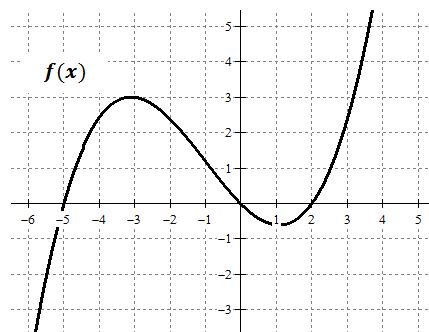
What is the increasing interval for the function below?
(−∞,∞)
(−∞,2]
(−∞,6]
(−6,6)

What is the decreasing interval(s) on the function shown?
(−7, −6) and (−2, 4)
(−7, 0) and (−2, 4)
(−7, −6) and (−2, 0)
(−7, 0) and (4, 5)
The intervals in which the function f given by f (x) = x2 – 4x + 6 is increasing is
(−∞, 2)
(2, ∞)
(−∞, ∞)
none of these
The logarithmic function is increasing on
(0, 1)
(0, ∞)
(1, ∞)
(−∞, ∞)
The interval in which y=x2e–x is increasing is
(−2, 0)
(−∞, ∞)
(2, ∞)
(0, 2)
The interval on which the function f (x) = 2x3 + 9x2 + 12x – 1 is decreasing is:
[−1, ∞)
[−2, −1]
(−∞, −2]
[−1, 1]
Which of the following functions is decreasing on (0, 2π)
sin2x
tanx
cosx
cos3x
The interval in which y=x2e–x is increasing is
(−2, 0)
(−∞, ∞)
(2, ∞)
(0, 2)
y = x (x – 3)2 decreases for the values of x given by :
1<x<3
x<0
x>0
0<x<23
If dydx=∞ , then the tangent at a point P(x,y) on the curve is perpendicular to the x- axis.
False
True
For Maximum point : (i) dydx=0 ; (ii) dx2d2y < 0
False
True
The smallest value of the polynomial
x3−18x2+96x in [0, 9] is126
0
135
160
The maximum value of
sinx.cosx is1/4
1/2
2
22
The absolute maximum and the absolute minimum values of the function f(x)=4x−2x2 in [-2, 4.5] is
8, -10
4, - 2
0, 3
3, 6
The points at which the function changes its nature from increasing to decreasing or from decreasing to increasing are called
(a)
The slope of the normal to the curve x=acos3θ, y=asin3θ at θ=4π is
(a)
The equation of the tangent line to the curve y = x2 – 2x +7 which is parallel to the line 2x – y + 9 = 0 is
y – 2x – 3=0
y +2x – 3=0
y – 2x + 3=0
y +2x + 3=0
The equation of normal to the curve y = tan x at (0, 0) is ________
x−y=0
x+y=1
x+y=0
x−y=1
The equation of the normal to the curve y=x4– 6x3+13x2 – 10x+5 at (0, 5) is
x +10y+50=0
x – 10y+50=0
x – 10y−50=0
x +10y+50=0
The equations of all lines having slope 0 which are tangent to the curve y=x2−2x+31 is
y=1
2y=1
2y+1=0
y+1=0
Determine the point on the curve f(x)=(2x-1)2 where the tangent is parallel to the line y=4x-2
(0 , 1)
(1 , 9)
(1/2 , 0)
(1 , 1)
What is the equation of the normal line to the curve y=3x2+2x at x=1 ?
y=8x−3
y=8x−13
y=−81x+841
y=81x+839
The point on the curve y2=xat which the tangent is parallel to the line joining (1,4) and (3,2) is
(5,6)
(1/2,-1/2)
(1/2,3/2)
(-1/2,1/2)

What is the equation of the line tangent to the curve y = x2 at x = 1?
y = 2x + 1
y = 2x - 1
y = -2x + 1
y = x - 1
Find the equation of the normal line at x = 0 of:
f(x) = x3+ex
y=−x+1
y= x+1
y=−x −1
y=x − 1
f(x) = 7
g(x) = 6 + ⅔x
f(x) = 1/x2 (hint: use your pink sheet)
f(x) = x4 + 4x3 - 2x2


If x=0.5 is a critical point of f(x) and f′′(x) = cos2x⋅lnx then x=0.5 is a
local maximum
local minimum
neither
Which of the following is NOT a critical point of f(x) = ex⋅x2 ?
x=0
x=1
x=−2
Where is the point of inflection for the function f(x) = x3 +6x2 ?
x=0
x=−4
x=−2
x=4
On what interval(s) is the function
f(x) = x3 +6x2
concave up?
(−∞,∞)
(−∞,−2)
(−2,∞)
(0,∞)

The following sign chart shows whether f′(x) is positive, negative, or zero.
There is/are ...
a local maximum at x=−2
a local maximum at x=4
local maxima at x=−2 and x=4
no local extrema
If f(x) = 1−x2 ,
then f′(1) is...
f(x) is not defined at x=1
1
32
f′(1) does not exist
The interval in which
y=x2e−x is increasing is(A) (−∞, ∞)
(B) (−2, 0)
(C) (2, ∞)
(D) (0, 2)
The line
y=x+1 is a tangent to the curve y2=4x at the point(A) (1, 2)
(B) (2, 1)
(C) (1, −2)
(D) (−1, 2)
The slope of the tangent to the curve
x=t2+3t−8, y=2t2 −2t−5 at the point (2, -1) is
(A) 22/7
(B) 6/7
(C) 7/6
(D) -6/7
The line y=mx+1 is a tangent to the curve y2=4x if the value of m is
(A) 1
(B) 2
(C) 3
(D) 1/2
The minimum value of logexx is
(A) e
(B) 1/e
(C) 1
(D) None of these
Slope of a line parallel to x-axis is (a) .
Point which is neither a point of local maxima nor a point of local minima is called (a)
If the angle of intersection of two curves is a right angle, then two curves are called (a)
Product of slope of a tangent and slope of a normal at a certain point on the given curve is equal to (a)
A function f(x) is said to be (a) on (a, b), if x1<x2 ⟹ f(x1)>f(x2) ∀ x1, x2 ∈(a, b)
A particle moves in a straight line with a velocity of v(t) = 2t2. How far does the particle move between times t = 1 and t = 3?
18
52/3
26/3
16
For times t > 0, a particle moves on the x axis with its acceleration defined by a(t) = 6t – 2. If the velocity of the particle is -7 at t = 1, then at what time is the particle at rest?
t = 4
t = 1
t = 2
t = 4/3
If x=0.5 is a critical point of f(x) and f′′(x) = cos2x⋅lnx then x=0.5 is a
local maximum
local minimum
neither
Which of the following is NOT a critical point of f(x) = ex⋅x2 ?
x=0
x=1
x=−2

How many critical points does the function f(x) = ex⋅x3 have?
0
1
2
∞
Where does the global maximum of f(x) = e−x2 occur on [−1,2] ?
x=−1
x=0
x=1
x=2
The function f(x) = ∣x−3∣−4 is...
not continuous on [−1,4]
not differentiable on [−1,4]
continuous and differentiable on [−1,4]
... what do those bars mean again?
The function f(x) = x32 is...
not continuous on [5,6]
not differentiable on [5,6]
continuous and differentiable on [5,6]
one of the greatest functions of all time
Where is the point of inflection for the function f(x) = x3 +6x2 ?
x=0
x=−4
x=−2
x=4
On what interval(s) is the function
f(x) = x3 +6x2
concave up?
(−∞,∞)
(−∞,−2)
(−2,∞)
(0,∞)
If f(x) = 1−x2 ,
then f′(1) is...
f(x) is not defined at x=1
1
32
f′(1) does not exist
Find the inflection point(s) of f(x) = ex+2x2−3x .
x=23
x=0, x=23
x=0
f(x) has no inflection points.
Which of the following functions does not satisfy the conditions put forth in Rolle's Theorem?
f(x) = (x−2)32 on [3,5]
f(x) = 1−x2 on [−1,1]
f(x)=(2x−3)4 on [1,2]
f(x)=e−x2 on [−4,4]
Identify the conclusion of Rolle's Theorem.
f′(c)=b−af(b)−f(a)
f′(c)=0
Identify the conclusion of the Mean Value Theorem.
f′(c)=b−af(b)−f(a)
f′(c)=0

Find the interval of decrease for the function y=−x2−2x .
x>2
x<2
x>0
x<0
Find the interval of increase and decrease for the function y=4x3−15x2−72x−8 .
−4<x<23
−23<x<4
x<−23 ∪x>4
x<−4∪x>23
Given f(x)=3x5−2x4+5x3 . Find dx2d2y, and dx3d3y .
it is concave up there
it has an inflection point
It's zero
it is concave down there
1. The total revenue in ₹ received from the sale of x units of an article is given by R(x) = 3x² + 36x + 5. The marginal revenue when x = 15 is (in ₹ )
(a) 126
(b) 116
(c) 96
(d) 90
A
B
C
D
4. The equation of the normal to the curve y = sin x at (0, 0) is
(a) x = 0
(b) y = 0
(c) x + y = 0
(d) x – y = 0
A
B
C
D
What is a horizontal tangent?
Has a positive slope.
Has a negative slope.
Has a slope of zero.
Has an undefined slope.
What is the slope of the line tangent to the graph of y=ln(2x) at the point where x=4?
1/8
1/4
1/2
3/4
4

