wayground logo

Free Printable Worksheets

Font size

S
M
L
XL
Worksheets

Unit 3 Review

Total questions: 108

Worksheet time: 4hrs 28mins

Name
Class
Date
1.
A line that passes through parallel lines is called a ______________.
a)
transitive
b)
passer through line
c)
transversal
d)
bisector
2.

Which angles are corresponding angles?

a)

∠16 and ∠2

b)

∠9 and ∠16

c)

∠12 and ∠13

d)

∠5 and ∠6

3.

What is the relationship between angle 7 and angle 1?

a)

Corresponding Angles

b)

Same-Side Interior Angles

c)

Alternate Interior Angles

d)

Alternate Exterior Angles

4.

What is a transversal?

a)

Three or more lines that intersect

b)

Two line segments cut by a plane

c)

Two parallel lines cut by another line

d)

A vocabulary word used in English class

5.

Which angles are alternate exterior angles?

a)

1,2

b)

3,4

c)

2,7

d)

2,8

6.

What angles are corresponding angles?

a)

2,3 6,7 1,4 5,8

b)

1,5

c)

1,5 & 4,8

d)

1,5, & 4,8 & 2,6

7.

Which angles are consecutive Interior angles?

a)

1,4 & 2,3

b)

5,8 & 6,7

c)

1,3 & 5,7

d)

3,6 & 4,5

8.

Which angles are vertical angles?

a)

1,3 & 2,4

b)

6,5 & 7,8

c)

9,2 & 1,3

d)

1,8 & 2,7

9.

What is complementary angles?

a)

Angles less than 90 degrees

b)

Angles that add up to 180 degrees

c)

One angle that is 90 degrees

d)

Two angles that add up to 90 degrees

10.

What are supplementary angles?

a)

Angles that supplement each other

b)

Angles that add up to 360 degrees

c)

Angles that we use in geometry

d)

Angles that equal 180 degrees

11.

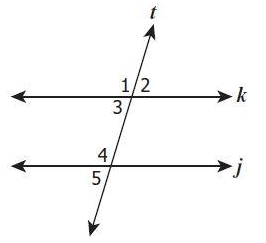
1 \angle1\ and  2\angle2    are __.

a)

Alternate Interior Angles

b)

Alternate Exterior Angles

c)

Same-side Interior Angles

d)

Corresponding Angles

e)

None of these

12.

8\angle8  and  6\angle6   are __.  

a)

Alternate Interior Angles

b)

Alternate Exterior Angles

c)

Same-side Interior Angles

d)

Corresponding Angles

e)

None of these

13.
a)
corresponding
b)
alternate exterior
c)
vertical
d)
alternate interior
14.
a)
consecutive interior
b)
alternate exterior
c)
corresponding
d)
alternate interior
15.
a)
alternate interior
b)
consecutive interior
c)
alternate exterior
d)
corresponding
16.
a)
alternate interior
b)
corresponding
c)
alternate exterior
d)
consecutive interior
17.
a)
68º
b)
60º
c)
124º
d)
134º
18.
a)
125º
b)
102º
c)
83º
d)
109º
19.
a)
126º
b)
130º
c)
116º
d)
135º
20.
a)
60º
b)
98º
c)
122º
d)
64º
21.
a)
122º
b)
95º
c)
43º
d)
113º
22.
Solve for x.
a)
x = 12
b)
x = 9
c)
x = 3
d)
x = 6
23.
Solve for x.
a)
x = -8
b)
x = 8
c)
x = 7
d)
x = 9
24.
Solve for x.
a)
x = 5
b)
x = 4
c)
x = 10
d)
x = -10
25.
Solve for x.
a)
x = 7
b)
x = 6
c)
x = -12
d)
x = 9
26.
Solve for x.
a)
x = -7
b)
x = 6
c)
x = 9
d)
x = 5
27.
a)
75º
b)
110º
c)
70º
d)
55º
28.
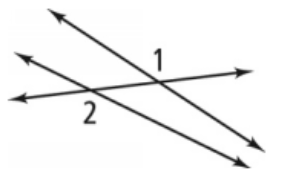
Which pair of angles must be supplementary so that r is parallel to s?
a)
∠2 and ∠3
b)
∠5 and ∠6
c)
∠4  and ∠10
d)
∠6  and ∠14
29.
Which of the following relationship proves that j is parallel to k?
a)
∠3 and ∠4 are supplementary
b)
∠4 and ∠5 are supplementary
c)
∠1 ≅ ∠3
d)
∠2 ≅ ∠3
30.
Which condition will prove that line l is parallel to line m?
a)
∠1 ≅ ∠3
b)
∠3 ≅ ∠5
c)
∠1 ≅ ∠6
d)
∠6 ≅ ∠5
31.
Which could be used to prove the lines are parallel?
a)
Alternate Interior
b)
Corresponding
c)
Vertical
d)
Cannot be proved parallel
32.
Which could be used to prove the lines are parallel?
a)
Corresponding
b)
Alternate Interior
c)
Linear Pair
d)
Cannot be proved parallel
33.
Which could be used to prove the lines are parallel?
a)
Alternate Interior
b)
Consecutive Interior
c)
Corresponding
d)
Cannot be proved parallel
34.
Which could be used to prove the lines are parallel?
a)
Alternate Interior
b)
Corresponding
c)
Alternate Exterior
d)
Cannot be proved parallel
35.
Which could be used to prove the lines are parallel?
a)
Vertical
b)
Alternate Interior
c)
Corresponding
d)
Cannot be proved parallel
36.
Name the angle relationship.
a)
Alternate Interior
b)
Alternate Exterior
c)
Corresponding
d)
Vertical Angles
37.
Name the angle relationship.
a)
Alternate Interior
b)
Alternate Exterior
c)
Corresponding
d)
Vertical Angles
38.
What type of angle pair is ∠1 and ∠3?
a)
alternate interior angles
b)
 supplementary angles
c)
corresponding angles
d)
vertical angles 
39.
What value of x would make line m || line n?
a)
70
b)
110
40.
What value of x would make line m || line n?
a)
60
b)
120
41.

Which could be used to prove the lines are parallel?

a)

Converse of Vertical Angles

b)

Converse of Alternate Interior Angles Theorem

c)

Converse of Corresponding Angles Postulate

d)

Cannot be proved parallel

42.
a)

No

b)

Yes, Corresponding angles are congruent

c)

Yes, Alternate Interior angles are congruent

d)

Yes, Alternate Exterior angles are congruent

43.
a)

No

b)

Yes, Corresponding angles are congruent

c)

Yes, Alternate Interior angles are congruent

d)

Yes, Alternate Exterior angles are congruent

44.
a)

No

b)

Yes, corresponding angles are congruent

c)

Yes, consecutive interior angles are congruent

d)

Yes, Alternate exterior angles are congruent

45.
a)

Yes, vertical angles are congruent

b)

No, vertical angles are not enough to prove lines parallel

c)

Yes, corresponding angles are congruent

d)

Yes, alternate interior angles are congruent

46.
What value of x would make line m || line n?
a)
54
b)
126
47.

Given the angle measure in the diagram, which two lines MUST be parallel?

a)

P and Q

b)

R and S

c)

R and T

d)

S and T

48.

What reason is missing from this proof?

a)

Reflexive Property of congruence

b)

Substitution

c)

Transitive Property of equality

d)

Transitive Property of congruence

49.

What reason is missing from this proof?

a)

Reflexive Property of Congruence

b)

Transitive Property of Equality

c)

Transitive Property of Congruence

50.

Supply the first statement.

a)

m ll n

b)

< 4 = < 6

c)

Given

d)

Definition of parallel lines

51.

Supply the second reason.

a)

Linear Pair Postulate

b)

Alternate Interior Angles Theorem

c)

Vertical Angles Theorem

d)

Corresponding Angles Postulate

52.

Supply the third reason.

a)

Vertical Angle Theorem

b)

Corresponding Angles Postulate

c)

Alternate Interior Angles Postulate

d)

Same Side Interior Angles Theorem

53.

The last statement is <4 = <6. What is the last reason

a)

Prove

b)

Definition of congruent angles

c)

Transitive Property

d)

Alternate Interior Angles Theorem

54.

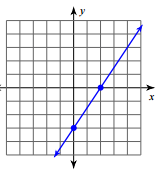
Find the slope.

a)

3/2

b)

-3/2

c)

(-0,-3)

d)

none of the above

55.

Find the slope.

a)

1/2

b)

-1/2

c)

2

d)

-2

56.
Find the slope of the line.
a)
-5/4
b)
5/4
c)
-4/5
d)
4/5
57.
Find the slope
a)
-5/3
b)
-3/5
c)
5/3
d)
3/5
58.

Identify the slope from the equation y = 3x + 6

a)

m = 3

b)

m = 6

c)

m = x

d)

m = 3x

59.

Identify the slope from the equations y = -x -6

a)

m = 6

b)

m = -1

c)

m = -x

60.

Identify the slope from the equation y = -8x

a)

m = -8

b)

m = 8

c)

m = x

d)

m = -8x

61.
Find the slope of the line that passes through the points (2, 4) and (6, 12)
a)
1/2
b)
-1/2
c)
2
d)
-2
62.
Find the slope of the line that passes through 
(-4, 7) and (-6, -4)
a)
2/11
b)
-2/11
c)
11/2
d)
-11/2
63.
Find the slope of the line that passes through
(10, 1) and (5, 2)
a)
1/5
b)
-1/5
c)
5
d)
-5
64.
Find the slope of the line that passes through
(-2, 8) and (0, 8)
a)
0
b)
-2
c)
2
d)
1/2
65.
Find the Slope
a)
No Slope
b)
3
c)
1/3
d)
Zero
66.
What is the slope?
a)
1/4
b)
4
c)
-3
d)
-2
67.
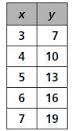
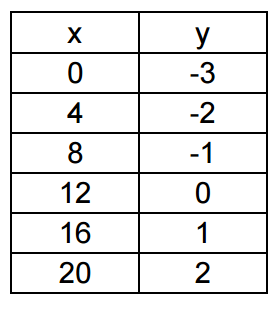
Find the slope from the table:
a)
-2/5
b)
5/-2
c)
5/2
d)
2/5
68.
Find the slope of the line that goes through the points (-8,6) and (7,-3).
a)
1/3
b)
-1/3
c)
-3/5
d)
-5/3
69.
Find the slope of the line.
a)
Undefined
b)
0
c)
1
d)
-1
70.
Are these two lines parallel, perpendicular or neither?
y = -1/3x - 5
y = 1/3x + 2
a)
Parallel
b)
Perpendicular
c)
Neither
71.
Slopes of parallel lines are...
a)
opposite reciprocals.
b)
opposites.
c)
the same.
d)
always 7.
72.
Slopes of perpendicular lines are...
a)
opposite reciprocals.
b)
opposites.
c)
the same.
d)
always 7.
73.
y = 3x +2
y = 3x - 3
These lines are...
a)
Parallel
b)
Perpendicular
c)
Neither
d)
The same line
74.
y = - 2/3x + 2
y = 3/2x + 9
These lines are...
a)
Parallel
b)
Perpendicular
c)
Neither
75.
y = 1/3x + 2
y = 4x + 9
These lines are...
a)
Parallel
b)
Perpendicular
c)
Neither
76.
Which line is perpendicular to
y = 2x - 7  ?
a)
y = -2x + 8
b)
y = 1/2x - 7 
c)
y = -1/2x + 2
d)
y = 2x - 3 
77.
What does "m" represent in y=mx+b?
a)
y-intercept
b)
slope
c)
macaroni
d)
nothing
78.
What is the slope in the equation:  y=4x+3
a)
3
b)
4x
c)
4
d)
3x
79.

Find the slope of a line perpendicular to the line below

y = ½x + 4

a)

1/2

b)

-1/2

c)

2

d)

-2

80.
The following represents slopes of two lines.  Which answer choice describes the two lines?
m = 5 and m = -1/5
a)
Parallel
b)
Perpendicular
c)
Neither
81.
The following represents slopes of two lines.  Which answer choice describes the two lines?
m = -1/3 and m = -1/3
a)
Parallel
b)
Perpendicular
c)
Neither
82.
The following represents slopes of two lines.  Which answer choice describes the two lines?
m = 3/4 and m = 4/3
a)
Parallel
b)
Perpendicular
c)
Neither
83.
a)
y = 3x + 2
b)
y = 2x - 3
c)
y = 1/2x - 3
d)
y = -2x + 3
84.
a)
y = 4x + 3
b)
y = 1/3x - 3
c)
y = 3x + 4
d)
y = -1/3x + 4
85.
a)
x = 2
b)
y = 2
c)
y = 2x
d)
x = -2
86.
a)
x = -3
b)
y = 3
c)
y = -3
d)
x = 3
87.
What is the slope between these points?
(5, 7) and (3, 10)
a)
-3/2
b)
2/3
c)
-2/3
d)
3/2
88.
What is the slope between these points?
(-3, -1) and (1, -9)
a)
8/3
b)
1/2
c)
-2
d)
-4/9
89.
Find the equation of the line that has a slope of 3 and passes through (-4, 1).
a)
y = 3x - 11
b)
y = 3x + 13
c)
y = -4x - 13
d)
y = x + 11
90.
Find the equation of the line with a slope of 3/4 and passes through (4, -2).
a)
y = 4x - 2
b)
y = 3/4x - 2
c)
y = 3/4x + 1
d)
y = 3/4x - 5
91.
Find the equation of the line that is parallel to the line y = 2x - 1 and passes through the points (4, 6)
a)
y = 2x - 2
b)
y = -1/2x + 8
c)
y = 2x + 8
d)
y = -2x + 2
92.
Find the equation of the line that is perpendicular to the line y = 1/3x - 7 and passes through (1, -1).
a)
y = 1/3x - 1
b)
y = 3x - 4
c)
y = -3x + 2
d)
y = -3x - 1
93.

Find the equation of the line that passes through the points (-2, 3) and (-1, 7)

a)

y = 1/4x + 2

b)

y = -4x - 5

c)

y = 4x + 5

d)

y = 4x + 11

94.

Find the equation of the line that passes through the points (2, -6) and (0, -3)

a)

y=32x3y=-\frac{3}{2}x-3

b)

y=32x+3y=\frac{3}{2}x+3

c)

y=23x6y=\frac{2}{3}x-6

d)

y=32x6y=-\frac{3}{2}x-6

95.
What is the slope intercept form for the equation x + 4y = -12?
a)
y = -x - 12
b)
y = 4x - 3
c)
y = -1/4x - 3
d)
y = 4x + 12
96.
What is the slope intercept form for the equation 3x - 5y = 30?
a)
y = 3/5x + 30
b)
y = -3/5x + 10
c)
y = 5/3x - 6
d)
y = 3/5x - 6
97.

Find standard form for the equation  y=32x6y=\frac{3}{2}x-6  

a)

3x - y = 12

b)

2x - 3y = -12

c)

3x - 2y = 12

d)

3x + 2y = -6

98.

Find standard form for the equation  y=54x+7y=-\frac{5}{4}x+7  

a)

5x + 4y = 28

b)

4x - 5y = 7

c)

5x - 4y = -28

d)

5x + 4y = -7

99.
Which of these represents point-slope form of a linear equation?
a)
y - y1 = m(x - x1)
b)
Ax + By = C
c)
y = mx + b
100.

Select all of the following equations in point-slope form.

a)

y - 2 = 5(x - 2)

b)

3x + 2y = 12

c)

y + 2 = 1/4(x + 4)

d)

y = 4x + 6

e)

2y = 5x - 7

101.

Write the equation in point-slope form

for the line that contains the points

(3, -5) and (5, - 1)

a)

y - 5 = 2(x + 3)

b)

y + 5 = 2(x - 3)

c)

y - 3 = 2(x + 5)

d)

y + 3 = 2(x - 5)

102.

What is the equation in Point-Slope form

of the line that goes through

the point (6,1) and has a slope of -3?

a)

y - 6 = -3(x - 1)

b)

y + 6 = -3(x + 1)

c)

y - 1 = -3(x - 6)

d)

y + 1 = -3(x + 3)

103.

Convert the equation of the line

y + 5 = -3(x - 6)

into slope intercept form.

a)

y = -3x - 23

b)

y = -3x - 13

c)

y = -3x - 11

d)

y = -3x + 13

104.

Write the following equation in slope intercept form:

y + 9 = 3(x - 1)

a)

y = 3x + 12

b)

y = 3x - 12

c)

y = 3x - 6

d)

y = 3x + 6

105.

The line with the equation

y + 1 = -3(x - 5),

contains the point (5, -1)

and has a slope of _______.

a)

-1

b)

1

c)

-3

d)

5

106.
For the equation
y - 3 = 2(x + 4),
the line has a slope of 2 and contains what point?
a)
(-4, 3)
b)
(3, -4)
c)
(-3, -4)
d)
(-4, -3)
107.

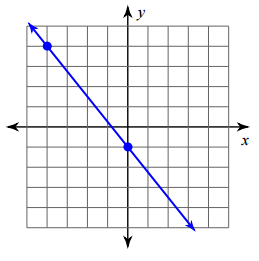
What is the point slope form equation of the graph given(use blue point in equation)

a)

y + 2 = 32\frac{3}{2} (x + 2)

b)

y - 2 = 32\frac{3}{2} (x - 2)

c)

y + 2 = - 32\frac{3}{2} (x + 2)

d)

y - 2= - 32\frac{3}{2} (x - 2)

108.

Convert the equation to slope-intercept form: y - 5 = 3 ( x + 2 )

a)

y = 3x + 8

b)

y = 3x + 11

c)

y = 3x + 1

d)

y = 3x - 8