wayground logo

Free Printable Worksheets

Font size

S
M
L
XL
Worksheets

QII Chemistry Review

Total questions: 84

Worksheet time: 1hrs 22mins

Name
Class
Date
1.
Which statement is true about the ENTROPY?
a)
Entropy refers to DISORDER, the unusable energy that escapes a system.
b)
Entropy refers to the balance of temperature among two or more systems.
c)
Entropy refers to the average kinetic energy of the molecules.
d)
Entropy refers to the inability to destroy or create energy. 
2.
The second  law of thermodynamics states that entropy of a system  tends to ______________. 
a)
increase
b)
decrease
c)
stay constant
d)
fluctuate wildly
3.

What does the first law of thermodynamics relate? Select all that apply

a)

heat

b)

power

c)

temperature

d)

internal energy

e)

work

4.
When applying the first law of thermodynamics to a system, when is heat a positive quantity?
a)
when the system does work
b)
when the system has work done on it
c)
when the system absorbs heat
d)
when the system loses heat
e)
when no work is done either on the system or by the system
5.
What does the heat capacity of an object measure?
a)
the amount of energy required to change the temperature of an object
b)
the total amount of energy an object can store
c)
the thermal potential energy of the object
d)
the amount of work done by the object
e)
the amount of energy required to melt a solid object
6.

If heat is released from a system which statement will be true?

a)

Heat will be positive

b)

Heat will be zero

c)

Heat will be negative

7.
ΔH value in an endothermic reaction is a positive number.
a)
True
b)
False
8.
Which statement is true regarding endothermic reactions?
a)
a) Temperature change is positive and enthalpy change is positive
b)
b) Temperature change is positive and enthalpy change is negative
c)
c) Temperature change is negative and enthalpy change is positive
d)
d) Temperature change is negative and enthalpy change is negative
9.

In an endothermic reaction, energy is _________.

a)

absorbed

b)

released

10.

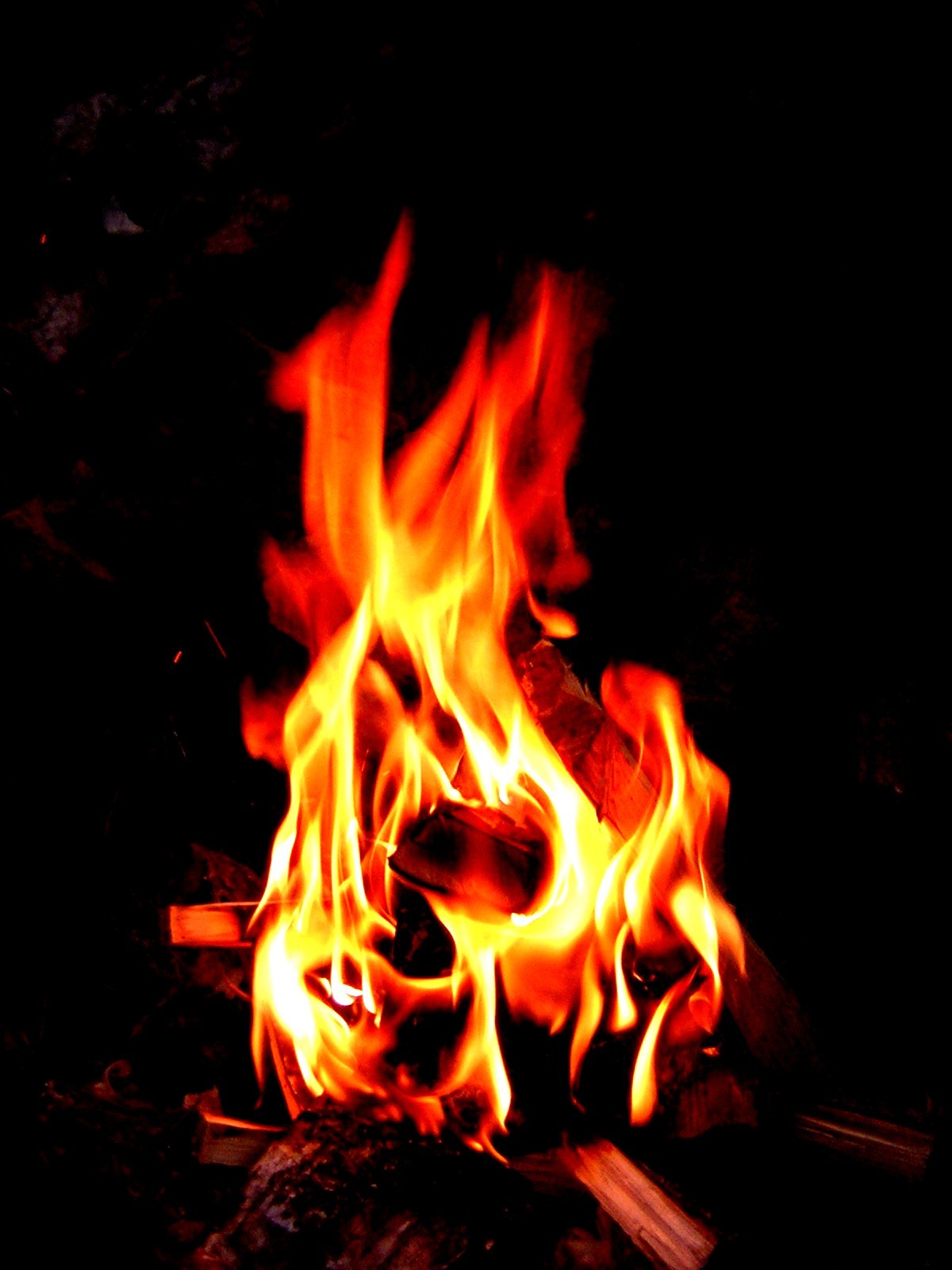
_____ reactions usually feel hot!

a)

endothermic

b)

exothermic

11.

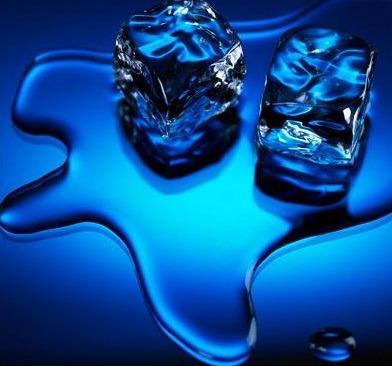
____ reactions usually feel cold.

a)

endothermic

b)

exothermic

12.

What term is given to a reaction which transfers heat energy to the surroundings?

a)

Endothermic

b)

Reversible

c)

Exothermic

d)

Exotermic

13.

When barium hydroxide and ammonium chloride react, the temperature of the mixture decreases. What kind of reaction is this?

a)

Endothermic

b)

Decomposition

c)

Exothermic

d)

Indothermic

14.

if more heat energy is released in making bonds in the products than is taken in when breaking bonds in the reactants

a)

Exothermic

b)

Endothermic

c)

Exotermic

d)

Endotermic

15.

if less heat energy is released in making bonds in the products than is taken in when breaking bonds in the reactants

a)

Endothermic

b)

Exotermic

c)

Exothermic

d)

Entrothermic

16.

What type of chemical reaction absorbs energy and requires energy for the reaction to occur?

a)

Endothermic

b)

Exotermic

c)

Exothermic

d)

Endotermic

17.
In an exothermic reaction, heat is ...
a)
taken in
b)
given out
18.

In an endothermic reaction, heat is ...

a)

taken in

b)

given out

19.
During an endothermic reaction in a beaker if we are part of the surroundings and touched the beaker, it would feel _______. 
a)
Warm
b)
Cold
20.
If a chemical reaction is EXOTHERMIC, the temperature would....
a)
Stay the same
b)
Increase
c)
Decrease
21.
Valence electrons are the...
a)
Innermost electrons
b)
Middle electrons
c)
Outermost electrons
d)
Any electrons
22.

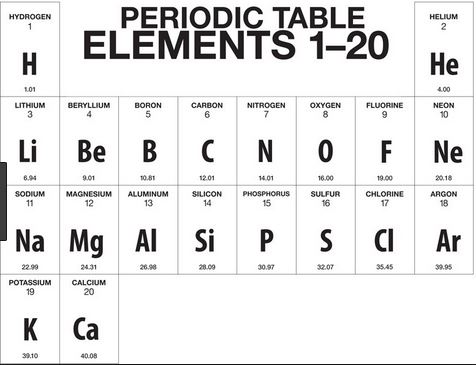
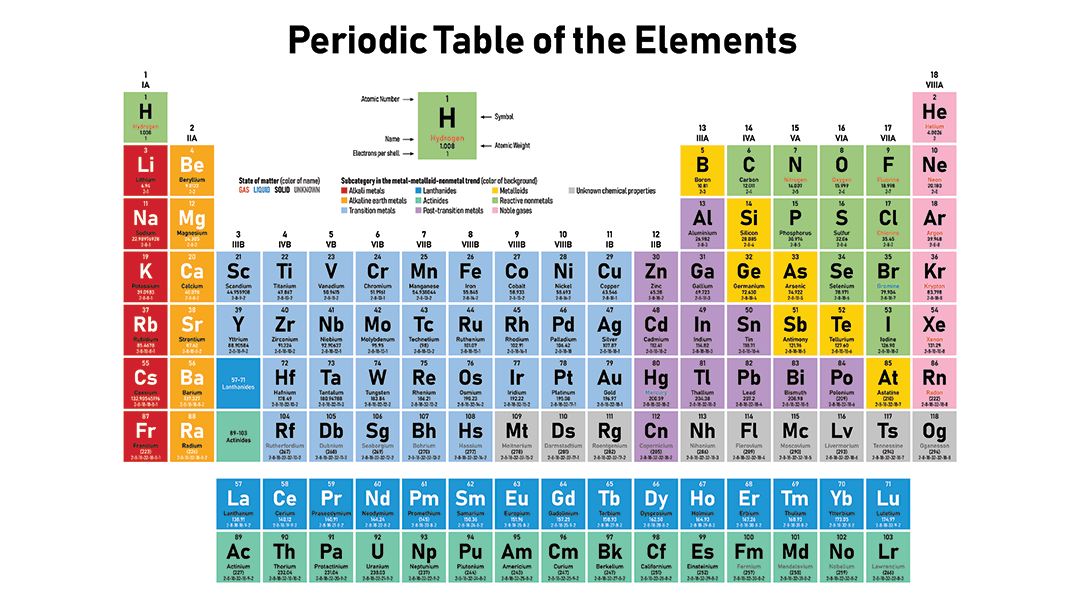
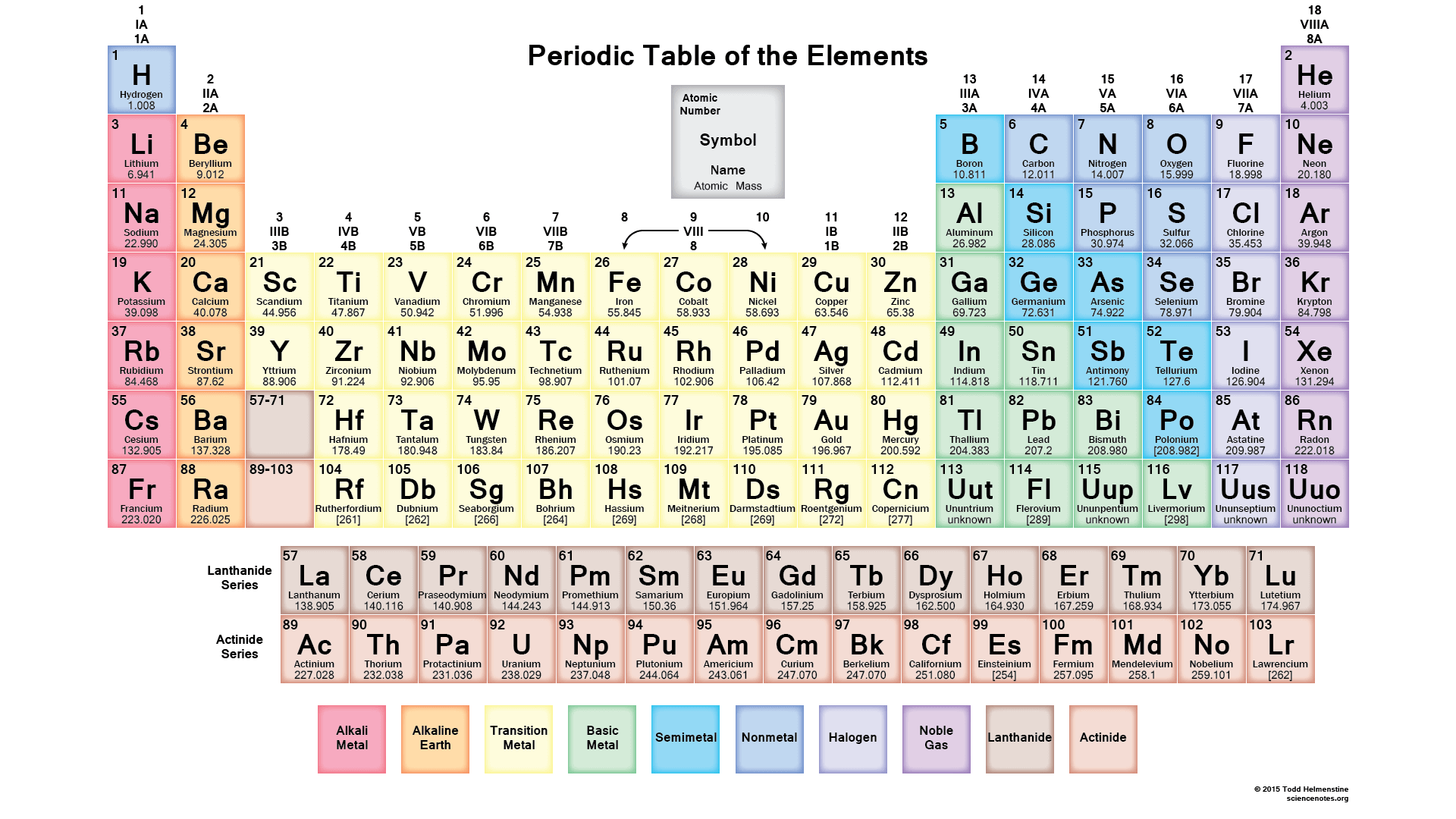
USE THE PERIODIC TABLE

How many valence electrons does sodium have?

a)

1

b)

2

c)

3

d)

4

23.

USE THE PERIODIC TABLE

How many valence electrons does Phosphorus have?

a)

31

b)

5

c)

15

d)

4

24.
Elements in the same column of the periodic table always have the same # of _______ as one another.
a)
Protons
b)
Neutrons
c)
Electrons
d)
Valence Electrons
25.
How many valence electrons are found in atoms of group 14?
a)
4
b)
3
c)
14
d)
16
26.
Which group has the greatest number of valence electrons?
a)
1
b)
14
c)
18
d)
16
27.
How many valence electrons are in an atom of Ba?
a)
2
b)
8
c)
4
d)
1
28.

How many valence electrons does Hydrogen Have?

a)

1 Valence electron

b)

2 Valence electron

c)

3 Valence electron

d)

4 Valence electron

e)

5 Valence electron

29.

How many valence electrons does Nitrogen Have?

a)

1 Valence electron

b)

2 Valence electron

c)

3 Valence electron

d)

4 Valence electron

e)

5 Valence electron

30.

How many valence electrons does Magnesium Have?

a)

1 Valence electron

b)

2 Valence electron

c)

3 Valence electron

d)

4 Valence electron

e)

5 Valence electron

31.

How many valence electrons does Aluminum Have?

a)

1 Valence electron

b)

2 Valence electron

c)

3 Valence electron

d)

4 Valence electron

e)

5 Valence electron

32.

How many valence electrons does Potassium Have?

a)

1 Valence electron

b)

2 Valence electron

c)

3 Valence electron

d)

4 Valence electron

e)

5 Valence electron

33.

How many valence electrons does Silicon Have?

a)

1 Valence electron

b)

2 Valence electron

c)

3 Valence electron

d)

4 Valence electron

e)

5 Valence electron

34.

How many valence electrons does Lithium Have?

a)

1 Valence electron

b)

2 Valence electron

c)

3 Valence electron

d)

4 Valence electron

e)

5 Valence electron

35.

How many valence electrons does Boron Have?

a)

1 Valence electron

b)

2 Valence electron

c)

3 Valence electron

d)

4 Valence electron

e)

5 Valence electron

36.
Rows on the period table are called _____ while columns are called _____.
a)
groups, families
b)
groups, periods
c)
periods, groups
d)
families, groups
37.
How many Valance electrons does Iodine Have?
a)
6
b)
16
c)
7
d)
17
38.
How many valence electrons are found in atoms of group 1?
a)
7
b)
6
c)
4
d)
1
39.
How many valence electrons are in an atom of Ar?
a)
2
b)
8
c)
4
d)
1
40.

Chlorine ( Cl) has _________ valence electrons.

a)

3

b)

5

c)

7

d)

8

41.

Select the elements that has 8 valence electrons.

a)

Ne

b)

Br

c)

Kr

d)

Xe

42.

TRUE OR FALSE Lithium and Beryllium have the same number of valence electron.

a)

TRUE

b)

FALSE

43.

All of the elements has 4 valence electrons EXCEPT______

a)

Carbon

b)

Silicon

c)

Germanium

d)

Selenium

44.

Vertical columns on the periodic table are called ___?

a)

groups

b)

periods

c)

rows

d)

families

45.

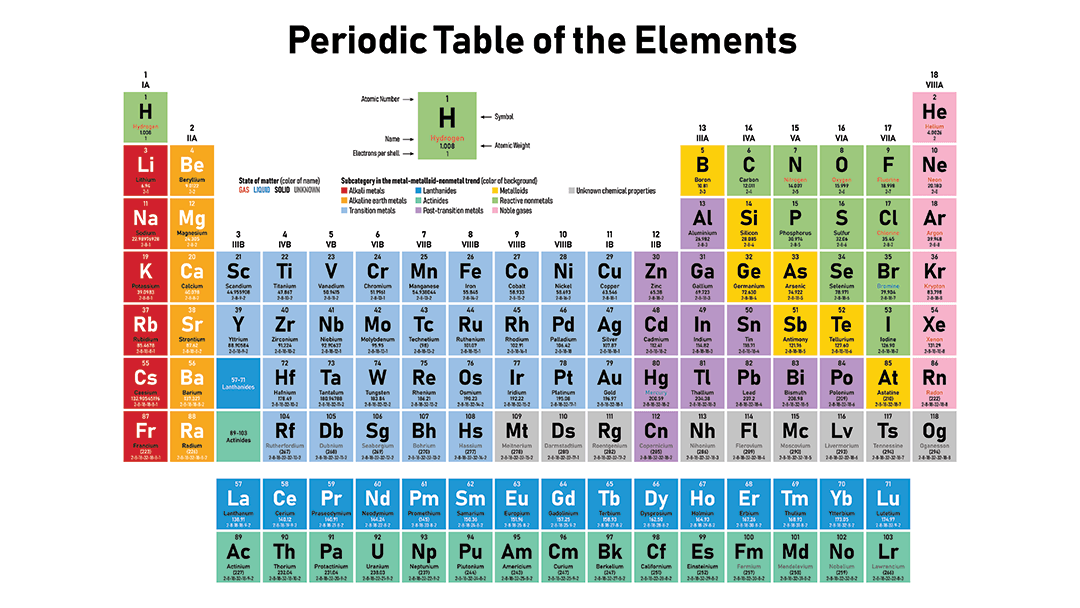
Which color on the image of the periodic table corresponds with the halogens.

a)

red

b)

black

c)

blue

d)

orange

46.

Which color on the image of the periodic table corresponds with the noble gases.

a)

red

b)

black

c)

blue

d)

orange

47.

Which color on the image of the periodic table corresponds with the transition metals.

a)

red

b)

black

c)

blue

d)

orange

48.

Horizontal rows on the periodic table are called ___?

a)

groups

b)

periods

c)

rows

d)

families

49.
Sodium (Na) is found in group 
a)
1
b)
2
c)
3
d)
4
50.

Which group of the periodic table is composed of inert (not reactive) gases with 8 valence electrons?

a)

alkali metals

b)

alkaline earth metals

c)

halogens

d)

noble gases

51.
Which is a halogen?
a)
Helium
b)
Chlorine
c)
Oxygen
d)
Neptune
52.
Which is an alkali metal?
a)
Magnesium
b)
Iron
c)
Sodium
d)
Europium
53.
Beryllium is in group number______.
a)
Group 2
b)
Group 3
c)
Group 4
d)
Group 7
54.
Name groups 3B - 12B on the periodic table.
a)
noble gases
b)
halogens
c)
metalloids
d)
transition metals
55.
Name group 8A on the periodic table.
a)
alkali metals
b)
alkaline earth metals
c)
transition metals
d)
noble gases
56.
Where are the nonmetals located on the periodic table?
a)
top left corner
b)
bottom left corner
c)
top right corner
d)
bottom left corner
57.

Which elements have 1 valence electron?

a)

period 1

b)

group 1

c)

group 4

58.
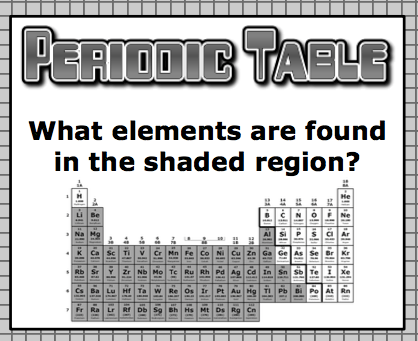
a)
Metals
b)
Nonmetals
c)
Metalloids
59.
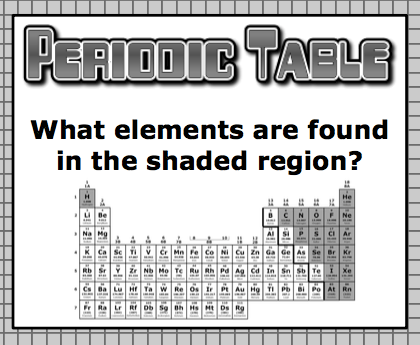
a)
Metals
b)
Nonmetals
c)
Metalloids
60.

What did Dmitri Mendeleev develop?

a)

Vaccines

b)

Periodic Table

c)

Russian currency

d)

Calculator

61.
What atom matches this electron configuration?
1s22s22p63s23p64s23d10
a)
Zinc
b)
Copper
c)
Nickel
d)
Germanium
62.
What electron configuration matches an oxygen atom?
a)
1s22s22p63s2, 3p64s23d104p5
b)
1s22s22p4
c)
1s22s22p6
d)
1s22s22p63s23p64s23d1
63.
Which electron configuration belongs to Chlorine (Cl)?
a)
1s2s2p3s3p5
b)
1s2s2p3s3p6
c)
1s2s2p3s3p7
64.
What atom matches this electron configuration?
1s22s22p63s2
a)
Neon
b)
Magnesium
c)
Aluminum
d)
Potassium
65.

Choose the correct shortcut configuration for iodine.

a)

[Ar]4s24d104p5

b)

[Kr]5s24d105p5

c)

[Xe]5s25d105p5

d)

none of the above

66.
What is the noble gas configuration for beryllium?
a)
[He]1s2
b)
[He]2s2
c)
[Li]2s1
d)
[Li]2s2
67.
What is the abbreviated electron configuration for barium?
a)
[Xe] 6s2
b)
[Rn] 6s2
c)
[Ar] 4s2 3d10 4p5
d)
[He] 2s2 3p1
68.
What is the noble gas configuration for Neon?
a)
[Ne]
b)
[He]2s22p6
c)
[F]2p1
d)
[Ne]2s21p6
69.
Ionization energy is the...
a)
energy needed to remove the outermost electron.
b)
ability of an atom to attract electrons from another atom.
70.
Electronegativity is the...
a)
energy needed to remove the outermost electron.
b)
ability of an atom to attract electrons from another atom.
71.
Which element has the greatest ionization energy: Aluminum (Al)    or    Chlorine (Cl)?
a)
Aluminum (Al)
b)
Chlorine (Cl)
72.
Which element has the greatest electronegativity: Nitrogen (N) or Arsenic (As)?
a)
Nitrogen (N)
b)
Arsenic (As)
73.
The atom with the largest atomic radius in Group 18 is - 
a)
Ar
b)
He
c)
Kr
d)
Rn
74.
The atom with the largest atomic radius in Period 4 (row 4) is - 
a)
K
b)
Kr
c)
Fe
d)
Fe
75.
The element with the smallest ionization energy in Period 6 is - 
a)
Rn
b)
Cs
c)
Os
d)
Tm
76.
Which has the greater Electronegativity: 
N or C?
a)
C
b)
N
77.

Which of the group 13 elements is the largest?

a)

B

b)

Ti

c)

Fr

d)

Ga

78.

Of the halogens, which has the smallest radius?

a)

F

b)

Br

c)

He

d)

At

79.
Which of the following will have a larger radius than Zinc?
a)
Gallium
b)
Aluminum
c)
Magnesium
d)
Strontium
80.
Which of the following will have a higher electronegativity than arsenic (As)?
a)
Carbon (C)
b)
Neon (Ne)
c)
Antimony (Sb)
d)
Germanium (Ge)
81.
Which of the following will have a lower ionization energy than Scandium (Sc)?
a)
Helium (He)
b)
Titanium (Ti)
c)
Calcium (Ca)
d)
Magnesium (Mg)
82.
Which atom has the largest atomic radius?
a)
potassium
b)
rubidium 
c)
francium
d)
cesium
83.

when atom gain an electron (negative) the size of atom

a)

Increase

b)

Decrease

c)

No change

d)

Small

84.

When an atom loses an electron the size of atom

a)

will increase

b)

will decrease

c)

will not change