wayground logo

Free Printable Worksheets

NEW

Font size

S
M
L
XL
Worksheets

Pre Calculus Final Exam Review #1 (Multiple Choice)

Total questions: 76

Worksheet time: 13hrs 40mins

Name
Class
Date
1.
Which of the following is correct? 
a)
Root over Power
b)
Power over Root
2.
Write the following expression in radical form:
a)
a.)
b)
b.)
c)
c.)
d)
d.)
3.
a)

A

b)

B

c)

C

d)

D

4.

Simplify the expression

a)

6a5b3√6b

b)

2a5b3√54b

c)

3a5b3

d)

6√2a10b7

5.
Solve for x
l 2x−1 l = 9
a)
x = 5 and x =-4
b)
x = 5 and x = -5
c)
Only x = 5
d)
No Solution
6.
Solve for x
2 lx−4l+8=18
a)
x = 9 and x =-1
b)
x = 1 and x = -9
c)
x= 4 and x = -2
d)
No Solution
7.
Write logb(x/y) as two logs
a)
logbx-logby
b)
logbx+logby
c)
logbx*logby
d)
logbx/logby
8.
Rewrite logb(xn)
a)
nlogbx
b)
(logbx)n
c)
xnlogbx
d)
logb(xn)
9.
a)
log(x) + log(z) + 4log(y)
b)
3log(x) − log(z) − 4log(y)
c)
3log(x) + log(z) + 4log(y)
d)
log(x) − 4log(z) − 3log(y)
10.
Simplify: 2log(x) + 3log(xy)
a)
log(x5y3)
b)
log(5xy)
c)
5log(x2y)
d)
log(6x2y)
11.
How do you find the vertical asymptote of a rational function?
a)
Set numerator equal to 0
b)
Set denominator equal to 0
c)
Plug in 0
d)
Use Degrees and their rules
12.
How do you find the horizontal asymptote if your degree on the top is bigger?
a)
You divide the leading coefficients
b)
It is y=0.
c)
There isn't one.
d)
It is y=1.
13.

What's the vertical asymptote of the function?

a)

x = -4, x = 1

b)

x = 4, x = -1

c)

x = -4, x = -1

d)

x = 4, x = 1

14.
What are the asymptotes?
a)
x=1, x= 2, y =1, y= 2
b)
x= 2, x=-2, y = 1
c)
x=2 y =-1
d)
x=1 y =2, y =-2
15.
Where is the removable discontinuity?
a)
x=2
b)
x=2 and x=3
c)
x=-3
d)
x=3
16.
What is the horizontal asymptote?
a)
y = -4
b)
y = 1
c)
x = 1
d)
y = -6
17.
What is csc(x) equivalent to?
a)
1/sin(x)
b)
1/tan(x)
c)
sin(x)
d)
1/cos(x)
18.
Please select the correct solution
a)
csc x
b)
sec x
c)
cot x
d)
tan x
19.
Solve the following for cos2θ:
sin2θ + cos2θ = 1
a)
cos2θ = 1 - sin2θ
b)
cosθ = 1 + sin2θ
c)
cosθ = 1 - sinθ
d)
cos2θ = Adj/hyp
20.
secθ=
a)
1/cosθ
b)
1/sinθ
c)
1/tanθ
d)
1/cscθ
21.
Simplify
a)
-1
b)
sin θ
c)
csc θ
d)
1
22.
What is the measure of angle A?
a)
58 degrees
b)
61 degrees
c)
78 degrees
d)
74 degrees
23.
Find AC
a)
12
b)
10
c)
23
d)
14
24.

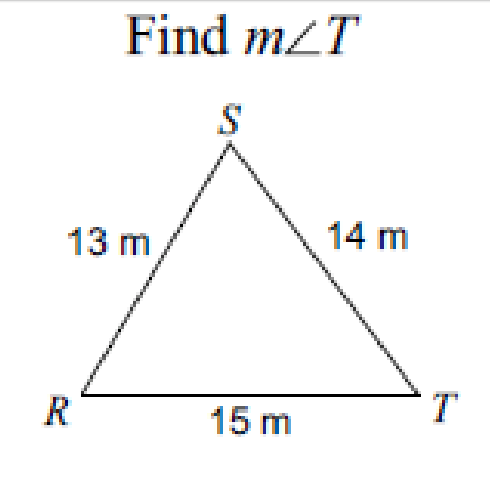
Use Law of Cosines to find angle T

a)

62.2°

b)

53.1°

c)

59.5°

d)

64.7°

25.
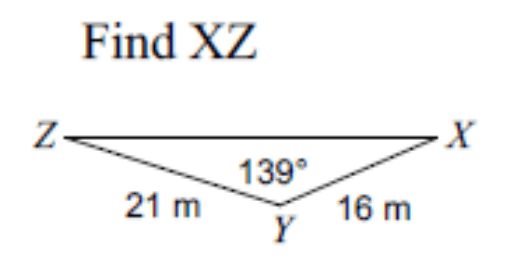
Find XZ
a)
16.004 meters
b)
544.165 meters
c)
34.7 meters
d)
1204.165 meters
26.

Find the area of ABC to the nearest tenth.

a)

62.3 units2

b)

124.6 units2

c)

77.0 units2

d)

100 units2

27.

What is the area of a triangle with two sides that measure 6 m and 8 m with an included angle of 137°?

a)

17.8m²

b)

14.6m²

c)

16.4m²

d)

12.9m²

28.
p(x) = 3x + 4
q(x) = 2x2
Find p(p(-3))
a)
-9
b)
7
c)
-11
d)
None of these
29.
p(x) = 3x + 4
q(x) = 2x2
Find p(q(x))
a)
10x2
b)
18x2 + 4
c)
6x2 + 4
30.
g(x)=3x+4
h(x)=3x-1
Find g(h(x))
a)
-9x+11
b)
4x2+4x
c)
9x+1
d)
9x+11
31.
a)

0

b)

2

c)

3

d)

4

32.
What is the limit?
a)
Infinity
b)
20
c)
DNE
d)
12
33.
What is the limit?
a)
DNE
b)
Infinity
c)
6
d)
12
34.
What is the limit?
a)
DNE
b)
2/3
c)
1/4
d)
Infinity
35.
What is the limit of the function as x approaches -4 from the left?
a)
2
b)
-4
c)
DNE
d)
-2
36.
Which value represents a vertical shift in the following function y=a*sin(bx - c)+d?
a)
a
b)
b
c)
c
d)
d
37.
Sine or Cosine?
a)
y=sinx
b)
y=cosx
38.
Sine or Cosine?
a)
y=sinx
b)
y=cosx
39.
What is the midline for
y=2cos(1/3x +π/6) +2
a)
1/3
b)
-2
c)
+2
d)
4
40.
What is the amplitude of y = 3 cos 2x?
a)
3
b)
2
c)
90
90⁰
d)
350⁰
41.
Write an equation for the cosine function with amplitude 3, period 2pi, phase shift of pi, and vertical shift of 5.
a)
y = 5cos(x - pi) + 3
b)
y = 3cos(x - pi) + 5
c)
y = 3cos(2x - pi) + 5
d)
y = 5cos(2x - pi) + 3
42.

What is the equation of the graph shown?

a)

y = 2sin(θ + π/2) + 2

b)

y = 2cos(θ - π/2) + 2

c)

y = 2sin(θ - π/2) + 2

d)

y = 2cos(θ + π/2) + 2

43.

What is the equation of the graph shown?

a)

y = 3sin(θ + π/4) - 1

b)

y = 3cos(θ - π/4) -1

c)

y = 3sin(θ - π/4) + 1

d)

y = 3cos(θ + π/4) + 1

44.

On which interval is the function positive?

On which interval is the function negative?

a)

positive (-2,1) U (3,∞)

negative (-∞,-2) U (1,3)

b)

positive (-∞,-1) U (2,∞)

negative (-1,2)

c)

positive (-1,4)

negative (2,-2)

d)

positive (∞,3) U (1,-2)

negative (3,1) U (-2,-∞)

45.

For the pictured polynomial, which of the following is the absolute max?

a)

(3, -2)

b)

(0, 3)

c)

(2, 0)

d)

(4, 1)

46.

Identify where the function is increasing and where it is decreasing.

a)

increasing (-1, ∞) and decreasing (-∞,-1)

b)

increasing (-∞, -1) and decreasing (-1, ∞)

c)

increasing (-∞,∞) and decreasing nowhere

d)

increasing (-1, -4) and decreasing (-3, 1)

47.

Derivative means the same thing as

a)

slope of the tangent line

b)

slope of the normal line

c)

slope of the secant line

d)

the function’s value

48.
Which if the following is not a correct notation for 'derivative?'
a)
f'(x)
b)
y'
c)
dy
d)
dy/dx
49.
What is the derivative of a constant, C?
a)
C
b)
1
c)
0
50.
Differentiate y= x3 + 2x
a)
3x3+2x
b)
3x2+2
c)
3x+2
d)
3x
51.
Find the derivative of f(x) = 6x30 -2x15 + 4x3 - 2x + 1
a)
f'(x) = 18x29 + 30x15 + 12x
b)
f'(x) = 180x29 - 30x14 + 12x2 
c)
f'(x) = 180x29 - 30x14 + 12x2 - 2
d)
f'(x) = 180x29 - 30x14 + 12x2 +1
52.
Find the derivative f(x) = (3x + 5)4
a)
f'(x) = 12(3x)3
b)
f'(x) = 12(3x + 5)3
c)
f'(x) = (3)4
d)
f'(x) = (3x + 5)3
53.
Set up the derivative of y=(3x- 7)*(5x+ 1)
a)
(12x3)*(10x)
b)
(3x4 - 7)*(10x) + (12x3)*(5x2 + 1)
c)
(3x4 - 7)*(10x) - (12x3)*(5x2 + 1)
d)
(3x4 - 7)/(10x) + (12x3)/(5x2 + 1)
54.
10.1-10.2 Converting between rectangular and polar coordinates:
x = ?
a)
rcosθ
b)
rsinθ
c)
x² + y²
d)
y/x, x ≠ 0
55.

When converting between rectangular and polar coordinates:

y = ?

a)

rcosθ

b)

rsinθ

c)

x² + y²

d)

y/x, x ≠ 0

56.
Convert the rectangular coordinates to polar form
a)
(√2 , 7π/4)
b)
(2 , 3π/4)
c)
(4 , π/4)
d)
(4 , 5π/4)
57.
Which equation represents the polar graph?
a)
r = sin θ
b)
r = sin 4θ
c)
r = 4 sin θ
d)
r = 4 cos θ
58.
Which point represents the polar coordinate
(-4, -2π/3)
a)
B
b)
F
c)
D
d)
A
59.
How do you write an ordered pair?
a)
(X,X)
b)
(θ, r)
c)
(r,θ)
d)
(Y,Y)
60.
Which point represents (-4, π/2)
a)
D
b)
C
c)
B
d)
A
61.
Factor the Trinomial:
x2 - 8x + 15
a)
(x + 5) ( x + 3)
b)
(x - 5) (x - 3)
c)
(x + 15) (x - 1)
d)
(x - 7) (x - 8)
62.

Factor Completely.
 4x2+24x644x^2+24x-64  

a)

 4(x+8)(x2)4\left(x+8\right)\left(x-2\right)  

b)

 4(x2+6x16)4(x^2+6x-16)  

c)

 4(x2+24x16)4\left(x^2+24x-16\right)  

d)

 4(x8)(x+2)4\left(x-8\right)\left(x+2\right)  

63.

Factor Completely.
 25x210025x^2-100  

a)

 5(x+4)(x4)5\left(x+4\right)\left(x-4\right)  

b)

 5(x220)5\left(x^2-20\right)  

c)

 25(x24)25\left(x^2-4\right)  

d)

 25(x+2)(x2)25\left(x+2\right)\left(x-2\right)  

64.
Factor completely.  3𝑥3y2 – 2𝑥2y + 5xy
a)
y(3x3y-2x2+5)
b)
xy(3x2y-2x+5)
c)
x(32y2-2xy+5y)
d)
2xy(3/2x2y-x+5/2)
65.
Factor: 8x3 - 1
a)
(2x - 1)(4x2 + 2x + 1)
b)
(2x + 1)(4x2 - 2x + 1)
c)
(2x - 1)(4x2 - 2x - 1)
d)
(2x + 1)(4x2 +2x + 1)
66.
64-27a3
a)
(4-3a)(9a2+12a+16)
b)
(3a-4)(3a2+12a+16)
c)
(4-3a)(3a2+12a+16)
d)
(4-3a)3
67.

Factor completely 648a+1029a4

a)

a(18+21a)(36-42a+49a2)

b)

a(18+21a)(36+42a+49a2)

c)

3a(6+7a)(36+42a+49a2)

d)

3a(6+7a)(36-42a+49a2)

68.
Factor:   x+ 1
a)
(x + 1)3
b)
(x+1)(x- x + 1)
c)
(x - 1) (x2 + x - 1)
d)
(x + 1)(x2 - 2x + 1)
69.
What is the radius of the unit circle?
a)
0
b)
1
c)
1/2
d)
√2/2
70.
sinθ is positive in
a)
the 1st and 2nd quadrants
b)
the 1st and 3rd quadrants
c)
the 1st and 4th quadrants
d)
the 2nd and 3rd quadrants
71.
cosθ is positive in
a)
the 1st and 2nd quadrants
b)
the 1st and 3rd quadrants
c)
the 1st and 4th quadrants
d)
the 2nd and 3rd quadrants
72.
sin 7π/6
a)
1/2
b)
-1/2
c)
√3/2
d)
-√3/2
73.
cos 4π/3
a)
-√3/2
b)
√3/2
c)
1/2
d)
-1/2
74.
Based on your unit circle sin(90o)=
a)
1/2
b)
0
c)
-1
d)
1
75.
For what angles are sine and cosine the same?
a)
0o
b)
45o and 1350
c)
45o and 2250
d)
45o and 3150
76.
Find the difference quotient when f(x) = x2 - x + 1
a)
2x - 1 + h
b)
4x - 5 - h
c)
-2x - 1 + h 
d)
x2 + 2h