
 Worksheets
Quarter 4 Review 20-21
Total questions: 30
Worksheet time: 2hrs 36mins


What two things does gravity depend on?
distance and speed
distance and space
mass and distance
mass and speed
Objects that have more mass also have more gravity.
True
False

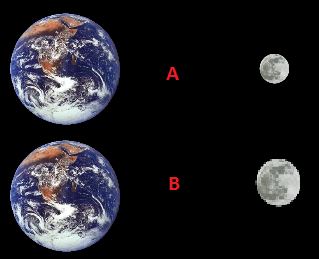
The revolution of the Earth causes our ___________, and the rotation of the Earth causes our ______________.
years, days
seasons, years
days, seasons
summer, winter
What are the 3 main ingredients for photosynthesis to take place inside plants?
oxygen, glucose, sunlight
sunlight, oxygen, water
water, oxygen, carbon dioxide
carbon dioxide, sunlight, water
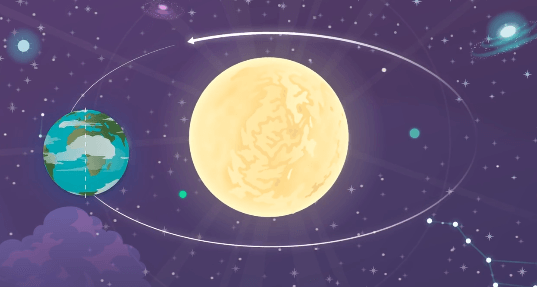
What does the orbit of the Earth around the Sun look like ? (The shape of the orbit)
circle
ellipitical
it has no shape
a square to match up with the four seasons

Which statement best describes the motion of the planets in our solar system?
The planets rotate around the sun.
The sun rotates around the planets
The planets revolve around the sun.
The sun revolves around the planets.

According to the data table above, what would be a good estimate for Mars’ Period of Orbit?
65 days
90 days
308 days
687 days

The student thought about the movement of the planets in our solar system. They learned that the planets are all in orbit because of the sun. The model below shows the orbit and movement of the planets in relation to the sun.
The data table provides information on the distance and period of orbit for the planets closest to the sun.
What is the relationship between a planet’s distance from the sun and its period of orbit?
There is no relationship
The farther the planet from the sun, the longer its period of orbit
The farther the planet from the sun, the shorter its period of orbit
The farther the planet from the sun, the hotter its surface temperature.

The student recently learned about the planets in the solar system. The student realized that the stars in the night sky are not part of our solar system. However, in school, they learned that some of the stars are a part of our galaxy, the Milky Way. The student wanted to learn more information on galaxies and found the following information.
Galaxies
The universe is made up of billions of different objects in space called galaxies. The Sun and the solar system, including Earth, are part of the Milky Way Galaxy, which encompasses hundreds of billions of stars. Galaxies come in lots of different shapes. Our home galaxy, the Milky Way, is a spiral galaxy. Gravity also pulls galaxies together into groups called clusters. These clusters can include just a couple of galaxies or up to thousands. Really big clusters can be tens of millions of light years across or even larger.
Based on the information about galaxies, which of the following best describes a galaxy?
A massive system of stars, dust, planets and other objects bound together by gravity
The visible path of a meteorite as it enters Earth’s atmosphere
Many large frozen planets in motion in an organized space
About ten stars and planets in a single system in space

A student had a flowerpot in her house. Everyday for one month, the student observed changes within the pot. The student developed a model to show the change in growth of the plant.
Based on the student’s investigation, what happened to the plant after one month?
A. The plant used energy from the sunlight to eventually grow.
B. The plant used energy from the water to eventually grow.
C. The plant was unable to use energy from the sun, and eventually died.
D. The plant was unable to use energy from the water, and eventually died.

In summer the northern hemisphere is tilted toward the sun, therefore the angle of the impact of the solar rays are ____________ which creates _______________ temperatures
indirect, lower
indirect, higher
direct, lower
direct, higher
Which statement best explains the cause of the phases of the moon?
The sun, moon, and Earth all rotate
From Earth we see different portions of the illuminated half of the moon
Only the light from the back side of the sun is reflected by the moon
The sun hides part of the surface of the moon
________ holds all of the planets in orbit around the sun.
gravity
electricity
energy
velocity

As the distance between 2 objects increases, what happens to gravitational force?
increases
decreases
stays the same

Which of the following data would support the claim that the gravitational force between objects depend on mass?
An object's weight can change depending where it is on earth.
If a ball is thrown up it will come back down to earth
Gravitational force is stronger on planets with more mass
A rocket can escape Earth's gravity by traveling at a high speed.
Eclipses of the sun and moon are best explained by which of the following?
The irregular shape of the orbits of Earth and the moon.
The rotation of Earth and the moon on their axis.
The positions of the earth, sun and moon
The different chemical compositions of the sun and the moon.

On the quarterly I can expect to get a ___________________.
A- I've done this review 8-10l times scoring a 95% or better
B- I've done this a review 5-7 times times scoring a 90% or better
C- I've done this review 4-5 times scoring a 85% or better
D- I've done this review 2-3 times scoring a 75% or better
E- I've done this review 1-2 times scoring at least a 70%

