
 Worksheets
Class 10, LIGHT REFLECTION AND REFRACTION
Total questions: 50
Worksheet time: 1hrs 2mins
When light hits an area and bounces back it is called:
echo
refraction
reflection
absorbing
When light goes from one material(medium) to another it becomes bent, what term means bent?
reflected
refracted
absorbed
turned
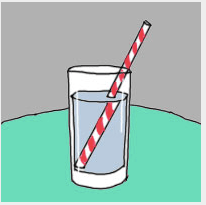
Why does the straw appear to be bent?
light is reflected
light is absorbed
light is turned
light is refracted
When light passes from air to water, what happens to the speed of the light?
speeds up
slows down
stays the same
Which of the following characteristics are correct for the image formed in a plane mirror?
I. Upright
II. Inverted
III. Real
IV. Same size as the object
V. Virtual
I, II, III
I, III, IV
I, IV, V
III, IV, V
Which of the following factors contributes to the bending of light?
Change of speed of light
Change of density of light
Change of colour of light
Change of energy of light
When the light passes out of the glass, back into the air
It bends away from the normal
It does not bend
It bends towards the normal
It continues to be the normal
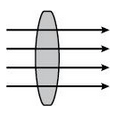
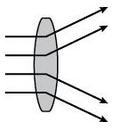
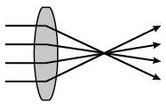
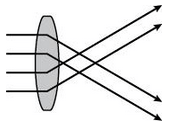
Which figure represents the path light takes through a converging lens?
A mirror having focal length –15 cm is _________________
Plane mirror
Concave mirror
Convex mirror
None of these
Which of the following characteristics are correct for the image formed in a plane mirror?
I. Upright
II. Inverted
III. Real
IV. Same size as the object
V. Virtual
I, II, III
I, III, IV
I, IV, V
III, IV, V
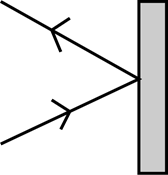
In the illustration, the light ray striking the object is-
Focal length of plane mirror is
At infinity
Zero
Negative
None of these
A concave mirror gives real, inverted and same size image if the object is placed
At F
At infinity
At C
Beyond C
Power of the lens is -5D, its focal length is
4m
-40m
-0.2m
-25m
A concave mirror gives virtual, refract and enlarged image of the object but image of smaller size than the size of the object is
At infinity
Between F and C
Between P and F
At E
Convex lens focus a real, point sized image at focus, the object is placed
At focus
Between F and 2F
At infinity
At 2F
The unit of power of lens is
Metre
Centimetre
Diopter
M-1
The radius of curvature of a mirror is 20cm the focal length is
20 cm
10 cm
40 cm
5 cm
Which position of the object will produce a magnified virtual image, if a concave mirror of focal length 15 cm is being used?
10 cm
20 cm
30 cm
35 cm
A lens of focal length 12 cm forms an erect image, three times the size of the object. The distance between the object and image is:
8 cm
16 cm
24 cm
36 cm
If an object is placed 21 cm from a converging lens, the image formed is slightly smaller than the object. If the object is placed at a distance of 19 cm from the lens, the image formed is slightly larger than the object. The approximate focal length of the lens is:
20 cm
18 cm
10 cm
5 cm
An object at a distance of 30 cm from a
concave mirror gets its image at the same point. The focal length of the mirror is
– 30 cm
30 cm
– 15 cm
+15 cm
If a man’s face is 25 cm in front of concave shaving mirror producing erect image 1.5 times the size of face, focal length of the mirror would be
75 cm
25 cm
15 cm
60 cm
The refractive index of water is 1.33. The speed of light in water will be
1.33 × 10⁸ m/s
3 × 10⁸ m/s
2.26 × 10⁸ m/s
2.66 × 10⁸ m/s
No matter how far you stand from a spherical mirror, your image appears erect. The mirror may be
only plane
only concave
either plane or convex
only convex
Power of’ a lens is the (a) of its focal length
A ………. lens will always give a virtual, erect and diminished image, irrespective of the position of the object.
(a)
A positive sign in the value of magnification indicates that the image is
real
virtual
enlarged
near
If the image is formed in front of the mirror, then the image distance will be
positive or negative depending on the size of the object
neither positive nor negative
positive
negative
A ray of light coming parallel to the principal axis after passing through a convex lens, has passed through its
optical centre
focus
center of curvature
mid point
To get real magnified image in convex lens, the object position is
in between lens and F
in between F and 2F
at 2F
beyond 2F
Centre point of a lens is called (a)
A point object is placed at a distance of 20 cm from a convex mirror of focal length 20 cm. The image will form at
at infinity
at focus
at the pole
behind the mirror
First law of reflection states that the angle of incidence is ___ angle of reflection.
Greater than
Less than
Equal to
None of these
Second law of reflection states that?
The incident angle, the reflected angle and the normal all lie in same plane
The incident ray, the reflected ray and the surface of object all lie in same plane
The incident angle, the incident ray and the normal all lie in same plane
The incident ray, the reflected ray and the normal all lie in same plane
Which of the following is true with respect to magnification of spherical mirrors
a. It is the ratio of height of object to height of image
b. It can be also expressed as negative ratio of image distance to object distance
c. Magnification is always greater than zero
a and c
a and b
b and c
All are true
Why the rear-view mirrors in vehicles are convex mirrors?
These mirrors give virtual erect image and slightly diminished image
Concave mirror also gives virtual erect image but these are highly magnified
Both of these
None of these
Lens formula is given as
1/v -1/u = 1/f
1/v + 1/u = 1/f
1/u -1/v = 1/f
None of these
Recently, In A Science Class Test, You Are Asked A Question Where You Have To Say Whether The Statements Are Correct Or Not?
The angle between incident ray and normal is called the angle of incidence.
The angle between the refracted ray and the normal is called the angle of refraction.
In refraction of light, the angle of refraction is usually not equal to the angle of incidence.
All the above.
Linear Magnification Produced By A Concave Mirror May Be:
Less than 1 or equal to 1
More than 1 or equal to 1
Less than 1, more than 1 or equal to 1
Less than 1 or more than 1
Light travels through a liquid at 2.25 x 10⁸ m/s. What is the absolute refractive index of the liquid?
1.33
1.0
1.523
2.45
Which of the following is a concave mirror?


The relation between focal length and radius of curvature is
R = 2f
1/f = 2R
f = R/2
R = 2/f
The point on the spherical mirror at the middle of the surface is called
focus
centre of curvature
pole
radius of curvature
Where will be the images of the Sun or the moon are formed by a concave mirror?
Focus
Pole
centre of curvature
beyond centre of curvature

