
 Worksheets
CE 34 Final Exam
Total questions: 85
Worksheet time: 2hrs 30mins
Which one of the followings is not considered as geostatic stresses?
Total stress
Effective stress
Pore water pressure
Triaxial pressure

With the soil profile shown below. Calculate the total stress, effective stress and pore water pressure at the ground level, at 4m, 6m, 10m and 15m depth.
(a)
Geologists Briefly explain the Shear Strength of soil. List THREE (3) that factor govern to increase of shear strength in soil.
The frictional resistance between the particles at their point of contact
The action of temperature, gravity, wind, rain and chemical weathering
Cohesion between particles
Interlocking between particles.
All above

Determine the stress increase, ∆σz, at A, given the following data:
q1 = 70 kN/m x1 = 3m z = 2m
q2 = 15 kN/m x2 = 1m

The HIGHER the plasticity of soil, the LESS compressible of the soil. TRUE OR FALSE?
FALSE
TRUE
The minimum water content at which the soil just begins to crumble when rolled into threads 3 mm in diameter, is known
Liquid Limit
Plastic Limit
Shrinkage Limit
Plasticity Index
Capillarity occurs due to
cohesion and adhesion
gravitational movement
hygroscopic adhesion
Name the two parameter of the soil shear strength; one is cohesion, the other one is (a)
Two condition in shear strength analysis
normal and shear
total and effective
cohesion and shear
resistance and shear
Cohesive soil such as silt and clay has internal friction angle.
TRUE
FALSE
Soil generally fails in ___________________
normal stress
shear
shear strength
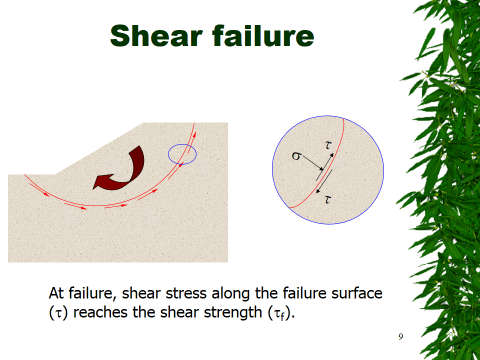
Failure plane or failure surface is representation of shear failure.
TRUE
FALSE
τ = c + σ tan Φ
is a Mohr Coulomb Criterion
shear strength with two parameters
c is cohesion
Φ is internal friction angle
all of them

Calculate the current overburden stress at mid of clay layer, σo. If the pre-consolidation of clay soil, σc is 100 kN/m2, the clay soil condition is normally consolidated soil.
TRUE
FALSE

Define the equation of settlement if we want to obtain settlement for the mid clay layer. The soil profile also have an external loading from embankment (assume to be wide enough) with Q of 20 kN/m2 laid at the ground surface. Given the effective pre-consolidation pressure is 80 kN/m2. Assume the unit weight of water is 10 kN/m3.
Normally consolidated
Over consolidated soil with Cc parameter only
Over consolidated soil with Cc and Cr parameter
Settlement is a __________ of ground movement due to compression and consolidation
magnitude
volume change
rate
Immediate settlement occurred
in a small amount in sand compare to clay
instantaneously after the application of loading
induce plastic soil rearrangement
Three factors that will affect the consolidation are as follows EXCEPT for
time
drainage height
pore water pressure
soil volume
The coefficient of consolidation can be obtained either using Casagrande and Taylor method. Choose NOT TRUE statement
define the degree of consolidation at 50% and 90%, respectively.
for Casagrande, the Tv is 0.196
for Taylor, the Tv is 0.848
address in-unit mm/s
The 2 components of in-situ stress that are often measured
Liquid Stress and Total Stress
Stress and Solid Pressure
Tensile Stress and Pressure
Total Stress and Fluid Pressure
Name the two parameter of the soil shear strength
internal friction angle
cohesion
normal stress
shear stress
Consolidated Drained triaxial test produced ________
normal shear strength parameter
total shear strength parameter
effective shear strength parameter
Cohesive soil such as silt and clay has internal friction angle.
TRUE
FALSE
To obtain the shear strength of the soil. What types of laboratory test can be conducted
Consolidation test
Triaxial test
Shear box test
Permeability test
Which are the types of Triaxial Test
Consolidated Drained
Unconsolidated Drained
Consolidated Undrained
Unconsolidated Undrained
In CD Triaxial Test, during the consolidation stage. What pressure we apply?
Deviator stress
Cell pressure
Axial stress
During the consolidation stage in CD Triaxial Test, what is the condition of the valve of pore water pressure?
closed
opened
During the shearing stage in CD Triaxial Test, you will apply ____________
σ3
σd
σ1
Deviator, σd = ___________
σ1 + σ3
σ1 - σ3
Stages in CD Triaxial Test
Saturation > Consolidation > Shearing
Sample preparation > Consolidation > Shearing
Sample preparation > Saturation > Consolidation > Shearing
Sample preparation > Consolidation > Saturation > Shearing
What are the disadvantages of the CD Triaxial Test?
analysis not accurate
will take longer time
will increase the cost
analyse the true behavior of the soil for long term stability
In CD Triaxial Test, during the shearing stage. The valve of pore water pressure will kept opened.
TRUE
FALSE
Consolidation settlement happened due to stress________ in soil mass, causing excess pore water pressure increase and eventually the pore water pressure dissipates. The soil experience changes in _______ and finally the soil will settle.
Reduce, volume
Increase, volume
In unconfined compression test the value of σ2 and σ3 is equal to
1
0
0.5
None
The unconfined compression test is derived from?
Direct shear test
Vane shear test
Triaxial compression test
Drained test
The unconfined compression test is generally applicable to ____________
Unsaturated clay
Saturated clay
Fine grained soil
Coarse grained soil
In plastic failure, load corresponding to __________ strain is arbitrarily taken as the failure load.
10%
5%
20%
50%
When the Mohr circle is drawn in unconfined compression test, its radius will be equal to ____________
Cu
qu
Ru
None of these
In-situ vane shear test is used to measure shear strength of
Very soft and sensitive clays
Stiff and fissured clays
Sandy soils
All the above
UCC test is a
Drained test
Undrained test
None of the above
Either of the above
The shear vanes were lowered gradually without disturbing the soil specimen so that the top of the vane is at least ----- below the top of the specimen.
20mm
10mm
20cm
10cm
Failure of soil sample in vane shear test is indicated by
return of strain indicator
return of dummy needle
any of these
None of these
The un-drained test is carried out on sample of clay, silt, and peat to determine _____________
Shear Strength of natural ground and Sensitivity
Pore pressure
None of the mentioned
All of the mentioned
In an un-drained test on saturated clays, both σ1’ and σ3’ is independent of ____________
Pore pressure
Shear strength
Cell pressure
Effective pressure
Which of the following cannot be obtained by using un-drained test?
Effective stress failure envelope
Shear strength
sensitivity
All of the mentioned
The change in the pore pressure during an un-drained shear can be explained by ___________
Lateral pressure
Effective stress
Pore pressure parameter
Mohr’s circle
Negative pore pressure in clay or sand is developed due to __________
Expansion on loading
Over loading
Loose structure
Compaction
If the pore pressure is measured during un-drained stage of the test, the result can be expressed in terms of __________
C’ and φ
cu
None of the mentioned
All of the mentioned
The equation for the unconsolidated un drainage strength of clay is __________
τ = c + σ tan φ
τf = ccu + σ tan φcu
τ = c + σ
τ = σ tan φ
Which of the following parameter is used to represent unconfined compressive strength at failure?
τf
cu
qu
Au
Which of the following strength test is commonly used in the laboratory?
Direct shear test
Confined compression test
Tri axial shear test
Unconfined shear test
Which of the following outlet is provided at the base of the tri axial test apparatus?
Cell fluid inlet
Pore water outlet
Drainage outlet
All of the mentioned
Pore pressure developed in the tri axial test can be measured by ____________
Bishop’s apparatus
Pore pressure apparatus
Terzaghi’s apparatus
Mohr’s apparatus
The vertical stress on the solid cylindrical test apparatus is applied by ____________
Major principal stress
Minor principal stress
Intermediate principal stress
All of the mentioned
The deviator stress developed in the proving ring, through the applied pressure is equal to are____________
σ1 + σ3
σ1 – σ3
σ2 – σ3
σ2 + σ1
When the sol is in the state of stress, it is said to be in _____________
Constant state
Plastic equilibrium
Stress conditioned state
Equilibrium condition
The deviator stress σd is given by __________
σd = σ1 + σ
σd = σ3 – σ1
σd=additional axial load/A2
σd = σ1 – σ3
Which of the following is an advantage of using tri axial test?
Accurate result is not possible
The plane of shear failure is predetermined
Stress conditions are complex
Precise measurement
Which of the following shear test is developed based on drainage conditions?
Quick test and Consolidated un drained test
Direct shear test
None of the mentioned
All of the mentioned
The direct shear test can also be called as ___________
Simple shear test
Stress test
Strain controlled shear box test
All of the mentioned
The coefficient of consolidation can be determined by comparing characteristics of _______
time factor Tv and degree of consolidation U
degree of consolidation U and pore pressure u
pore pressure u and effective pressure σ’
effective pressure σ’ and total pressure σ
In Vane shear test, torque rod is rotated at a uniform speed of:
0.1 Degree per second
1 Degree per minute
1' per minute
1' per second
The shearing strength of a cohesion-less soil depends upon
dry density
rate of loading
confining pressure
nature of loading.
For an OC soil the in-situ horizontal effective stress depends on
Vertical total stress, pore water pressure and stress history
Vertical effective stress
Only the characteristics of the geomaterial
For a NC soil the in-situ horizontal effective stress depends on.
Vertical total stress, pw and stress history
Vertical effective stress
Only the characteristics of the geomaterial
The preconsolidation pressure with respect to settlement
increases if settlement increases
increases if settlement decreases
is not affected by settlement
The shear strength of clays with respect to cohesion
increases if cohesion increases
increases if cohesion decreases
is not affected by cohesion
The gradual subsiding of a structure as the soil beneath its foundation consolidates under loading
Foundation
Shallow foundation
Footing
Settlement
The gradual reduction in the volume of a soil mass resulting from the application of a sustained load and an increase in compressive stresses
Primary consolidation
Differential settlement
Secondary consolidation
Consolidation
A reduction in volume of a soil mass under the action of a sustained load, due chiefly to a squeezing out of water from the voids within the mass and a transfer of the load from the soil water to the soil solids
Primary consolidation
Differential settlement
Secondary consolidation
Consolidation
A reduction in volume of a soil mass under the action of a sustained load, due chiefly to adjustment of the internal structure of the soil mass after most of the load has been transferred from the soil water to the soil solids
Primary consolidation
Differential settlement
Secondary consolidation
Consolidation
The relative movement of different parts of a structure caused by uneven settlement or failure of its foundation
Primary consolidation
Differential settlement
Secondary consolidation
Consolidation
Non-uniform soil pressure is caused by lateral forces while the friction between footings and soil can create __________.
Soil pressure
Active earth pressure
Passive earth pressure
Shear resistance
The actual pressure developed between a footing and the supporting soil mass, equal to the quotient of the magnitude of the forces transmitted and the area of contact
Soil pressure
Active earth pressure
Passive earth pressure
Shear resistance
Zone in a loaded soil mass bounded by an arbitrarily selected isobar of stress, from a single or number of friction piles
Negative friction
Pressure bulb
Isobar
Timber pile
At a planned construction site, a 2m thick buried clay layer lies beneath a surface stratum of free draining soil. Free draining granular soil also underlies the clay layer. Double drainage from the clay layer can therefore occur when construction loads cause consolidation. The coefficient of consolidation for the clay is 0.001 m2/day. Settlement calculations indicate that the clay layer will eventually compress 4 cm. (primary compression or consolidation) due to the effect of building loads.
How long a time period is required for 90% of the estimated settlement to occur?
How much settlement occurs in the first 12 months considering the degree of consolidation is equal to the ratio of Sct/Sc where Sct = settlement of the layer at time “t” while Sc = ultimate settlement of the layer from primary consolidation
A cohesive soil specimen has a shearing resistance equal to 28 degrees and a cohesion of 32. if the maximum shearing stress of the soil sample is equal to 64 kPa.
Determine the following:
a. Lateral pressure in the cell for failure
b. Max. principal stress to cause the failure
c. Normal stress at the point of max. shear
Soil investigation at a site gave the following information. Fine sand exists to a depth of 10.6 m and below this lies a soft clay layer 7.60 m thick. The water table is at 4.60 m below the ground surface. The submerged unit weight of sand yb is 10.4 kN/m3, (take note that the submerged unit weight is equal to saturated unit weight of the soil minus the unit weight of water) and the wet unit weight above the water table is 17.6 kN/m3. The water content of the normally consolidated clay w = 40%, its liquid limit = 45%, and the specific gravity of the solid particles is 2.78. The proposed construction will transmit a net stress of 120 kPa at the middle of the clay layer. Find the average settlement of the clay layer.

