wayground logo

Free Printable Worksheets

Font size

S
M
L
XL
Worksheets

G5 - Chapter 9 Final Revision [Minerals-Rocks-Soil] Practice

Total questions: 132

Worksheet time: 2hrs 32mins

Name
Class
Date
1.
A mineral is a _______________, naturally occuring solid that has its own regular arrangement of particles in it.
a)
Living
b)
Nonliving
c)
Rock
d)
Small
2.
What properties are used to identify minerals?
a)
Hardness, Luster, Color, Streak, Shape, Magnetism
b)
Diamond, Crystal, Topaz, Quartz, Apatite, Calcite
c)
Hardness, Luster, Color, Topaz, Talc, Fluorite
3.
The hardest mineral is the ______________.
a)
Diamond
b)
Corundum
c)
Topaz
d)
Calcite
4.
____________ describes how a mineral's surface reflects light.
a)
Hardness 
b)
Luster
c)
Color
d)
Streak
5.
________________ is the color of a mineral in its powdered form.
a)
Streak
b)
Shape
c)
Magnetism
d)
Luster
6.
The color of a mineral in powder form is called the mineral's 
a)
hardness
b)
specific gravity
c)
luster
d)
streak
7.

Why is coal not a mineral?

a)

It's not a solid

b)

It is man-made

c)

It has living remains

d)

It is made of carbon

8.
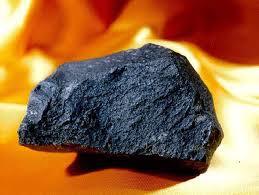
The following image shows what mineral property?
a)
Hardness
b)
Streak
c)
Cleavage
d)
Density
9.
Diamond has a hardness of ___ on Mohs Hardness Scale.
a)
1
b)
5
c)
8
d)
10
10.
By definition, a mineral has which of the following characteristic(s)?
a)
definite chemical composition
b)
crystal structure
c)
naturally occuring
d)
all of the above
11.
How do you test the hardness of a mineral? 
a)
Throw it against a wall
b)
Step on it
c)
Scratch Test
d)
Kick it until it breaks
12.
What mineral is used for pencils?
a)
Graphite
b)
Galena
c)
Magnetite
d)
Quartz
13.
What mineral is salt?
a)
quartz
b)
sulfur
c)
halite
d)
calcite
14.
A naturally occurring, inorganic solid with a crystal structure and a definite chemical composition is referring to
a)
density
b)
streak
c)
mineral
d)
non silicate mineral
15.
The solid, geometric form of a mineral produced by a repeating pattern of atoms
a)
crystal
b)
density
c)
element
d)
fracture 
16.
What mineral is the softest mineral on Moh's Hardness Scale and the main ingredient in baby powder?
a)
feldspar
b)
talc
c)
gypsum
d)
kaolinite
17.
A mineral's resistance to being scratched is called?
a)
streak
b)
luster
c)
hardness
d)
heft
18.

Hardness:

a)

It’s the ability of some minerals to break in geometric shapes

b)

It's the stripe colour of a mineral

c)

It's a measure of a mineral’s resistance to being scratched

d)

None of the answers is correct

19.

a naturally occurring, non-living solid that has a specific chemical make-up and a repeating structure.

a)

rock

b)

mineral

c)

stone

d)

mountain

20.

Scientists use mineral ________________ to identify and classify minerals.

a)

pieces

b)

names

c)

properties

d)

structures

21.

Which one is not a property used to identify minerals?

a)

streak

b)

luster

c)

hardness

d)

size

22.

-The color of the powder left behind when you rub the mineral against a tile.

a)

streak

b)

color

c)

harness

d)

luster

23.
  • the way a mineral's surface reflects light.
a)

streak

b)

luster

c)

color

d)

hardness

24.

Gold, silver and copper are examples of minerals that have ______________________ luster.

a)

metallic

b)

nonmetallic

25.
  • a mineral's ability to resist being scratched
a)

streak

b)

luster

c)

color

d)

hardness

26.

-the name of the scale used to determine a mineral's hardness.

a)

Miller's scale of hardness

b)

The Scale of Hardness

c)

Mohs scale of hardness

d)

Mineral Hardness Scale

27.

Which of the following minerals is one of the hardest minerals?

a)

pearl

b)

diamond

c)

talc

d)

quartz

28.

Rocks are made out of __________________.

a)

particles

b)

minerals

c)

molecules

d)

cells

29.

Minerals are made from ______________ which are chemically combined.

a)

rocks

b)

minerals

c)

particles

d)

elements

30.

A measure of how easily a mineral can be scratched.

a)

Structure

b)

Texture

c)

Luster

d)

Hardness

e)

Streak

31.

The size and shape of pieces of materials in a rock.

a)

Structure

b)

Texture

c)

Luster

d)

Hardness

e)

Streak

32.

Which of the following minerals has a metallic luster, a black streak, and could scratch Gold?

a)

Magnetite

b)

Graphite

c)

Galena

d)

Hematite

33.

What is the softest mineral on the Moh’s Scale?

a)

Corundum

b)

Talc

c)

Feldspar

d)

Diamond

34.

The Moh’s Scale tests the ________________ of minerals.

a)

Structure

b)

Texture

c)

Hardness

d)

Streak

35.

Which mineral could Fluorite scratch?

a)

Diamond

b)

Calcite

c)

Quartz

d)

Apatite

36.

Which mineral could Quartz not scratch?

a)

Corundum

b)

Talc

c)

Feldspar

d)

Calcite

37.

Which of the following minerals can Apatite scratch? Select all that apply.

a)

Gypsum

b)

Fluorite

c)

Calcite

d)

Diamond

38.

The repeating pattern of a mineral's particles in a solid is known as

a)

crystal structure

b)

streak

c)

fracture

d)

luster

39.

The property of a mineral splitting evenly and forming smooth surface is

a)

luster

b)

streak

c)

cleavage

d)

fracture

40.

How does a streak test help identify different minerals?

a)

minerals that leave a clear streak are usually gold

b)

if a mineral scratches a piece of tile, it is harder than the tile

c)

the streak left behind by a mineral helps classify the luster

d)

sometimes the streak can be a different color than the mineral's surface color

41.

How a mineral breaks apart when it does NOT split evenly and forms Rough surface is known as

a)

cleavage

b)

fracture

c)

luster

d)

solid

42.
This rock was another type of rock that was heated and compressed over time. What type of rock is this?
a)
Sedimentary
b)
Igneous
c)
Metamorphic
43.
This rock started as molten magma. What type of rock is this?
a)
Sedimentary
b)
Igneous
c)
Metamorphic
44.
This rock was formed by smaller pieces of rock that settled at the bottom of a lake millions of years ago. What type of rock is this?
a)
Sedimentary
b)
Igneous
c)
Metamorphic
45.
Cooling & crystalization produce
a)
igneous rocks
b)
metamorphic rocks
c)
sedimentary rocks
46.
True or False: Once a rock is sedimentary, it cannot become an igneous rock.
a)
True
b)
False
47.
The process when rocks break into smaller pieces due to exposure to natural elements is called
a)
erosion
b)
weathering
c)
sediments
48.
What are the 3 major types of rocks?
a)
Igneous, Metamorphic, Sedimentary
b)
Metamorphic, Igneous, Cementation
c)
magma, lava, crystals
49.
The process by which igneous rocks are formed...
a)
heat and pressure
b)
melting and cooling
c)
weathering and erosion
50.
The process by which metamorphic rocks are formed...
a)
heat and pressure
b)
erosion and deposition
c)
melting and cooling
51.
The name rock is given when it is broken down into smaller pieces.
a)
texture
b)
weathering
c)
sediment
d)
erosion
52.

Which sedimentary rock has a fine-grained texture?

a)

1

b)

2

c)

3

d)

4

53.

Rocks that form from colling magma inside Earth?

a)

Igneous intrusive

b)

Igneous extrusive

c)

Metamorphic foliated

d)

Metamorphic nonfoliated

54.
True/False: Igneous rocks can only turn into metamorphic rocks.
a)
True
b)
False
55.
The process in which dissolved minerals crystallize and glue sediment together.
a)
compaction
b)
deposition
c)
organic rock
d)
cementation
56.

Which is the process that breaks up rock on Earth’s surface?

a)

deposition

b)

melting

c)

compaction

d)

weathering

57.

Geologists have classified rocks into three major groups of rocks which are:

a)

inorganic, organic and chemical rocks

b)

igneous, sedimentary and metamorphic rocks

c)

metamorphic, chemical and non chemical rocks

d)

sedimentary, inorganic and igneous rocks

58.

Any rock that forms from another rock as a result of changes in heat or pressure (or both) is a:

a)

chemical rock

b)

igneous rock

c)

sedimentary rock

d)

metamorphic rock

59.

What kind of igneous rock usually contains large crystals?

a)

clastic

b)

extrusive

c)

organic

d)

intrusive

60.

A rock that forms from many small fragments of other rocks is a(n)

a)

igneous rock

b)

metamorphic rock

c)

sedimentary rock

d)

extrusive rock

61.

The process by which metamorphic rock changes to igneous rock begins with

a)

melting

b)

erosion

c)

deposition

d)

crystallization

62.

Which rock cycle process causes many sedimentary rocks to have visible layers?

a)

eruption

b)

intrusion

c)

crystallization

d)

deposition

63.

If heat and pressure inside Earth cause the texture and crystal structure of a rock to change, what new material is formed?

a)

sedimentary rock

b)

metamorphic rock

c)

igneous rock

d)

chemical rock

64.

A naturally occurring solid that can form by inorganic processes and that has a crystal structure and a definite chemical composition.

a)

It´s a rock

b)

It´s a crystal

c)

It´s a mineral

d)

It´s a substance

65.
A rock formed from fragments of other rocks is a(n)
a)
Metamorphic Rock
b)
Sedimentary Rock
c)
Extrusive Rock
d)
Igneous Rock
66.
This rock started as molten magma. What type of rock is this?
a)
Sedimentary
b)
Igneous
c)
Metamorphic
67.

What is underground molten rock?

a)

Lava

b)

Magma

c)

Soil

d)

Intrusive

68.

What is aboveground molten rock?

a)

Extrusive

b)

Magma

c)

Lava

d)

Sedimentary

69.

Limestone is an example of...

a)

Sedimentary

b)

Igneous

c)

Metamorphic

70.

Sandstone is an example of...

a)

Metamorphic

b)

Sedimentary

c)

Igneous

71.

Granite is an example of...

a)

Igneous

b)

Metamorphic

c)

Sedimentary

72.

Marble is an example of...

a)

Igneous

b)

Sedimentary

c)

Metamorphic

73.

Pumice is an example of

a)

Igneous

b)

Metamorphic

c)

Sedimentary

74.

Quartzite is an example of...

a)

Metamorphic

b)

Igneous

c)

Sedimentary

75.

Basalt is an example of...

a)

Igneous

b)

Sedimentary

c)

Metamorphic

76.

Shale is an example of...

a)

Metamorphic

b)

Sedimentary

c)

Igneous

77.

Gneiss is an example of...

a)

Igneous

b)

Sedimentary

c)

Metamorphic

78.

Obsidian is an example of...

a)

Igneous

b)

Sedimentary

c)

Metamorphic

79.

Coal is an example of...

a)

Igneous

b)

Sedimentary

c)

Metamorphic

80.

Conglomerate is an example of...

a)

Igneous

b)

Sedimentary

c)

Metamorphic

81.

What is the parent material of all rocks?

a)

Magma

b)

Lava

c)

Sedimentary

d)

Organic matter

82.

Intrusive & extrusive are 2 types of...

a)

sedimentary

b)

metamorphic

c)

Igneous

83.
This rock was formed when molten rock cooled into a solid. What type of rock is it?
a)
Igneous Rock
b)
Metamorphic Rock
c)
Sedimentary Rock
84.
This rock was found near the mouth of a volcano. What type of rock is this?
a)
Sedimentary
b)
Igneous
c)
Metamorphic
85.
When sediments are pressed together tightly, this is called ____________.
a)
Compaction
b)
Cementation
c)
Weathering
d)
Erosion
86.
The movement of weathered material (sediment) is called?
a)
weathering
b)
erosion
c)
deposition
87.
Extreme Heat and Pressure creates a _________ rock.
a)
Igneous
b)
Metamorphic
c)
Sedimentary
d)
Mineral
88.
You find a rock in which the grains are arranged in parallel bands of white and black crystals.  The rock is probably a(n)
a)
Igneous rock
b)
Sedimentary rock
c)
Metamorphic rock
d)
Extrusive rock
89.
The three groups of rocks are classified by
a)
How they form
b)
Color
c)
Grain size
d)
Chemical Composition
90.
Rocks are formed by
a)
minerals
b)
other metals
c)
small particles
d)
sediments
91.
Heat & pressure
a)
metamorphism
b)
volcanism
c)
magmarism
d)
lithification
92.
Cooling & crystalization produce
a)
igneous rocks
b)
metamorphic rocks
c)
sedimentary rocks
93.
Deposition & lithification or compacting & cementing produce
a)
sedimentary rocks
b)
igneous rocks
c)
metamorphic rocks
94.
Soil conservation includes all of the following EXCEPT_______.
a)
Desertification
b)
Contour plowing
c)
Terracing
d)
Crop rotation
95.
What soil conservation technique is this?
a)
Crop Rotation
b)
Wind Breaks
c)
Contour Plowing
d)
No-Till Farming
96.
Which type of soil conservation strategy is being  used in this picture?
a)
windbreakers
b)
contour farming
c)
planting of vegetation
d)
terracing
97.
Farmer Joe plowed curved rows that followed the shape of the land in order to create water breaks, what method did he use?
a)
contour plowing
b)
crop rotation
c)
subsoil preservation
d)
terrace farming
98.
What most likely happens to soil when crops are not rotated from year to year?
a)
The soil nutrients are depleted
b)
The soil fertility increases
c)
The soil becomes more porous
d)
The soil erodes less rapidly
99.
Why is soil an important natural resource?
a)
soil is used to make buildings
b)
soil can grow crops
c)
soil comes from bedrock
d)
soil is full of mircobes
100.
Two methods of soil conservation in farming are
a)
reclamation and subsurface mining
b)
landscaping and nylon fencing
c)
selective harvesting and replanting
d)
contour plowing and windbreaks
101.
What type of erosion is slowed down by contour plowing and terracing?
a)
wind
b)
water
c)
air
102.
What is a solution to stop wind erosion on a farmer's field?
a)
Plow up all of the plants
b)
Build a pond
c)
plant trees and shrubs on the edge
103.

Why is soil is a valuable resource?

a)

is important to all living things on land

b)

contains sand and gravel

c)

is rich in decomposers

d)

has all three soil horizons

104.

What term describes the management of soil to prevent its destruction?

a)

soil exhaustion

b)

soil decomposition

c)

soil conservation

d)

soil fertility

105.
What soil conservation is this?
a)
Cover Crops
b)
Soil Conservation
c)
Crop Rotation
106.

why is it important to have soil conservation

a)

save the soil

b)

prevent erosion

c)

prevent another dust bowl

d)

all of the above

107.

anything in the environment that humans use

a)

natural resource

b)

soil conservation

c)

sod

d)

Dust Bowl

108.

the management of soil to prevent its destruction

a)

natural resource

b)

soil conservation

c)

sod

d)

Dust Bowl

109.

planting different crops in a field each year in order to avoid using all the nutrients in the soil.

a)

contour plowing

b)

conservation plowing

c)

crop rotation

d)

sod

110.

Which layer of soil has the most rocks and the least amount of organic matter?

a)

topsoil

b)

subsoil

c)

bedrock

d)

organic layer

111.

How are earthworms good for soil?

a)

Worms eat decayed material and break it down

b)

They drink all of the water in the soil and dry it out.

c)

Worms break dance and break up rocks in the soil

d)

Worms chemically weather rocks in the soil.

112.

What has the largest particles in soil?

a)

silt

b)

sand

c)

clay

d)

loam

113.

Sandy soil has a lot of _______

a)

rocks and minerals

b)

clay and leaves

c)

organic matter

d)

sea shells

114.

Which activity can increase soil fertility?

a)

Cutting trees

b)

Burying trash in the ground

c)

Plants die and decay

d)

Taking earthworms out of the soil.

115.

Topsoil is darker than other layers of soil because it has more ______

a)

rocks

b)

organic material

c)

oreos

d)

sand

116.

How does erosion compare to weathering

a)

Weathering breaks down rock and erosion carries the sediment away

b)

Both move sediment from place to place

c)

Erosion breaks down rock and weathering carries sediment away

d)

Both form mountains

117.

When plants, animals, and other organisms die, they break down and become part of the soil. What is this part of the soil called?

a)

sand

b)

silt

c)

clay

d)

humus

118.

What is the layer of soil that contains the roots of the big trees?

a)

Organic

b)

Topsoil

c)

Subsoil

d)

Bedrock

119.

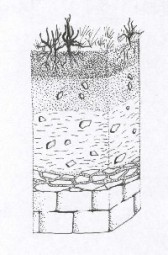
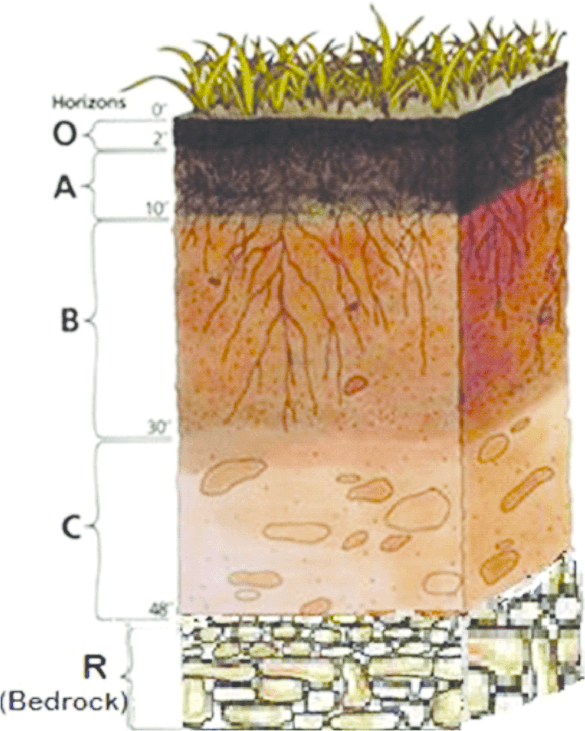
Which layer is the bottom of the soil profile?

a)

Partially Weathered Parent Material

b)

Separated rock

c)

Bedrock

d)

Topsoil

120.

Layers of soil are also known as?

a)

Soil Profiles

b)

Soil Horizons

c)

Soil sheets

d)

Soil cores

121.

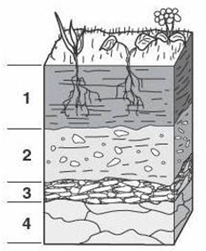
In which layer of the soil profile contains the MOST humus?

a)

Layer 1

b)

Layer 2

c)

Layer 3

d)

Layer 4

122.

Soil is made of?

a)

weathered rocks and minerals

b)

dead plants and animals

c)

air and water

d)

all of the above

123.

The first layer of soil, called the A horizon is also known as?

a)

Bedrock

b)

Parent Material

c)

Topsoil

d)

Subsoil

124.
What is the name of Soil Horizon B?
a)
Subsoil
b)
Topsoil
c)
Bedrock
d)
Transition Zone
125.
The layer of soil which the topsoil is found.
a)
Horizon A
b)
Horizon B
c)
Horizon C
d)
Horizon D or R
126.

What are the 3 most important minerals?

a)

NPQ

b)

NPL

c)

NPK

127.

Potassium's symbol is a?

a)

K

b)

Na

c)

Mg

128.

Nitrogen's symbol is a?

a)

Ni

b)

NH

c)

N

129.

Phosphorus's symbol is a?

a)

L

b)

P

c)

Ph

130.

What are the three essential elements that plants require?

a)

nitrogen phosphate potassium

b)

nitrogen sulphur potassium

c)

nitrogen potassium phosphorous

d)

nitrogen potassium polonium

131.

How do you Evaluate your learning about this chapter

a)
b)
c)
132.

What are the points you still need help to understand

ما النقاط التي لازلتي تحتاجين لمساعدة حتى تتمكنين من فهمها

4 lines