wayground logo

Free Printable Worksheets

Font size

S
M
L
XL
Worksheets

Bio Final Review (YL, Spring)

Total questions: 88

Worksheet time: 3hrs 42mins

Name
Class
Date
1.

What are prokaryotes?

a)

Small organisms

b)

Multicellular organisms

c)

Unicellular organisms

2.

What are groups of bacteria called?

a)

colonies

b)

clusters

c)

bunches

3.

Do bacteria produce asexually?

a)

yes

b)

no

4.

What bonds hold the two sides of DNA together?

a)

hydrogen bonds

b)

ionic bonds

c)

covalent bonds

5.

What are the base-pairing rules for DNA?

a)

A-C, G-T

b)

A-U, G-C

c)

A-T, G-C

d)

A-C, G-U

6.

What are the base-pairing rules for DNA with RNA?

a)

A-C, G-T

b)

A-U, G-C

c)

A-T, G-C

d)

A-C, G-U

7.

What is the largest taxonomic group?

a)

Family

b)

Kingdom

c)

Phylum

d)

Domain

8.

A group of similar species is a...

a)

kingdom

b)

phylum

c)

genus

d)

cladogram

9.

The system of biological classification was created by...

a)

Charles Darwin

b)

Stephen Gray

c)

Alex Fisher

d)

Carolus Linnaeus

10.

The lowest (most specific) level of classification is...

a)

order

b)

species

c)

genus

d)

kingdom

11.
Which sequence of DNA bases would pair with this partial strand
CAT TCA CTG
a)
ATG TGA CAG
b)
TAC ACT GTC
c)
GTA AGT GAC
d)
CAT TCA CTG
12.
Which of the following units are repeatedly joined together to form a strand of DNA?
a)
amino acids
b)
nucleotides
c)
fatty acids
d)
polysaccharides
13.
The enzyme that unwinds the DNA to prepare for replication
a)
helicase
b)
replicase
c)
polymerase
d)
synthase
14.
DNA replication results in two DNA molecules,
a)
each one with two original strands
b)
each one with two new strands
c)
each one with one new strand and one original strand
d)
one with two new strands and the other with two original strands
15.
order of replication
a)
3, 4, 2, 1
b)
3, 1, 4, 2
c)
2, 1, 4, 3
d)
3, 4, 1, 2
16.
In what phase of the cell cycle does DNA replication take place?
a)
G1
b)
S
c)
G2
d)
M
17.
Which enzyme is responsible for adding nucleotides?
a)
Topoisomerase
b)
DNA Polymerase
c)
Ligase
d)
Primase
18.
Why is DNA important?
a)
it is very small and very complicated
b)
it's in everything
c)
it serves as the blueprint for traits of all living things
d)
because we eat it every day for energy
19.
The building block of nucleic acids are nucleotides.  Nucleotides are composed of a sugar, a phosphate group, and a _________________ base.
a)
oxygen
b)
hydrogen
c)
nitrogen
d)
carbon
20.
The sugar in DNA is ?
a)
sucrose
b)
glucose
c)
deoxyribose
d)
fructose
21.
Which 2 molecules form the sides (backbone) of the DNA ladder?
a)
deoxyribose sugar and adenine
b)
deoxyribose sugar and a hydrogen bond
c)
deoxyribose sugar and the nucleus
d)
deoxyribose sugar and phosphate
22.
Identify #2.
a)
nitrogen base
b)
phosphate group
c)
deoxyribose sugar
d)
nucleotide
23.
A long chain of amino acids is a/an
a)
protein
b)
nucleic acid
c)
tRNA
d)
mRNA
24.

Genotype or Phenotype: Freckles

a)

Genotype

b)

Phenotype

25.

Genotype or Phenotype: ff

a)

Genotype

b)

Phenotype

26.

Homozygous or Heterozygous: ff

a)

Homozygous

b)

Heterozygous

27.

Homozygous or Heterozygous: Ff

a)

Homozygous

b)

Heterozygous

28.

The heterozygous DOMINANT trait of dimples?

a)

DD

b)

dd

c)

Dd

29.

The homozygous recessive trait for no taste of PTC paper

a)

tt

b)

Tt

c)

TT

30.

A mom with the heterozygous gene for Widows peak and a father with the heterozygous gene for Widows peak: odds their baby HAS a widow's peak?

a)

0%

b)

25%

c)

75%

d)

100%

31.

A mom with a dominant HOMOZYGOUS gene of a hitchhiker's thumb and a dad with a homozygous recessive gene for a straight thumb. What is the baby's phenotype?

a)

50% straight thumb

b)

100% Hitchhiker's Thumb

c)

25% Hitchhiker's Thumb

32.
Aa, DD, bB, yy are all examples of
a)
genotypes
b)
phenotypes
33.
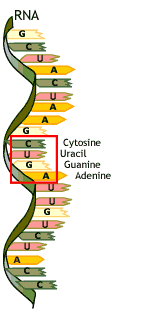
In RNA, Uracil pairs with ______. 
a)
cytosine
b)
adenine
c)
guanine
d)
thymine
34.
The process to go from DNA to mRNA is _______
a)
translation
b)
transcription
c)
replication
35.
The process to go from mRNA to a protein is called ____
a)
transcription
b)
rRNA
c)
replication
d)
translation
36.
DNA holds the code for
a)
lipids
b)
carbohydrates
c)
protein
d)
sugar
37.
Choose the nucleotide sequence of the RNA strand that would be complementary to the following strand: 
GTAGTCA
a)
UATUAGA
b)
ACGACTG
c)
CAUCAGU
d)
CATCAGT
38.
The main function of tRNA is to...
a)
carry a message that, when translated, forms proteins
b)
form a portion of ribosomes
c)
string together complementary RNA and DNA strands
d)
bring amino acids from the cytoplasm to the ribosomes
39.
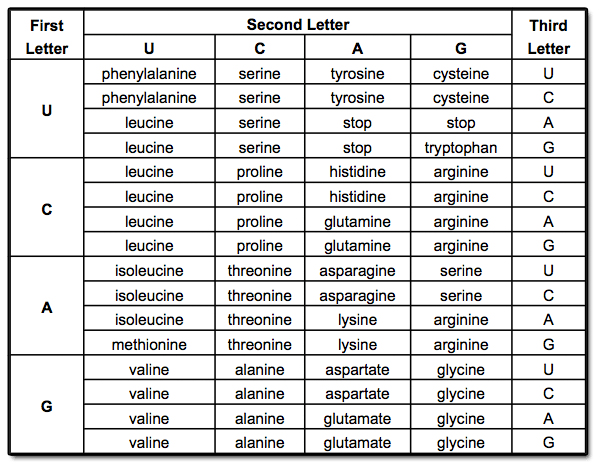
What amino acid is represented by the codon UUA?
a)
Phenylalanine
b)
Tyrosine
c)
Leucine
d)
Stop codon
40.
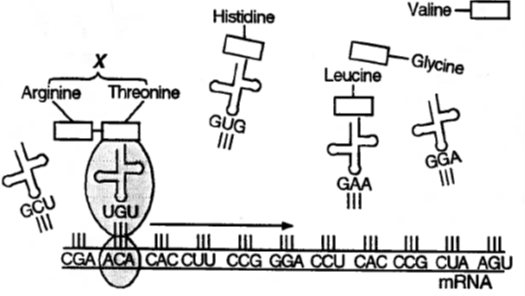
What process is going on in this photo? 
a)
Transcription 
b)
Translation 
c)
Replication 
d)
All the above 
41.
Which component of DNA determines the traits of an organism? 
a)
Nitrogen Bases
b)
Sugar-Phosphate Backbone
c)
Hydrogen bonds
42.

What is the location in the cell for translation?

a)

nucleus

b)

mitochondria in cytoplasm

c)

ribosome in cytoplasm

d)

chloroplast in cytoplasm

43.
What is the three base sequence of mRNA that codes for a single amino acid?
a)
Anticodon
b)
Codon
c)
Protein
44.
What is the location in the cell for transcription?
a)
nucleus
b)
cytoplasm
c)
ribosome
d)
mitochondria
45.
Does the order of amino acids in a protein matter?
a)
YES!
b)
NO!
46.
What mutation has occurred here? 
T-G-A-C-C-A
T-G-A-G-C-A
a)
Substitution
b)
Deletion
c)
Insertion
d)
Frameshift 
47.
Are all mutations bad?
a)
Yes
b)
No
48.
Any change in the sequence of DNA is...
a)
transgenic shift
b)
Single Genotype
c)
Monohybrid Trait
d)
Mutation
49.
Why are insertion and deletion (frameshift) mutations so harmful?
a)
They change all of the codons from the mutation on down the line, which changes the amino acid sequence
b)
They insert things that an organism doesn't need.
c)
They often delete things that organisms need.
d)
Insertion and deletions are not any more harmful than substitution mutations.
50.
Why is the order of amino acids so important?
a)
The order of amino acids dictates what shape the protein will fold into.
b)
It is not important. The protein folding chamber will force the protein to fold into the correct shape.
51.
DNA molecule segment is : TTACGCAAG
The mutated DNA segment is TTCGCAAG. This is an example of ___ mutation.
a)
Substitution
b)
Deletion
c)
Insertion
d)
Inversion
52.
DNA molecule segment is : TTACGCAAG
The mutated DNA segment is TTACGCAAC. This is an example of ___ mutation.
a)
Substitution
b)
Insertion
c)
Inversion
d)
Translocation
53.
a change in one DNA triplet that may result in a new triplet that codes for a stop codon instead of an amino acid is known as
a)
missense
b)
nonsense
c)
frameshift
d)
silent
54.
A type of substitution in which no  amino acids change is called 
a)
Missense
b)
Nonsense
c)
Silent
d)
Deletion
55.
In a point mutation, this would have the worst effect on the function of the protein 
a)
an insertion or deletion near the end of a gene
b)
an insertion or deletion at the beginning of the gene
c)
an insertion at the middle of the gene
d)
a base substitution
56.
Which of the following can increase the rate of mutation?
a)
UV Radiation
b)
Viruses
c)
toxic chemicals 
d)
All of the above
57.
A missense mutation results from...
a)
a base substiution that causes no change in amino acid
b)
a base substitution that causes a change in one amino acid
c)
a base change that codes for a stop 
d)
a base insertion or deletion
58.
Original: ATC CAT
Mutation: ATC GCAT
What mutation occurred?
a)
deletion
b)
insertion
c)
silent
d)
transverse
59.
According to fossil records, the horses that lived 50 million years ago were much smaller, weaker and slower than modern horses. Which process is most likely responsible for the changes that have led to the increased size, strength, and speed in horses?
a)
commensalism
b)
inbreeding
c)
migration
d)
evolution by natural selection
60.
The diagram illustrates an embryonic stage of two organisms.Which of the following can be determined by observing the embryos shown in the diagram? 
a)
The organisms share a common ancestry.
b)
The organisms belong to the same genus.
c)
The organisms are native to the same geographic areas.
d)
The organisms will grow into anatomically similar adults.
61.
Scientists are studying the evolutionary history of a group of plants in the United States, and they developed an evolutionary tree, as shown below.Which statement can be inferred from the evolutionary tree?
a)
Species 1 is most closely related to Species 8.
b)
Species 2 is most closely related to Species 3.
c)
Species 3 is most closely related to Species 7.
d)
Species 5 is most closely related to Species 6.
62.
Natural selection is best described as
a)
a change in an organism in response to a need of that organism
b)
a process of nearly constant improvement that leads to an organism that is nearly perfect
c)
differences in survival rates as a result of different inherited characteristics
d)
inheritance of characteristics acquired during the life of an organism
63.

Adaptations can be:

a)

camouflage

b)

ability to survive cold weather

c)

hunting skills

d)

all of the above

64.

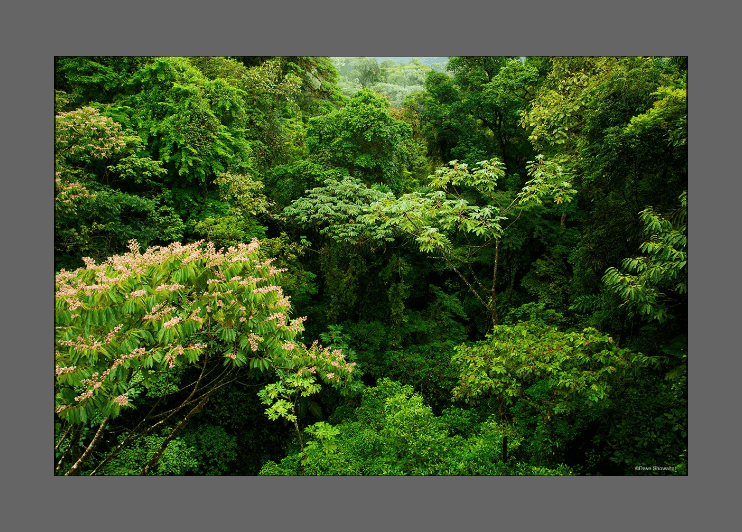
A yellow morph and green morph of an insect lives in the rainforest canopy. You would expect:

a)

the green population to increase and the yellow to decrease

b)

both populations should stay the same

c)

both populations will increase

d)

the green population to decrease and the yellow to increaseThis is a wrong answer

65.

How do you "win" at natural selection?

a)

survive

b)

go extinct

c)

survive & reproduce

66.
Survival of the Fittest and Evolution were proposed by what scientist?
a)
Charles Darwin
b)
Albert Einstein
c)
Steven Hawking
d)
Isaac Newton
67.
When every organism of a species has died.
a)
Evolution
b)
Natural Selection
c)
Extinction
d)
Artificial Selection
68.

What word describes a trait that helps an organism survive in its environment?

a)

natural selection

b)

mutation

c)

camouflage

d)

adaptation

69.
Change over time
a)
Natural Selection
b)
Selective Breeding
c)
Homeostasis
d)
Evolution
70.
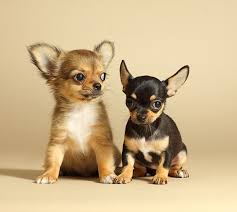
Dogs such as Chihuahuas are examples of....
a)
Artificial Selection 
b)
Natural Selection 
c)
Mutations 
71.
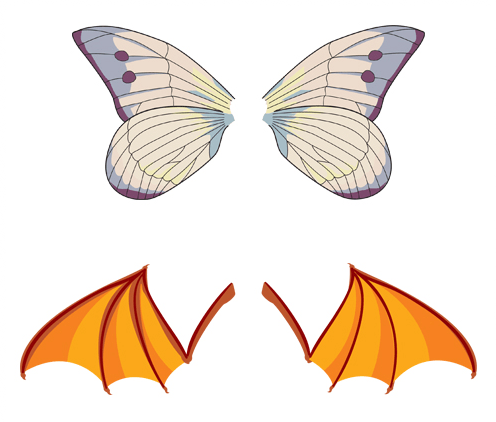
Structures are similar in appearance but not in structure
a)
Vestigial 
b)
Homologous 
c)
Analogous Structures 
d)
Embryonic 
72.
Which layer is the youngest
a)
1
b)
2
c)
3
d)
4
73.

Similar structures with different purposes found in different species are known as _____

a)

vestigial structures

b)

DNA

c)

homologous structures

d)

the fossil record

74.

The picture shows a/an ___________

a)

homologous structure

b)

vestigial structure

75.

What is this an example of?

a)

Homologous structure

b)

Analogous structure

c)

Vestigial organs

d)

Functional adaption

76.
The opossum and kangaroo both incubate their young in a pouch. This provides evidence that they---
a)
are descended from a common ancestor
b)
Have very similar skeletal structures
c)
belong to the same species
d)
must range great distances to eat
77.
Which kingdom do humans belong to?
a)
Plantae
b)
Fungi
c)
Animalia
d)
Protista
78.
Which domain is capable of living in extreme environments like hot springs, geysers, or very salty waters?
a)
Bacteria
b)
Archaea
c)
Eukarya
79.
Which domain includes all animals and plants?
a)
Archaea
b)
Eukarya
c)
Bacteria
80.
Almost all bacteria are...
a)
Unicellular
b)
Multicellular
81.
Which two kingdoms are entirely multicellular?
a)
Animalia and Plantae
b)
Animalia and Protista
c)
Protista and Plantae
82.
Which kingdoms have some organisms that can make their own food (autotrophic)?
a)
Plantae and Animalia
b)
Fungi and Plantae
c)
Protista and Plantae
83.
True or False: All cells have DNA.
a)
True
b)
False
84.
Algae and Kelp belong to the Kingdom...
a)
Plantae
b)
Protista
c)
Fungi
d)
Eubacteria
85.
Fungi are a type of...
a)
decomposer
b)
producer
86.
What is the genus name here:
Canis lupus
a)
Canis
b)
lupus
87.
Choose the correct way to write the scientific name for humans:
a)
homo sapiens
b)
Homosapiens
c)
Homo sapiens
d)
Homo Sapiens
88.
Mold, yeast, and mushrooms all belong to the Kingdom _______.
a)
Archaebacteria
b)
Fungi
c)
Eubacteria
d)
Protista